

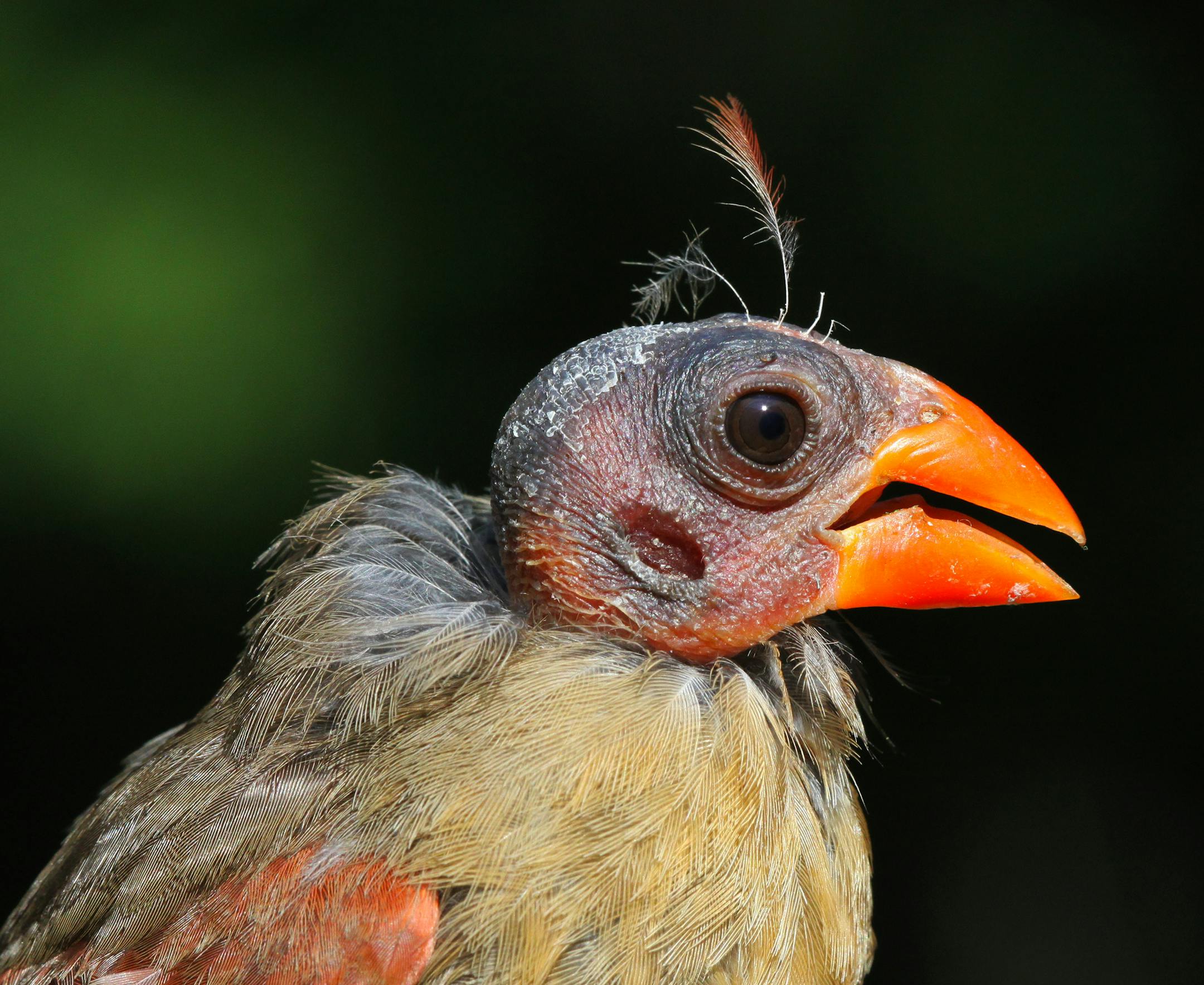
Q: The cardinals in our front yard seem to have lost feathers on their heads and are down to bare skin. What causes this?
A: You're noticing something that's not uncommon among cardinals and blue jays at this time of year. These bald-headed birds are very strange looking, but the good news is that once new feathers grow back in, the birds will look just like their peers. Some suggest that the baldness is due to an infestation of feather mites, causing the birds to scratch so vigorously they pull out their feathers. The other theory, and the one I subscribe to, says that these birds are genetically programmed to undergo a fast molt of their head feathers, with all dropping off at once, then growing back within several weeks.
Deterring bees
Q: I've had nonstop orioles — males, females and juveniles — at my jelly feeder since mid-summer. Unfortunately the bees have showed up to hog the jelly. Any ideas for discouraging them?
A: This is a great time of year for viewing oriole, robin and catbird families as parents bring their offspring in to dip up grape jelly. But bees like sweet stuff, too, and can drive birds away from feeders. I'd put a saucer or pie plate about 10 to 15 feet from the jelly feeder, and pour in some homemade solution of one part sugar to two parts water. Keep it refreshed every couple of days so it doesn't ferment and this should draw the bees away from the jelly.
No mold detectors
Q: I understand that it could be harmful for birds to eat moldy food, but don't they know enough not to eat it?
A: You're so right, molds are as bad for birds as they are for us, and consuming moldy foods can even be fatal. If the mold is within a feeder, hidden among the seeds or floating on the surface of hummingbird nectar, a bird might simply not see it. Even if mold is visible a bird might not recognize it as a danger because they consume wild foods (berries, nuts, etc.) as soon as they're ripe, so there's no chance for mold to develop. It's up to those of us who set out bird feeders to make sure they're mold-free: Check seed after rainstorms and change nectar every couple of days.
Confused cardinal?
Q: The other day I observed a female cardinal engaged in an odd behavior: She'd take a seed, then land under the feeder where smaller birds (maybe chickadees, I'm not sure) were waiting. She'd shuck the seed in her mouth and then place bits of it in the small bird's open mouth. What do you think was going on?
A: That's an interesting description of fairly unusual behavior. I suspect that the female cardinal had lost her nest and nestlings due to a storm or a predator, but still had a great deal of hormonally driven maternal instinct. She was primed to respond to begging young birds, so when she noticed hungry youngsters, even those of a different species, she fed them. I once observed a cardinal feeding a very noisy young house finch and this kind of thing occasionally happens in other species of birds, as well.

