

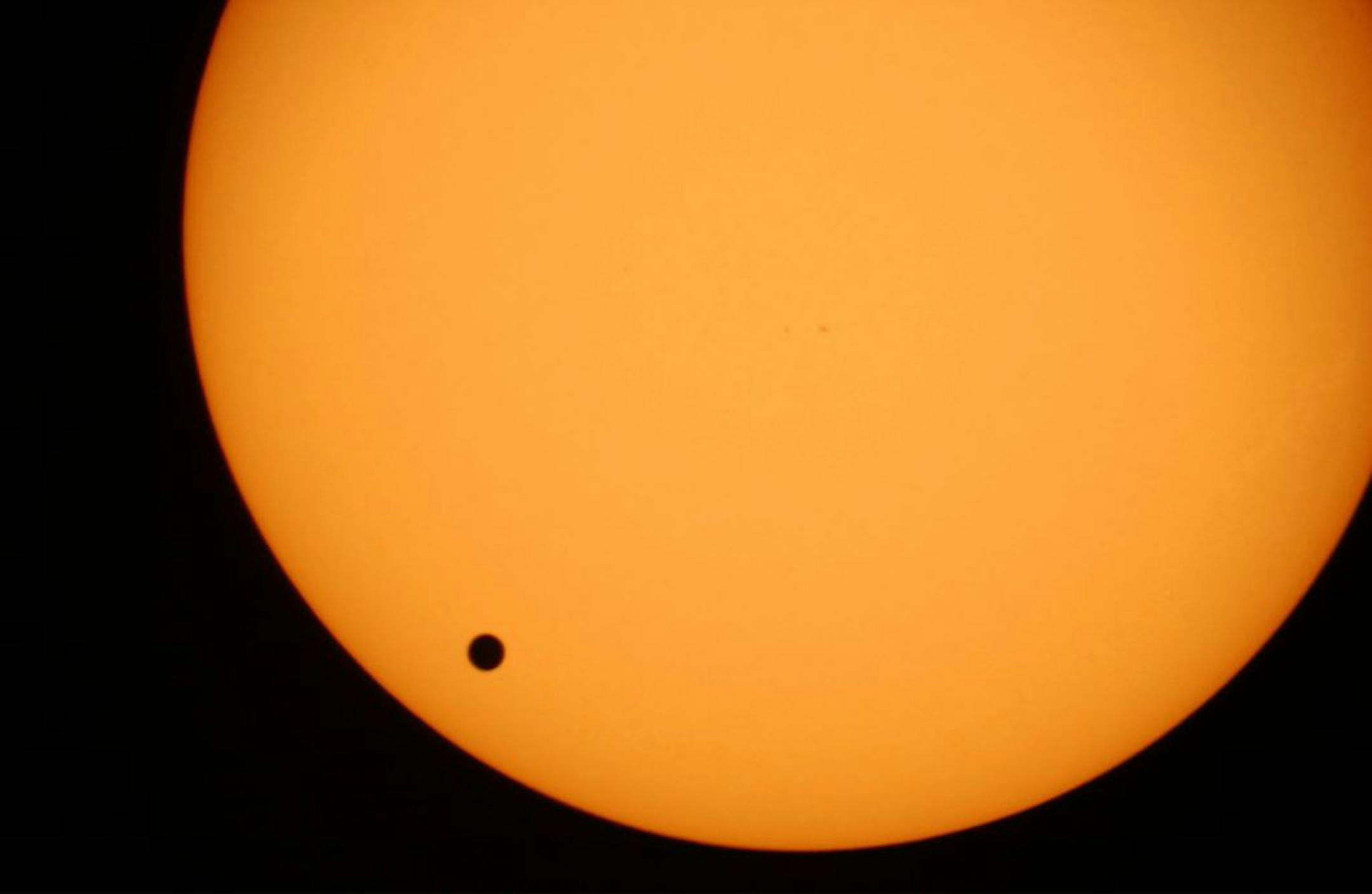
The planet Venus, which has been blazing high in the western sky since late winter, is now descending into the sunset. On Tuesday, beginning at five in the afternoon, our closest planetary neighbor will cross the face of the sun.
Those of us who wish to observe this not-to-be-repeated-in-our-lifetimes event must use the same precautions that were recommended for viewing the recent solar eclipse: smoked glass, a sun filter (my choice), or indirect projection. Direct, unshielded viewing of the sun can seriously and permanently damage eyesight.
Having taken proper precautions, we sky-gazers will be able to see, with the aid of binoculars or a small telescope or even, I am told, with the unaided (but shielded) eye, a planet almost the same size as our Earth crossing the face of our local star. Such an event will not happen again until 2117, when none of us will be around to see it. So it's now or never; see it on June 5, or never again.
Whatever, as my resident 17-year-old might say. Why should something that will happen 40 million miles away distract him from more important local concerns, his girlfriend of the moment, cool cars and his chronic cash flow problem? Why should his more serious elders pause in their efforts to prohibit gay marriage or tax the rich, and watch the skies?
In a word, perspective.
Consider this: Although such a transit will not occur again in our lifetimes, transits of the inner planets across the face of the sun are common occurrences in our solar system's more spacious time frame.
They have happened more than 20,000 times during the estimated lifespan of the human race, and more than 40 million times during the lifetime of the Earth. By my calculations, transits of Venus have occurred 54 times since the beginnings of human history, and only once before, in 2004, during my own history. Man that is born of woman does indeed live but a little while.
Or let's take another word, proportion. Venus is almost exactly the same size as our Earth, but silhouetted against the sun it is as a BB to a basketball. And lest we imagine our sun, known in astronomical circles as a "yellow dwarf," is some kind of supergiant, let us remember that Old Sol is to a real supergiant like Antares as a BB is to a beach ball.


