

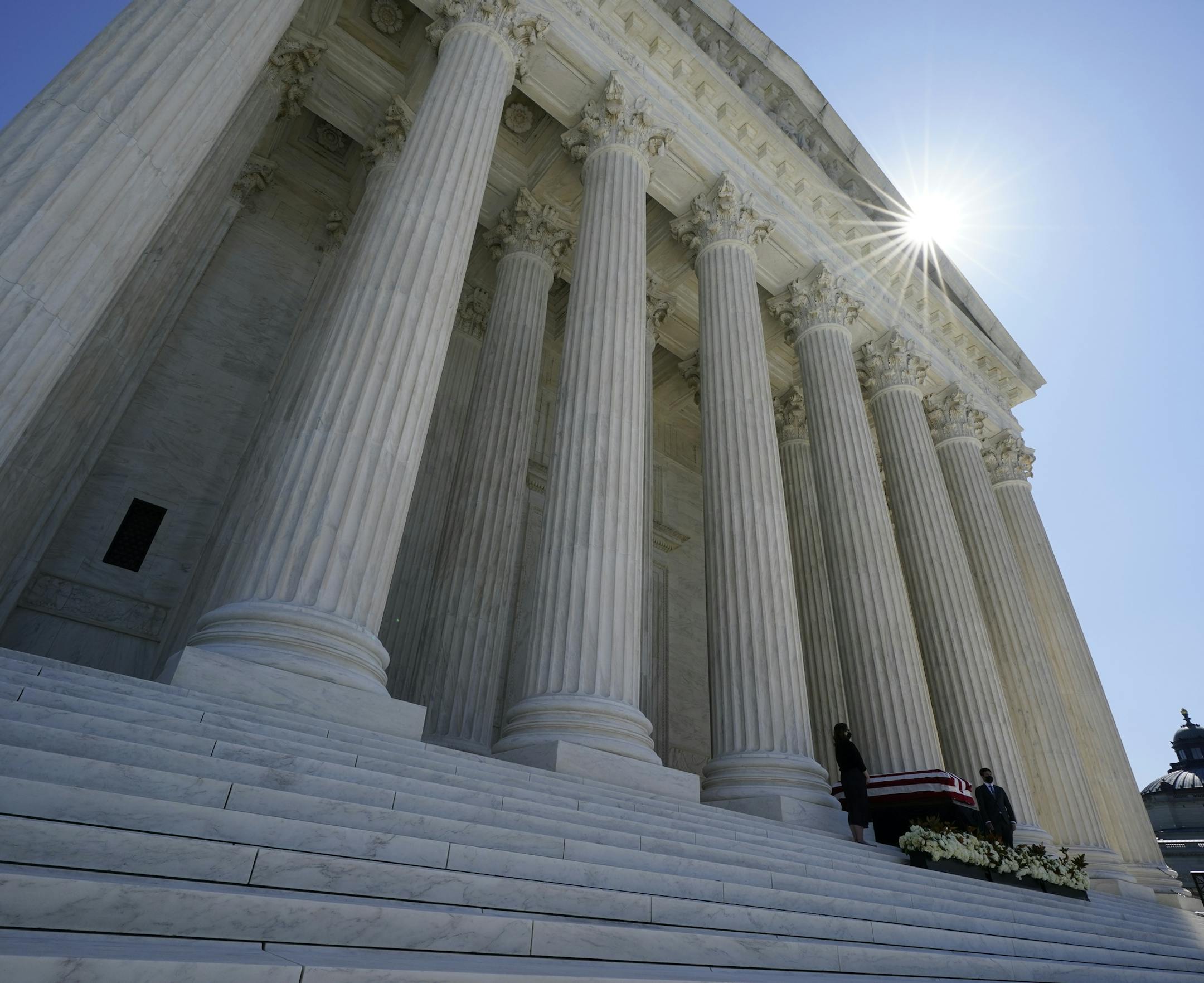
President Donald Trump and Senate Majority Leader Mitch McConnell wasted no time after Justice Ruth Bader Ginsburg died, immediately announcing their intent to nominate and confirm a replacement. Tempting as it is for Republicans to install a third Supreme Court justice during Trump's first term, it would nevertheless be a serious mistake — and potentially a historic one — for Senate Republicans to go along. The result would not only likely be the long-term erosion of the Supreme Court's legitimacy as a third branch of government, but also a backlash so strong it would hurt the Republican Party itself.
The reason for Republicans to hold off isn't the extraordinary hypocrisy they're showing by pushing a rapid confirmation now, despite holding Justice Antonin Scalia's seat open in 2016. Unfortunately, we don't live in a world where voters will punish a party for arrant hypocrisy. Republicans and Democrats alike all understood that McConnell was making a specious argument when he claimed the March nomination of Judge Merrick Garland was too close to the November election to deserve a vote. We all knew it was power politics then; and we all know it is power politics now.
To be clear, Trump has the constitutional authority to nominate a new justice right now and the Senate has the authority to vote — or not vote — on that nominee. The arguments pro and con are moral and political, as I've noted before, not legal.
In a rational version of Senate confirmation politics, the party in the majority thinks about how its actions will affect the other party when it takes control. Ideally, that norm leads to balance and some fairness: I don't take advantage of you so that in turn, you won't take advantage of me.
In our current world of power politics, the norms have eroded to the point of near-disappearance. What that leaves is medium-term self-interest about what the other side will do immediately, as opposed to what both sides would do if norms of fairness applied.
The self-interested reason Republicans shouldn't confirm Trump's nominee in short order is that it will create a potential backlash that could have disastrous effects for Republicans. If a conservative fills Ginsburg's seat, and then the Democrats win the presidency and both houses of Congress in November, an outraged, left-leaning Democratic base will pressure Democratic leadership to do things leadership would never otherwise have considered.
The most obvious is that left-leaning Democrats will push their leadership to pack the Supreme Court by adding new seats and filling them with progressive justices. Until now, when the left of the Democratic Party has talked about court packing, moderates have pushed back strongly. They may change their tune if Ginsburg is replaced by a conservative before the election. That will place enormous pressure on Joe Biden, who — before Ginsburg's death — made it clear that he opposed packing the court, because it would lead to an arms race in which the legitimacy of the court would ultimately be undermined.
So say Biden caves to the pressure and installs two, or three, or even four new justices on the Supreme Court. This would delegitimize the Supreme Court, which would be bad for the country as a whole. But it would also be bad for conservatives, who might find themselves stuck living under three Democrat-dominated branches of government for some time.


