

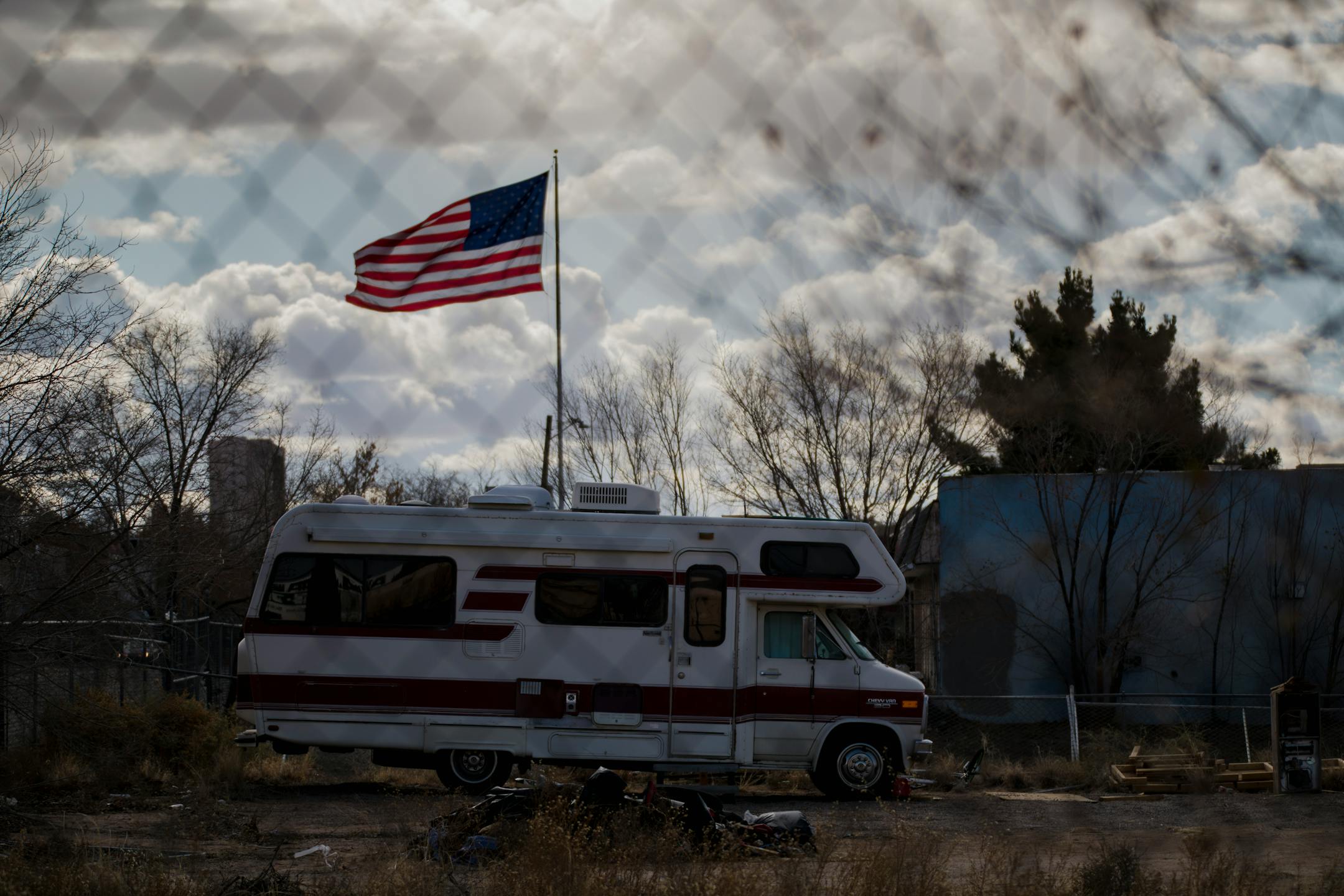
Spending the first night in my 1995 GMC camper van, I lay awake for hours in my sleeping bag, watching the window shades glow — white, then red, over and over — as cars sped past in the dark. Is that one slowing down? I wondered. Can they see I'm in here? Will they call the cops?
Van dwellers had told me about "the knock" — usually three sharp raps at the door, often by the police. The risk of getting jolted awake and kicked off my patch of asphalt kept me uneasy and made it hard to sleep.
I was living in a van as a journalist, as research for my book "Nomadland." Over the course of three years, I followed Americans who had been squeezed out of traditional housing and moved into vans, late-model RVs, even a few sedans. I drove more than 15,000 miles — from coast to coast, from Mexico to the Canadian border. And night after night, I bedded down in a new place, whether a truck stop or the Sonoran Desert. Sometimes I stayed on city streets or in suburban parking lots, which rattled me in ways I'd never expected.
For people whose only home is a vehicle, the knock is a visceral, even existential, threat. How do you avoid it? You hide in plain sight. Make yourself invisible. Internalize the idea that you're unwelcome. Stay hypervigilant to avoid trouble. Apart from telling you to clear out, the police can harass you with fines and tickets or get your home-on-wheels towed away to an impound lot.
I think about "the knock" a lot these days. More people are moving into vehicles as shelters of last resort, and their ranks are likely to swell when COVID-19 eviction bans expire. Laws punishing the unhoused population have been appearing around the country in a wave of NIMBYism.
We are emerging from what may be the most introspective year in American history. The meditative film based on my book, which was up for six Oscars and won three, fits that mood well. The pandemic has prompted much talk of interconnectedness and empathy, what we owe one another as a society. "Nomadland" reminds us that our bonds should extend to those who live in homes-on-wheels. No one should have to live in constant fear of the knock.
In the film, Fern, played by Frances McDormand, is startled by a knock that interrupts a quiet meal. She looks up with a start and swears. A face hovers at the window, and a fist pounds once, twice, three times on the door. Then comes a gruff voice. "No overnight parking! You can't sleep here."
Watching the character's panic at the sudden sound of a fist hitting her van gave me anxious flashbacks. Then it made me sad. Then I felt angry, because that scene was just too accurate, and I wished it didn't reflect the reality of how people treat one another.


