

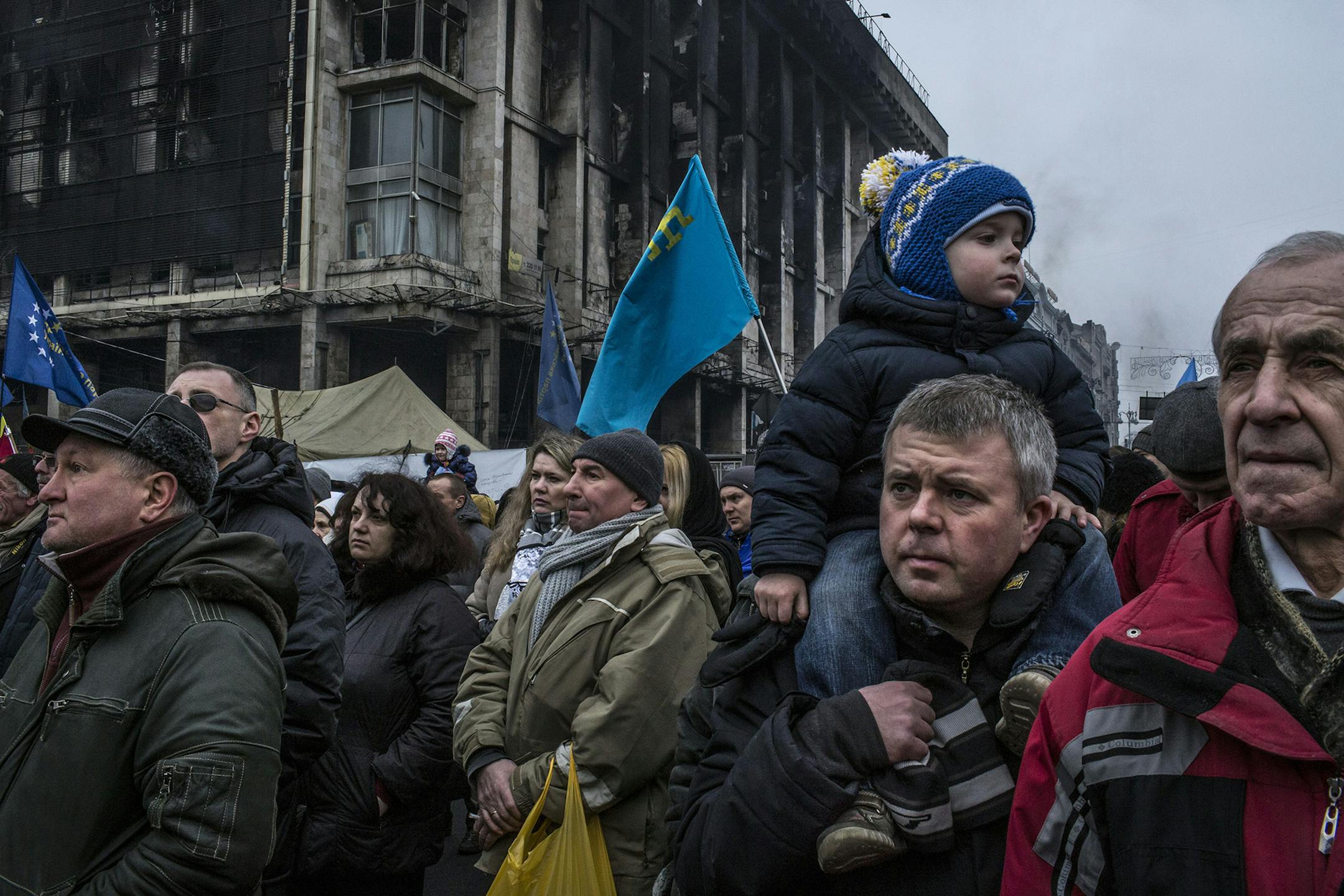
As the world struggled to rebuild in the years after World War II, a dangerous game unfolded in a seemingly unlikely place: Ukraine.
From 1946 through 1953, the U.S. Central Intelligence Agency parachuted small teams of nationalists from unmarked planes into Ukraine, then a part of the Soviet Union, in the hopes that a few armed men could spark a revolution against Moscow. The game, a deadly one to be sure, is afoot in Ukraine again. But in a sense it never really ended.
Yes, the battle for political control over Ukraine has revolved around the kleptocracy of old-line ex-communists, who have dominated, and deposed President Viktor Yanukovych, who has represented their interests well. But it was Yanukovych who killed the spread of NATO into Ukraine just four years ago. As a result, Ukraine is the only country not affiliated with NATO to share Russia's western border. A new government may try to join the Western alliance, and that is a concern not likely lost to Vladimir Putin's Kremlin.
A look at the map and a glance at history shed light on today's turmoil. Ukraine always has been coveted, needed and contested between Europe and Russia. It was divided by the Austrian and Russian empires, forced into the Soviet Union by the Soviet army in 1919 — a tragedy not lost on the Ukrainian diaspora. When the Nazis came during World War II, some Ukrainians fought them and some 80,000 volunteered for the SS, exclusively to fight the Soviets — a memory not lost on Russians. After the war, the country reverted to Soviet control.
After the Cold War, NATO coveted new members from the old Soviet bloc — none more so than Ukraine. Much of the country is vulnerable, flat, central European plain. Divided nearly in half by the Dnieper River, the country's eastern border is 365 miles — a fairly short drive — from Moscow. To put the Russian fear into perspective, having NATO forces on that border would be akin to having Russian forces in Toronto, the same distance to New York. In 2008, Kiev was a candidate for full-fledged membership in the western military alliance. There was talk of extending missile defenses to defend Ukraine.
Yanukovych's election in 2010 not only assured the old bosses' plundering, it also killed the military planners' dream of being able to put NATO forces on every inch of the Russian border in conflict, and with it the diplomatic leverage that would provide in peacetime. Today, from south to north, tiny Latvia on the Baltic is a member; Belarus is a junior partner. Poland is a member. Because it is not part of NATO, Ukraine thus fails to complete — from a strategic standpoint — the encirclement of Putin's Russia.
With the deployment of Russian forces in Crimea (Russia has rented its bases on the Black Sea for years), Putin is doing two things. First, he is warning a new government in Kiev to not even think of joining NATO. Second, he is illustrating to the alliance that it should not rekindle its ambitions. From a Russian perspective, it would have been a surprise had Putin done nothing, actually.
More menacingly, though, he is signaling that he could also cut the country in half at the Dnieper. Reinforced Russian forces from Crimea could drive up the alluvial plain all the way to Kiev, as well as enter at a few points in the east. Most of Ukraine's economic activity is east of the river; its trade is largely bound for Russia. The growing approval of the Russian parliament is not simply for protecting ethnic Russians in Ukraine. Access to the Black Sea is important, but assuring Russia's naval presence there — a few thousand marines and a few, largely aging ships — is not the crucial end result.


