

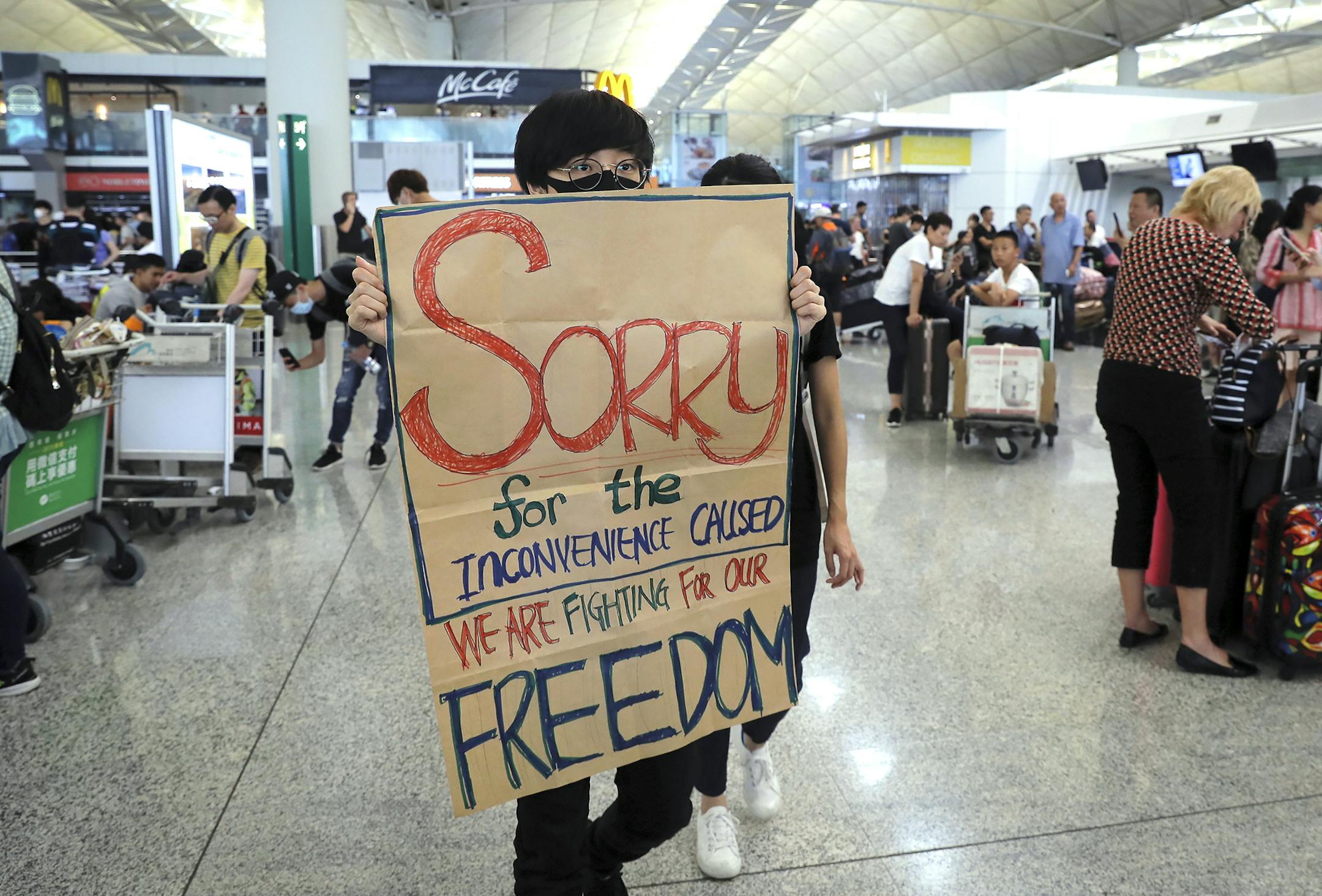
HONG KONG – As the hopes of the Arab Spring dissolved into brutality and chaos in 2011, I reported from Cairo's Tahrir Square. Motorbikes roared through clouds of tear gas to pull out injured men with bloodied faces from the front line, where soldiers were deliberately shooting demonstrators in the eyes.
Now I am in Hong Kong, where one of the planet's busiest airports has been largely closed for the second time in two days after protesters marched there in anger at police violence. Many had bandages or patches over one eye in solidarity with a young woman who was shown in a video that went viral on Sunday, her right eye bloodied by what the protesters say was a beanbag projectile fired by the police.
Such outrage over the wounding of one woman highlights what these protesters have been fighting to preserve for the past two months. A gentle city, one of the world's financial centers that has grown rich from globalization and China's rise, is battling to retain its values of civic and social freedom.
The Hong Kong police, for all their woeful failings, are not thugs; the protesters could not be further from Beijing's accusations that they are terrorists. Yet this is a clash of cultures symbolizing the struggle of our time between autocracy and democracy as it rapidly spirals into something dark, depressing and disruptive for global order.
The protesters are mostly young and well educated. Many are teenagers. All are polite and friendly when I ask why they are taking such risks amid the tear gas, the rubber bullets and the baton charges. And all give me the same response: that they are scared to be confronting well-armed police on their streets, but determined to resist their looming future under the rigid, repressive control of China's Communist leadership. "Our younger people are prepared to sacrifice their lives for the cause of freedom," Martin Lee, the veteran prodemocracy politician, told me.
I feel both ashamed and inspired to see such courage at a time when complacent Westerners are growing disenchanted with their own democracies and turning to crass populists. For this fight in Hong Kong may have begun over an extradition bill that inflamed justified fears that the "one country, two systems" agreement with Britain in the 1997 handover was being corroded. But the Beijing stooges in the local government refused to give ground, even after 2 million citizens marched in protest. Now the movement has morphed into something far more profound: the biggest internal challenge to the Chinese government by dissenters since the Tiananmen Square student-led protests 30 years ago.
One 16-year-old prodemocracy activist told me she never followed politics until Carrie Lam, Hong Kong's inflexible and incompetent chief executive, ignored the mass march. The young woman began by nervously joining the teams distributing supplies of food, water, helmets, gas masks and zip ties for building barricades. Now she is at the front, furious at being gassed and hit by a police baton while drawing strength from fellow protesters despite the threat of 10 years in prison if caught. "Of course I'm still afraid," she said — but then asked if they should let China "deprive us of all our freedoms until we lose freedom of speech completely?"
This teenager's tale shows how the crisis and violence are escalating on both sides. Protesters learned from the failure of the "umbrella movement" in 2014, which ended with the jailing of its young leaders. So they eschew leaders, hide identities (often under umbrellas) and rely on their technology skills to outwit foes.


