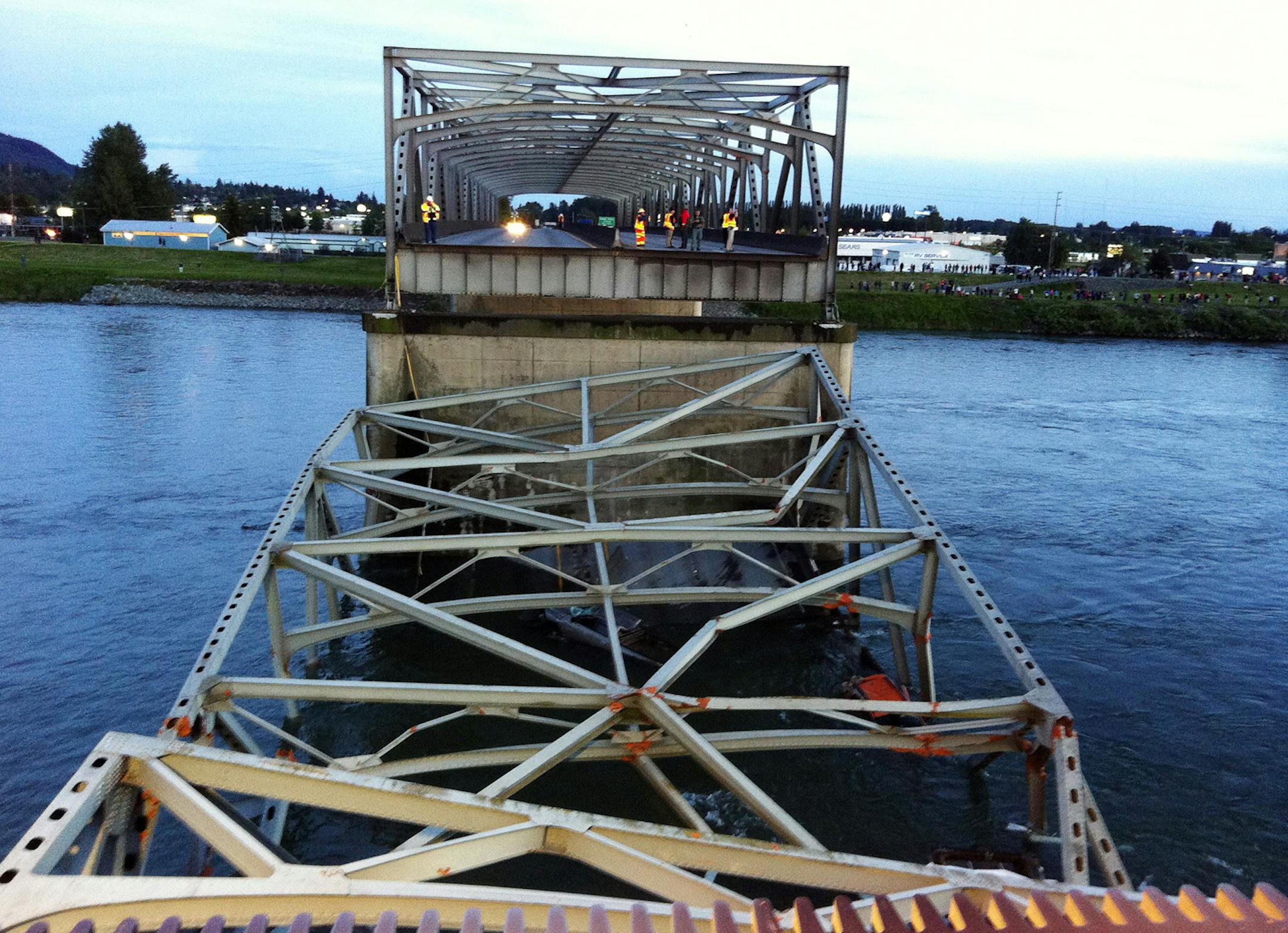
WASHINGTON – The collapse of an interstate highway bridge in Washington state brings new attention to the limits of the country's infrastructure, especially older structures that were designed with little room for error and were never intended to carry the number of cars and trucks they see today.
The 58-year-old Interstate 5 bridge over the Skagit River in Mount Vernon, Wash., was considered outdated but not structurally deficient. While state police believe an oversize truck hitting the bridge may have contributed to its collapse, an investigation by the National Transportation Safety Board will ultimately pinpoint the cause.
Bridge experts said the I-5 bridge shares a design feature with thousands of other bridges across the country that make them more vulnerable to failure.
The bridge was fracture-critical, which means there is no redundancy in the structure — if one component fails, the whole bridge can collapse. It's a scenario that's happened before, and experts say it will happen again if older, obsolete bridges are not replaced or reinforced.
"This is a repetitive story that's going to play out again like a horrible nightmare," said Barry Le- Patner, a New York construction lawyer who's identified nearly 8,000 of the country's most troublesome spans.
A 40-year-old interstate bridge in Minneapolis that collapsed into the Mississippi River in 2007 also had a fracture-critical design. Thirteen people were killed and scores more were injured. No one was killed or seriously injured in Thursday's collapse.
"It could have been a lot worse," said Pat Natale, executive director of the American Society of Civil Engineers.
Another fracture-critical bridge over the Ohio River between Louisville, Ky., and New Albany, Ind., was closed for several months in 2011 after inspectors discovered a large hidden crack that could have proved disastrous. Engineers added reinforcement to the structure for a fraction of the cost of replacement, and Le-Patner said that a bridge like the one on I-5 similarly could have been made stronger.