

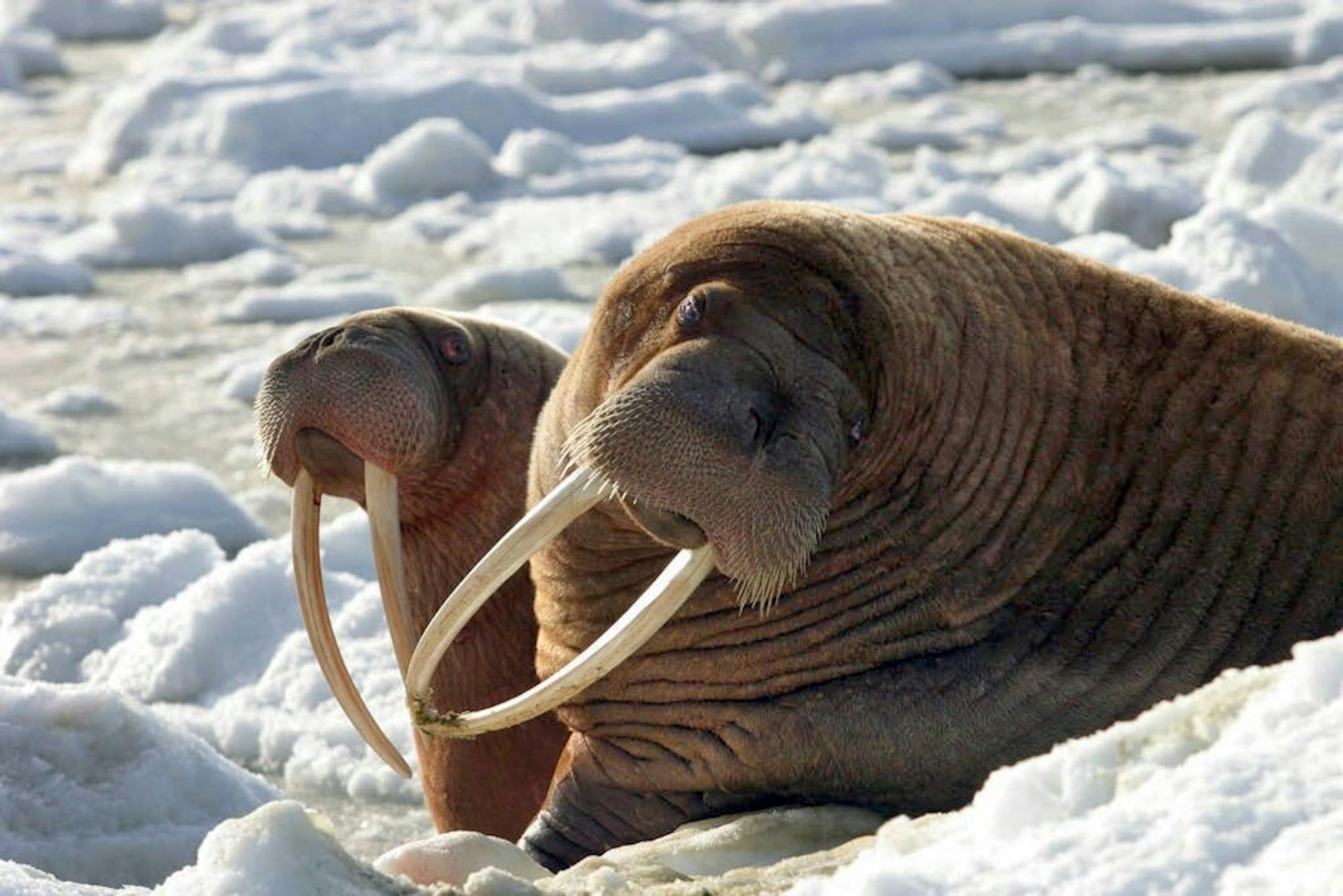
ANCHORAGE, Alaska — Anna Oxereok grew up eating walrus in the western Alaska village of Wales. Today it's such a rare treat she can't bring herself to part with the plastic gallon bag of meat in her freezer.
"I have to save it for something special," she says.
Her brother caught two animals this spring and shared the meat and fat, but it didn't go very far in the village of 150. She's thankful for what she got, though. It's become increasingly difficult to land a walrus.
Other remote communities at the edge of the Bering Sea also are seeing a steep decline in walrus harvested the past several years. Walrus, described by some as having a taste between veal and beef, is highly prized by Alaska Natives as a subsistence food to store for winter, with the adult male animals averaging 2,700 pounds. The sale of carved ivory from the tusks, legal only for Alaska Natives, also brings in supplemental income to communities with high unemployment rates.
Hunters and scientists say walrus migration patterns are veering from historical hunting grounds as temperatures warm and the ocean ice used by the animals to dive and rest recedes farther north. Village elders also tell biologists the wind is blowing in new directions. In 2013, a late-season icepack clustered around St. Lawrence Island, blocking hunters from the sea.
"I think one of the biggest issues is that things have gotten so variable. It's hard to really predict what's going to happen," said Jim MacCracken, Alaska walrus program supervisor for the U.S. Fish and Wildlife Service.
Iver Campbell and other Yup'ik Eskimo hunters from two St. Lawrence Island communities harvested more than 1,100 walrus in 2003. But a decade later, hunters managed to take only 555 — a fraction of the ideal of one walrus per resident, per year. Things still aren't looking any better for the 1,430 residents of the villages of Gambell and Savoonga. The recent spring take was 233 walrus, according to preliminary Fish and Wildlife figures.
The shore ice once served to block the wind for hunters but that's no longer the case, said Campbell, who's lived all 64 years in Gambell, population 713.


