

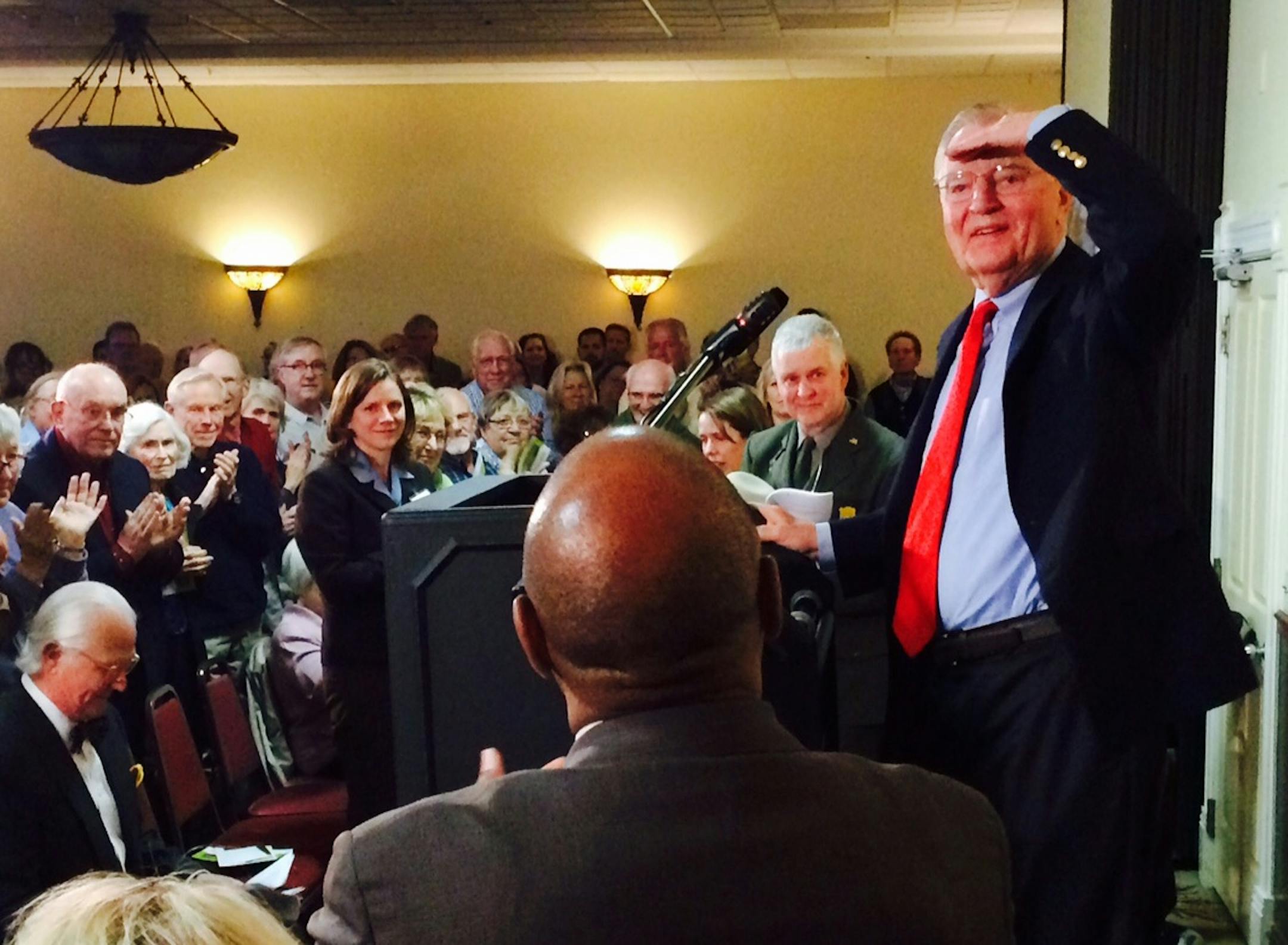
Walter Mondale can electrify a room, especially one filled with people who care as much as he does about the river he loves most.
"I don't come as an expert. I come as someone who loves this place," Mondale told about 300 people who greeted him with a standing ovation at a recent appearance at a Stillwater hotel to discuss the St. Croix River's future. "It's a blessed gift to all of us. I hope we do everything we can to make certain that we handle this river with wisdom, with justice, with courage."
To conservationists, Mondale is revered for what they see as an achievement even greater than his political ascent to Jimmy Carter's vice presidency — ensuring federal protection of the St. Croix and its Wisconsin tributary, the Namekagon River. Then a U.S. senator, Mondale and fellow Sen. Gaylord Nelson of Wisconsin led a campaign to shelter the rivers under the auspices of the U.S. Wild and Scenic Rivers Act, where they've remained protected since 1972.
But at a public event sponsored by several conservation groups and only a softball's throw from the St. Croix, Mondale talked less of the past than of a growing human pressure that threatens the St. Croix's shorelines.
"I think we ought to plan on more challenges, tougher challenges, than the ones we've been through," he said. "People starve to be near the river, the water, especially if it's a beautiful river and a fresh one. There's something in our whole being that pressures us to stick close to it.
"What you have here is really magnificent," he added. "The pressure will be on in ways I can't contemplate as the population builds to move in closer, and to get a little better view of the river."
Private vs. public
Some of the pressure Mondale spoke of comes in the form of landowner proposals to alter rules and laws to allow bigger houses with more prominent views of the river. Decisions to grant those "variances," as they're known, now rest exclusively with local governments because of a 2010 Minnesota Supreme Court ruling that removed the state Department of Natural Resources (DNR) from the oversight role it had held since 1972.
That ruling, referred to as "the Hubbard decision," figured prominently into Mondale's recent appearance because of concern over balancing private property rights with public enjoyment of the river. The court found that the DNR didn't have the legal authority it presumed it had when it turned down a variance for an 8,000-square-foot house that broadcasting magnate Rob Hubbard requested in Lakeland. That authority, the court said, had never been spelled out in state law.


