
Walleyes rule, but what about those rulers?

The walleyes we caught were keepers, or so we thought. It wasn't until the fish were measured again on shore by Upper Red Lake creel surveyors that we discovered the tape on our boat had been enlarged -- by intention? -- by its creators.

May 19, 2008 at 6:27AM
DNR fish rulers: Are they accurate, or intentionally made inaccurately?
DNR fish rulers: Are they accurate, or intentionally made inaccurately? (Star Tribune/The Minnesota Star Tribune)

Rules, they say, are meant to be broken. Maybe rulers are, also.

Consider these circumstances, mysterious all:

• Last Sunday, the day after blizzard-like conditions prevailed on Upper Red Lake, five of us were back on the water looking for walleyes to fill out our limits of three fish apiece. We fished in a boat owned by a friend of mine, Bob Kowalski of Vadnais Heights.

• Background: Bob fishes with our opening-weekend party nearly every spring, including in 2000, when we opened the season on Lake Winnibigoshish ("Winnie").

• More background: Only walleyes shorter than 17 inches are legal to keep on Upper Red -- with one trophy walleye larger than 26 inches also allowed in the legal bag of three. The same rule has applied to Winnie since 2000, except that six walleyes may be kept from it.

• In 2000, Bob received -- he can't remember from which resort or (possibly) which business in the Grand Rapids area (the largest town near Winnie) -- a stick-on ruler for his boat. The ruler is colored white from zero to 17 inches, red in the "protected" walleye slot, from 17 to 26 inches, then white again to the end.

• That tape is still on his boat, and is the one he uses to ensure he keeps only legal walleyes -- meaning those on certain lakes (including Upper Red) less than 17 inches.

• When we returned to the harbor at West Wind Resort on Upper Red late Sunday morning, we had 12 walleyes to our credit. To ensure the fish were less than 17 inches apiece, I had measured each one personally before placing them into the live well.

• As we docked, two DNR creel surveyors approached and asked if they could measure and record our fish. We said, "Sure."

• Thus began this mystery: About half of our walleyes were longer than 17 inches, some significantly so, measuring about 18 inches.

• • •

"That can't be possible," I said. "I measured those fish myself."

At which time I invited one of the creel surveyors onto Bob's boat to (I thought at the time) triumphantly demonstrate that his measuring stick was in error.

That wasn't the case. Instead, Bob's tape was wrong. But wrong in a way that suggests it was printed so intentionally -- perhaps to allow anglers to unknowingly hit the "keeper" slot more easily.

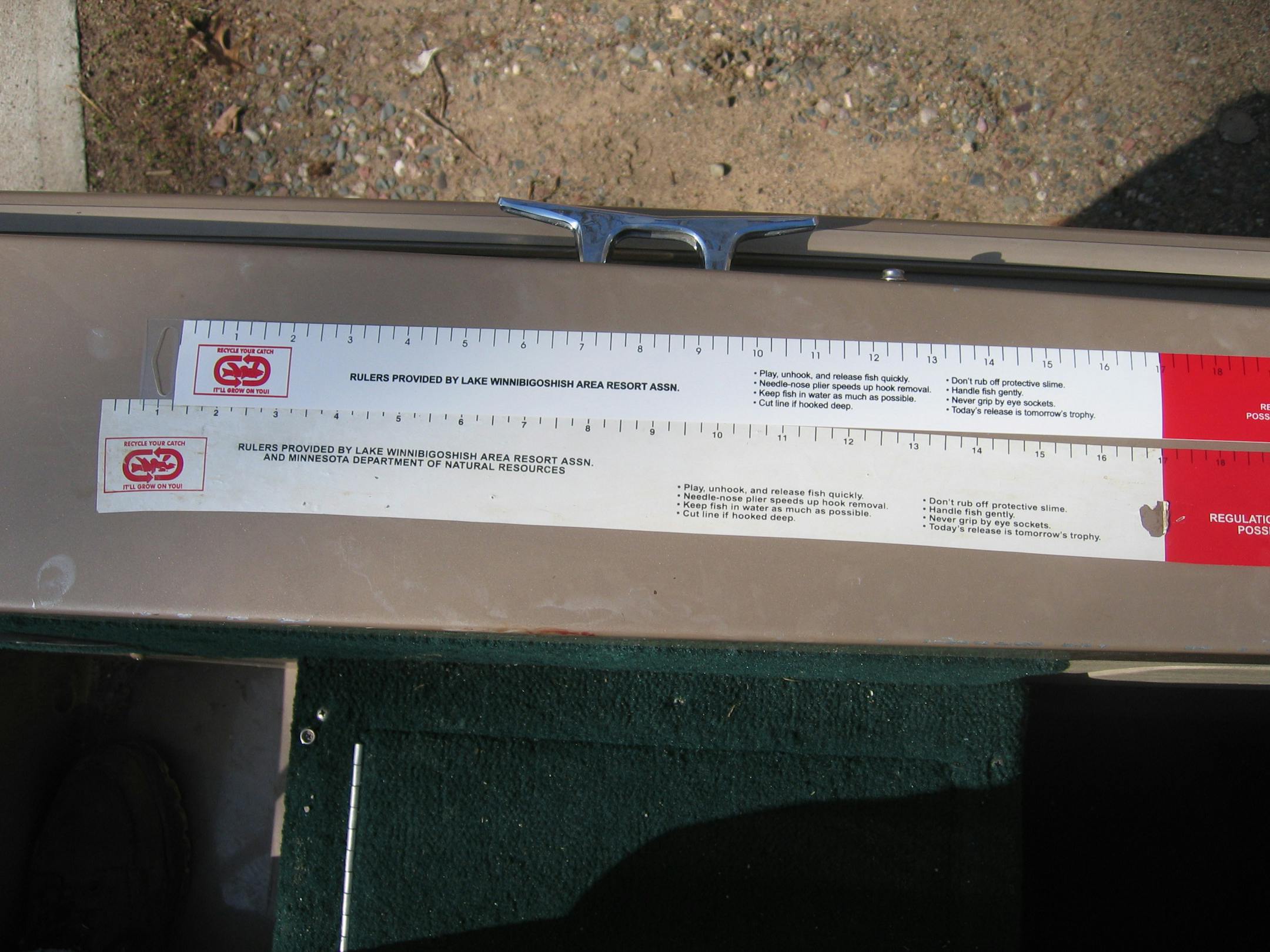
Take a look at the photo of the two tapes that accompanies this column.

The longer tape is the one on Bob's boat. Note that the white space to the left of the red-colored space is clearly marked as zero to 17 inches. The red space that follows is the "protected" slot -- 17 to 26 inches. White space follows thereafter to the end of the ruler.

But there's one problem. The left portion of the ruler isn't 17 inches, as it says it is. Rather, it is 18.25 inches. Further confounding matters -- and suggesting the tape was intentionally distorted -- the portion of the tape beginning with the red "protected slot" section lines up exactly as it should with a "legal" tape -- just as it does in the photograph when placed alongside the shorter (legal) tape.

The DNR is as puzzled by this as anyone. Beginning in the early 1990s, the agency printed these tapes for distribution, usually free and in association with various resort groups. By about 2000, the agency got out of this business, leaving the resorters to print and distribute their own, if they wanted.

The tape on Bob's boat says it is the product of a joint venture between Winnibigoshish resort owners and the DNR. The other tape (the more recently printed "legal" tape shown in the photograph) was printed by the resorters alone.

DNR Capt. Ken Soring of Grand Rapids said last week his officers have encountered various attempts by anglers to distort tapes. Most of the attempts, he said, are not very sophisticated. And DNR area fisheries manager Chris Kavanaugh of Grand Rapids said some of the initial run of tapes printed by the DNR and the resort owners in 2000 were "off" a little in some cases.

But not 1.25 inches.

Did someone intentionally print the errant tapes so visiting anglers could more easily hit the keeper slot? That sounds bizarre because a certain percentage of the anglers were sure to be checked by conservation officers.

But if that weren't the case, whoever printed the tapes (I don't have this information yet) would surely know, one would think, that he or she was producing a ruler that was 1.25 inches longer than contracted for. Moreover, if the inch markers were "off" by accident, the misprint seemingly would be noticeable throughout the length of the tape, not just in the slot anglers are most concerned about -- the "keeper" slot.

Ponder all of this and e-mail me your thoughts. Also, if you have a tape like Bob's, or a similar one, check to see if it's accurate. As important, check whatever you use to measure fish and see if it's legal or not.

"We picked the 17-inch mark for a reason," Kavanaugh said. "That's the length at which female walleyes begin to reproduce, and by protecting them at that length, we're protecting the fishery."

Final note: We offered to return our overlength fish to the lake last Sunday. But the creel surveyors, who don't have enforcement authority, felt they would probably die. So we filleted them, feeling less excited about the morning's fishing as we did.

Dennis Anderson • danderson@startribune.com

about the writer

about the writer

Dennis Anderson

Columnist

Outdoors columnist Dennis Anderson joined the Star Tribune in 1993 after serving in the same position at the St. Paul Pioneer Press for 13 years. His column topics vary widely, and include canoeing, fishing, hunting, adventure travel and conservation of the environment.

See Moreicon