

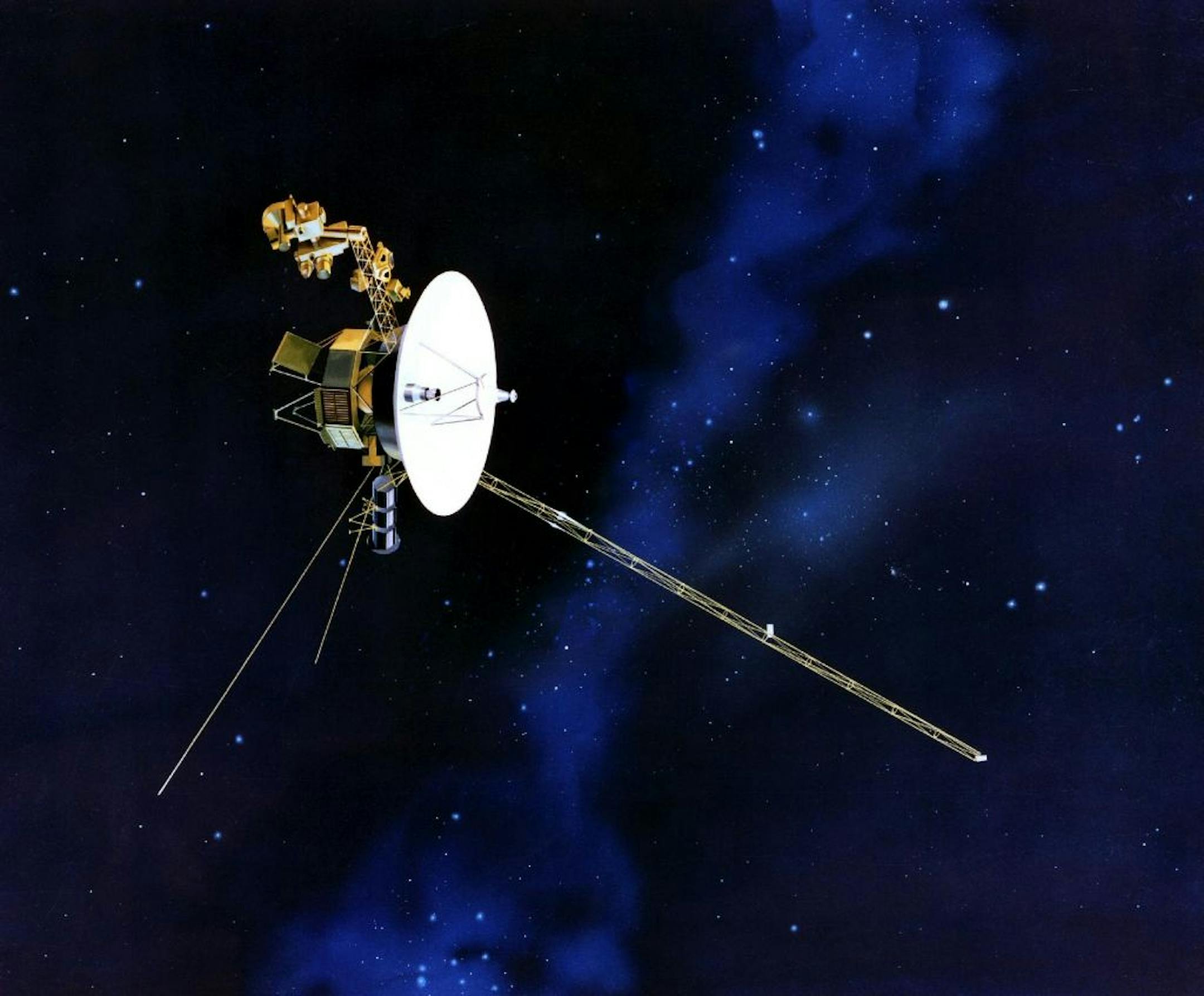
Voyager 1, the spacecraft famous for beaming back striking photos of Jupiter, Saturn and their moons more than 30 years ago, has made still another discovery: the existence of an unpredicted zone at the very edge of the solar system.
It had been thought that the NASA probe had already been passing through the outermost section of the solar system on its way toward the heliopause -- the boundary where the solar wind ends and interstellar space begins. For that reason, the existence of yet another district at our cosmic neighborhood's edge was completely unexpected, said Stamatios Krimigis, a solar physicist at the Johns Hopkins Applied Physics Laboratory in Laurel, Md. "Nature is imaginative," he said.
Krimigis described the newfound region as a "magnetic highway" that connects the heliosphere, the bubble surrounding the solar system, to the vast expanse of space beyond.
NASA researchers said in September that they thought Voyager 1 might pass out of the solar system by the end of the year. As the craft neared the heliopause, scientists expected to detect fewer particles of solar wind and more cosmic rays pouring in from interstellar space. They also expected the magnetic field to change direction.
Since late July, Krimigis said, the intensity of the solar wind particles had decreased a thousand-fold while cosmic ray intensities rose. But though they could tell the strength of the magnetic field had increased, Voyager's instruments never detected the anticipated change in the field's direction, said Leonard Burlaga, a member of the team that operates Voyager's magnetometer.
For this reason, he said, "there's no evidence we've entered interstellar space."
Rather, the highway region appears to allow particles from within the heliosphere to escape into interstellar space while permitting particles from the outside to pour in.


