

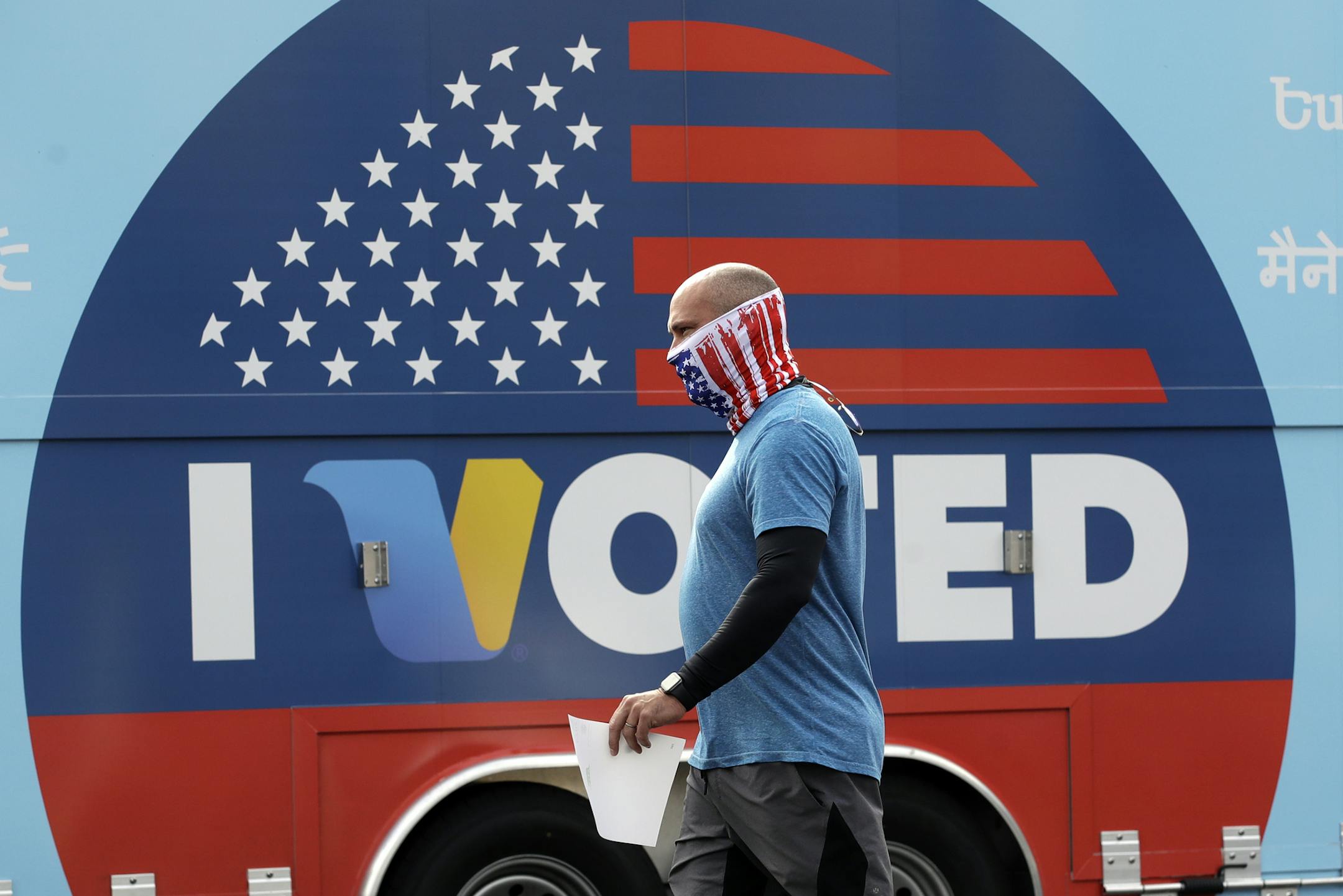
If you've been on the internet at all lately, you've probably seen the meme about Wisconsin's primary: a gravestone embossed with the words, "I Voted." The image is dark, but effective. As we have seen, holding elections during a pandemic is risky for voters and poll workers alike. In fact, several poll workers stationed in Chicago during Illinois' earlier primary have since tested positive for COVID-19, including one who tragically died.
That's why a growing movement of advocates such as the Just Democracy Illinois coalition, which I chair, is demanding an expansion of vote-by-mail to avoid more tragedy in November. Vote-by-mail is a system dating back to the Civil War that allows people to cast a ballot from the safety of their own homes. Best of all, we know that it works: In the last two federal elections, roughly 1 out of every 4 Americans cast a mail ballot.
While it's tempting to think that vote-by-mail could solve our problems with voting during a pandemic, the inconvenient truth is that vote-by-mail can't be the only solution. Not everyone can vote at home. If we do not maintain safe and healthy in-person voting options, existing and unjust disparities in voting between racial, age, income and other demographic groups will only get worse.
First of all, the data clearly indicate that black voters are more disenfranchised than others in a vote-by-mail system. That's because black Americans are the most likely to change addresses, making it harder for them to get a ballot delivered in the first place.
They also are most likely to rely on in-person voting due to cultural distrust in the mail system. That distrust is easy to understand when you consider cases like Gwinnett County, Ga., where election officials tossed out hundreds of mail-in ballots during the 2018 election due to discrepancies in addresses, signatures and birth dates. In a county that received just 6% of the state's mail ballots but provided over a third of Georgia's rejections, half of those tossed ballots belonged to black and Asian voters.
Black Americans, moreover, account for a disproportionate share of the country's homeless community members, and those who are homeless typically rely on in-person voting options to cast a ballot. These racial gaps may explain why, during the 2018 midterm elections, only about 11% of black voters cast ballots by mail, compared with 24% of white voters. Other people of color, Latino and limited-English proficient voters also face disproportionate risks of disenfranchisement in a vote-by-mail system without in-person options.
In addition, some voters with disabilities require in-person accommodations such as audio ballots and touch screens that can be found only at in-person polling places. Voters who rely on Election Day registration, too, would be unable to vote without an in-person polling place. More than 120,000 Illinois voters took advantage of Election Day registration in our last presidential election. Young voters and first-time voters are especially likely to rely on this tool, but they wouldn't have the opportunity without an in-person location.
The disproportionate impact on these communities and others is one reason even the five states that mail everyone a ballot (Colorado, Hawaii, Oregon, Utah and Washington) still preserve some form of in-person voting options.


