

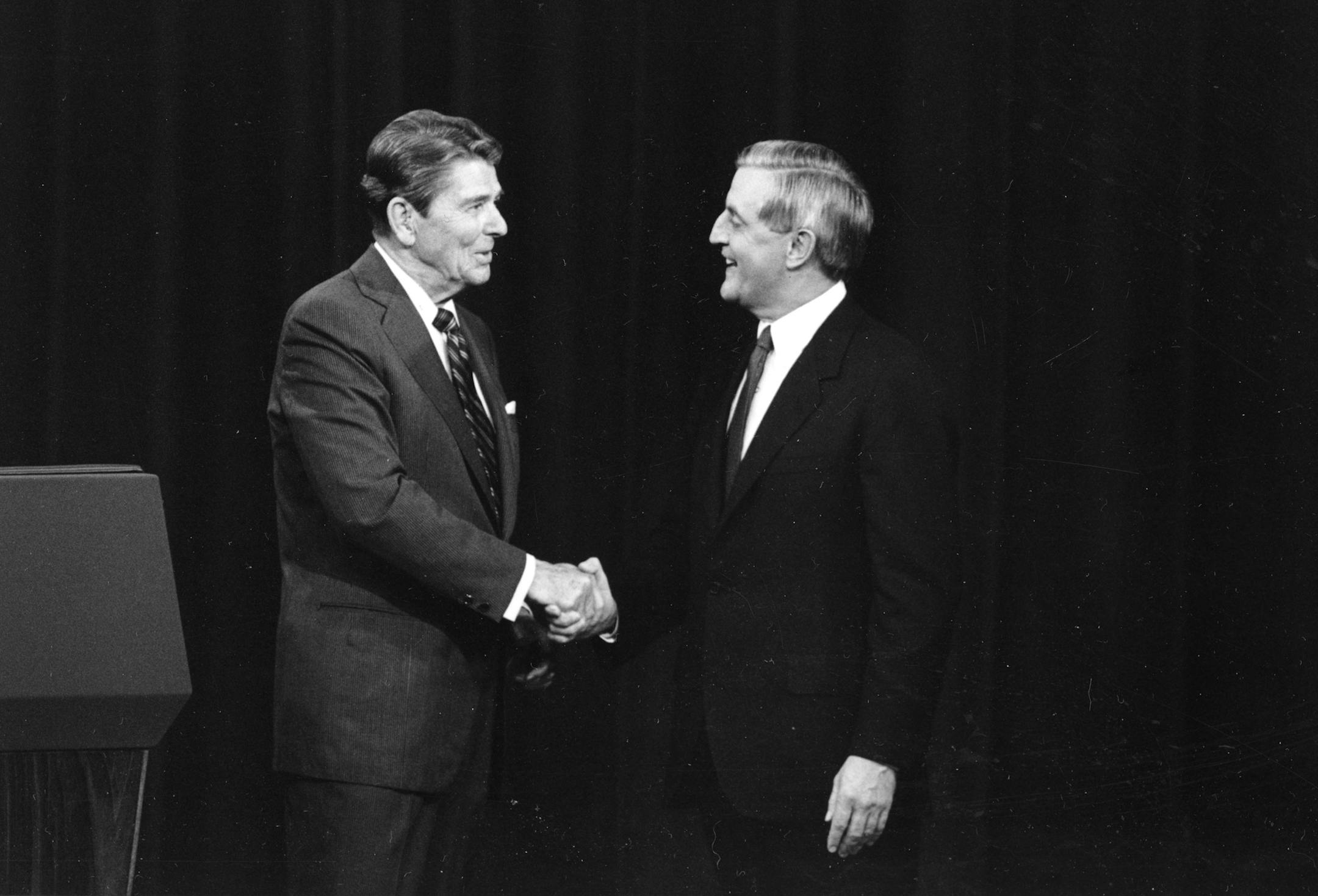
Fifty-eight years ago, John F. Kennedy, a rising-star senator from Massachusetts who was already leading the pack for the 1960 Democratic presidential nomination, stood in white tie and tails before the Washington establishment at the annual Gridiron Dinner and drew a piece of paper from his pocket. "I just received the following wire from my generous daddy," he said. " 'Dear Jack, Don't buy a single vote more than is necessary. I'll be damned if I'm going to pay for a landslide.' "
The crowd guffawed. The gag became a legendary example of something that is rare this election cycle: the self-deprecating joke.
To his detractors, Kennedy was a callow vessel for the ambitions of his wealthy and powerful father. So why would he tell a joke that copped to what so many thought to be his greatest liability? The Journal of Political Marketing isn't usually the first place you should go looking for a good laugh. But an experiment published there last year does provide part of the answer: People like it when politicians make jokes at their own expense.
Researchers from East Carolina University had test subjects view a clip of David Letterman's Top 10 list of "Ways the Country Would Be Different if Chris Christie Were President." The 2011 segment contained what the researchers called "other-disparaging" humor; those outside of academia call it "fat jokes." Among the items on Letterman's list were "New state: Fatasschusetts"; "Instead of Iraq, we'd invade IHOP"; "Scandal when president is caught in Oval Office with Betty Crocker and Sara Lee." After hearing the cracks at Christie's expense, test subjects liked him less and said they were less likely to vote for him.
A different group of test subjects saw a different clip, this one of the New Jersey governor being interviewed by Letterman. Early in the conversation, Christie pulls a doughnut from his pocket and proceeds to eat it, saying that he "didn't know this [interview] was going to be this long." Viewers who saw this self-deprecating joke showed a greater likelihood of voting for Christie.
That's because self-deprecating humor minimizes status distinctions. A study in another of America's comic journals — the Leadership & Organization Development Journal — found that leaders who use such jokes win higher marks and are seen as more relatable to followers. Additional research published in the International Journal of Public Opinion Research found that the very act of going on late-night television improved people's opinions of a politician. Those shows in particular, and humor in general, prime viewers to look at political leaders as people and evaluate them on character traits rather than policy. As Dannagal Young, a professor of political communication at the University of Delaware (who performs in an improv comedy troupe), puts it, "If your goal is to appear human, authentic and relatable, it makes sense to deploy self-deprecation as a tactic."
Some politicians get this intuitively and use it to good effect. Here's Michael Dukakis at New York's Al Smith Dinner in 1988: "I've … been told that I lack passion. But that doesn't affect me one way or the other. Some people say I'm arrogant, but I know better than that." In an appearance on "Saturday Night Live" days before the 2008 election, John McCain remarked, "I'm a true maverick — a Republican without money." The joke headlined numerous articles the next day.
President Obama frequently mocks himself, including at the 2010 White House Correspondents' Dinner, when he took double aim at his declining popularity and the birthers: "It's been quite a year since I've spoken here last — lots of ups, lots of downs — except for my approval ratings, which have just gone down. … It doesn't bother me. Besides, I happen to know that my approval ratings are still very high in the country of my birth." And President Bill Clinton has credited a video in which he made fun of his lame-duck status, shown at the 2000 correspondents' dinner, with helping him achieve the highest Gallup approval rating of any postwar president leaving office.


