

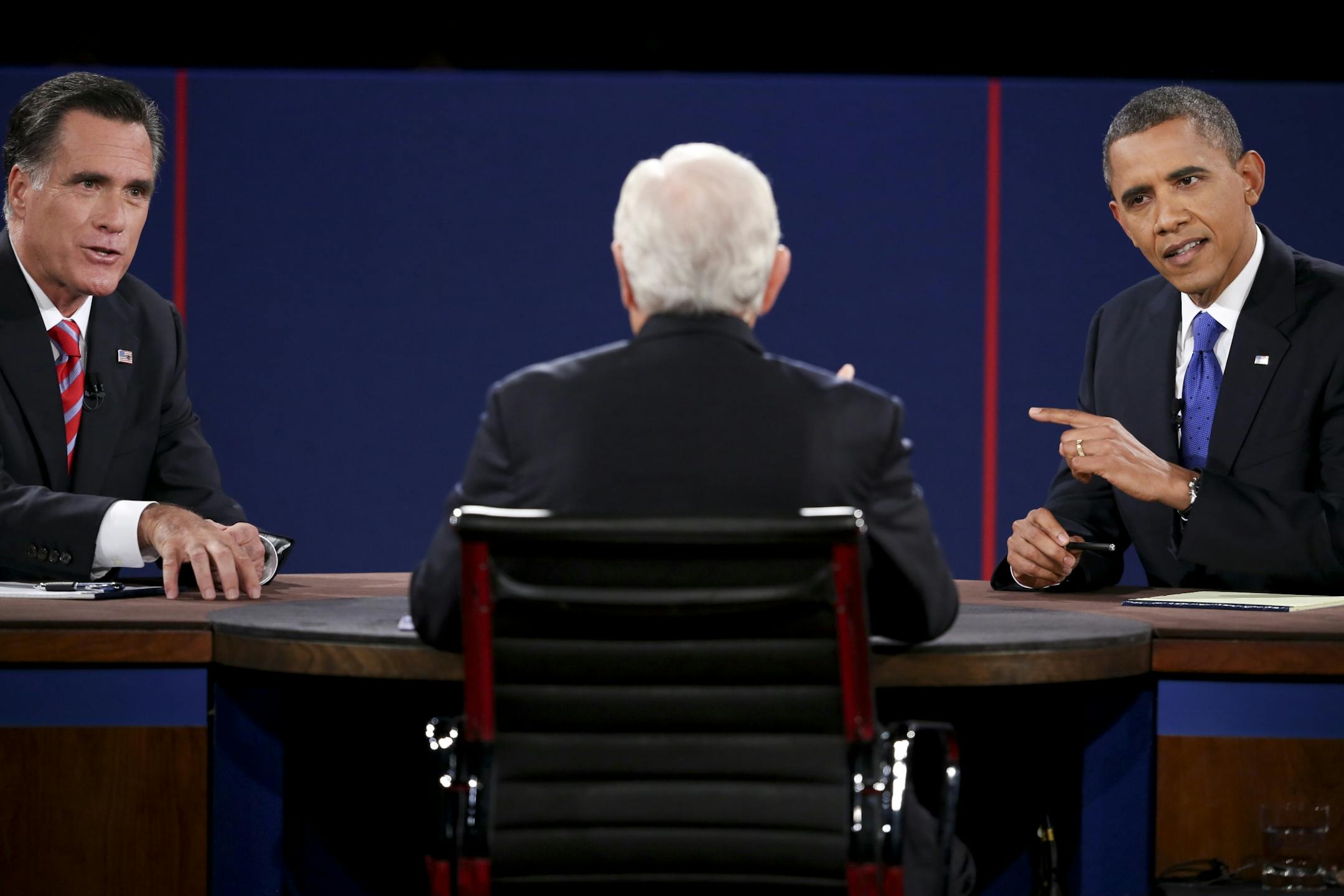
"You're all over the map," President Obama charged in the third debate.
Obama was talking about Mitt Romney, but he could have been referring to those watching, listening, reading, posting or tweeting about the debate and the race, according to a new Pew Research Center study.
"The numbers portray a diverse landscape in which no platform dominates as the place for politics, and the vast majority of Americans say they regularly rely on multiple platforms to get political information. ... The concept of a primary source of news -- a gatekeeper that provides most of what a voter might know -- seems obsolete," according to Pew.
The media mosaic is just one reason why one purveyor didn't emerge as the 2012 campaign's key media source. Another factor was the disconnect between media use and useful media.
For instance, cable news, where 41 percent report they "regularly get campaign news," holds the poll's top spot. But note that Pew was referring to the type of cable news that seeks to emulate Edward R. Murrow -- not cable news talk shows that channel "Network's" Howard Beale, the "mad-as-hell" anchorman. Only 18 percent regularly tune into those programs to follow the race. And the stats were starker when respondents were asked which source is "most helpful" for campaign news -- 24 percent named cable news, while only 2 percent named cable news talk shows.
Hostile hosts can also be heard -- loudly -- on some talk radio shows. But again, respondents found more heat than light: 16 percent cited talk radio as a regular source, but only 2 percent said it was most helpful.
Not to say that talk radio and cable didn't have an influence. But that influence might have been to encourage, or enforce, ideological rigidity instead of letting candidates move to the middle, where most Americans align.
At 38 percent, local news shows were the second-most-used, and 11 percent said they were most helpful. But that's more reflective of a reflexive tune-in, not because of any game-changing content. The same could be said for network news: 31 percent regularly tuned in, and 11 percent called it most helpful. Yet network news didn't have a 2012 media moment quite like Katie Couric's interview of Sarah Palin in 2008.


