

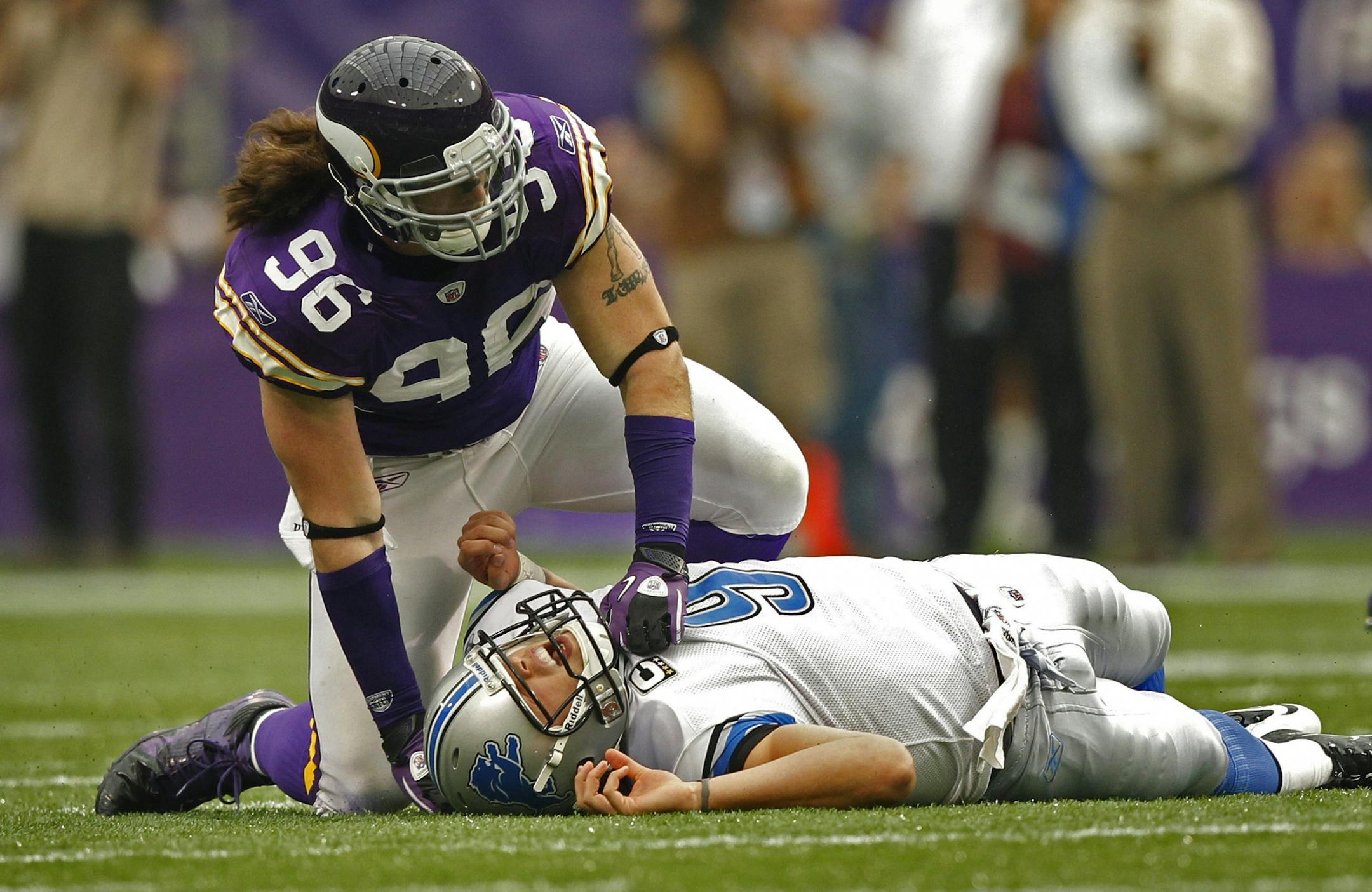
Throughout this week, we've brought you a three-part series examining the constant pain that NFL players play through and the methods and medicines they rely on to get back on the field as soon as possible. The links to our series can be found here:
To close things out, here are some final candid and eye-opening thoughts we obtained from a crop of current and former players on the pain, pressures and problems within the game. Chris Doleman, former Vikings defensive end and Pro Football Hall of Famer On the extreme pressures to play that players face on a daily basis… "Everybody knows you can't make the club in the tub. There is a huge amount of pressure. Every day a coach is going to ask you, 'Can you go? Can you go?' Every. Single. Day. And you'll get asked by everybody on the staff. 'Can you go? You able to go? If I needed you, could you go?' [You're thinking], 'Dude, we don't play until Sunday. Today is Tuesday. I just got hurt this past Sunday. No I couldn't go today.' "But listen, they don't want to hear no. You can't tell a coach, 'No I can't go.' Not that early in the week. If you get hurt on Sunday and Tuesday morning the coach asks how you feel, you can't say, 'Coach I don't think I'm going to be able to play next week.' Dude, are you freakin' nuts? It's just not the way it is." **** Tony Richardson, former fullback and executive committee member of the NFL Players Association On the NFLPA's persistent push to heighten player safety … "I've had coaches call me up with the CBA [collective bargaining agreement] and want to ask me about the whole call for no more two-a-days. Listen, we didn't eliminate two-a-days because we didn't want to work. We go to work to go to work. But the thought was if we could limit the number of concussive-type hits during the course of the season and reduce the pounding we take during training camp, if we can lessen that, it's going to not only extend guys' careers, but help them be able to walk off the field OK at the end of a 10-year career. That's all there is. If people think the game is watered down, I don't care. My biggest charge and my biggest concern is making sure we take care of our players and make the game better than when I came in." **** Brian Robison, Vikings defensive end On the concussion he suffered last December against Denver and the immediate urge he felt to get back on the field …
"I can still remember it plain as day. I went out [unconscious] for a split second. I got up and was cross-eyed and everything. I didn't think it was any big deal. I've never really had a concussion before so I get hit and I'm just like, 'Ah, I got dinged. It's one of those things that happens.' I go to the sideline, they check me out. And I'm sitting there and I'm like, 'OK when can I go back in? I'm good. I've done all the tests you want me to do on the sidelines.' They tell me they want to take me back into the locker room and ask me a few more questions. I'm thinking we'll make this a quick deal, I'll get back out here. And then all of a sudden they tell me, 'Yeah, you had a head injury. You're not going back in the game.' "Your first reaction is. 'I'm not going back in the game? What do you mean I'm not going back in the game? I'm fine.' They tell you what the rules say. But I'm like screw the rules. I want to play. When you finally sit back and actually think about it rationally, you realize that when you have a head injury, those aren't things to mess with. But the competitor in you doesn't understand that in the heat of the moment." On regularly seeing battered Hall of Fame running back Earl Campbell while working out at the University of Texas … "It would take Earl Campbell 10 minutes just to walk out of the weight room. He's in bad, bad shape. You think you're going to talk to him and he's going to come out and say, 'I wish I wouldn't have tried to run over every linebacker in the league. I wish I hadn't done this, done that.' But it's the total opposite. He'll look you in the eye and tell you straight up, 'If I had to do it all over again, I'd do the same things. I'd run that punk over.' "It's nuts. Because you're looking at him and seeing the pain and agony he's in but yet he wouldn't do anything different. It's definitely eye opening. Without a doubt. It's one of those deals, where you look at him and you're like 'Hell no, I don't want to end up like that.' And in your mind, rationally thinking, you say to yourself, if I've got to run somebody over I might just take a knee the next time. But the second you get out there and start competing, that all leaves your mind and you're only concerned with competing and being the best at what you do. It's one of those deals where once those lights turn on, that intelligent thought process you might ordinarily have is right out the window." ****
Mike Morris, former Vikings long snapper who retired from the NFL in 1999
On the evolution of the game and the players who play it …
"You can write your own paycheck in this game if you can get big enough, fast enough, strong enough. And guys did. People went out and showed these kids how to get stronger. How do you get bigger, stronger, faster? Now you've got Robocop out there. Guys are 6-5, 260 pounds, running a 4.4-[second] 40-[yard-dash] at 260. Today's player, today's gladiator benches 450, squats 700, power cleans 450, his vertical [leap] is 38 inches. Are you kidding me? That's what's out there now. You put a helmet on that, shoulder pads on that? What are we talking about? Now you've got everyone in the league like that. Because it's been several generations now of kids coming up through a structured strength and conditioning programs with huge beautiful weight room facilities for high, college and pro. We're getting those athletes now.
"With the sophistication of training, we know how to do it now. It's down to the last bite of protein and carbohydrates. These kids have it down to a science. So guess what? He's a machine and he knows that if he's good enough at this there are multiple millions of dollars on a contract if he just keeps at it. So what do you do? Pull the gear back, pull the plug and go backward on equipment so they don't come in like that? What do you do? We've developed and created a machine that works very well. And it's a cash machine that sells well and people love it and it's blood and guts and gladiators all over again. For 400 years people watched the gladiator sports. And not to get too philosophical, that's what we have in this country. We've got stadiums that fill for gladiator games. You call it a game because otherwise women and children couldn't get in. But otherwise it's a war. It's a war … It takes its toll. And some of those shots [today] are not the shots that were coming down 20 years ago. These are shots now that are car wrecks. This is different."
On the assistance that training staffs are able to provide to players …


