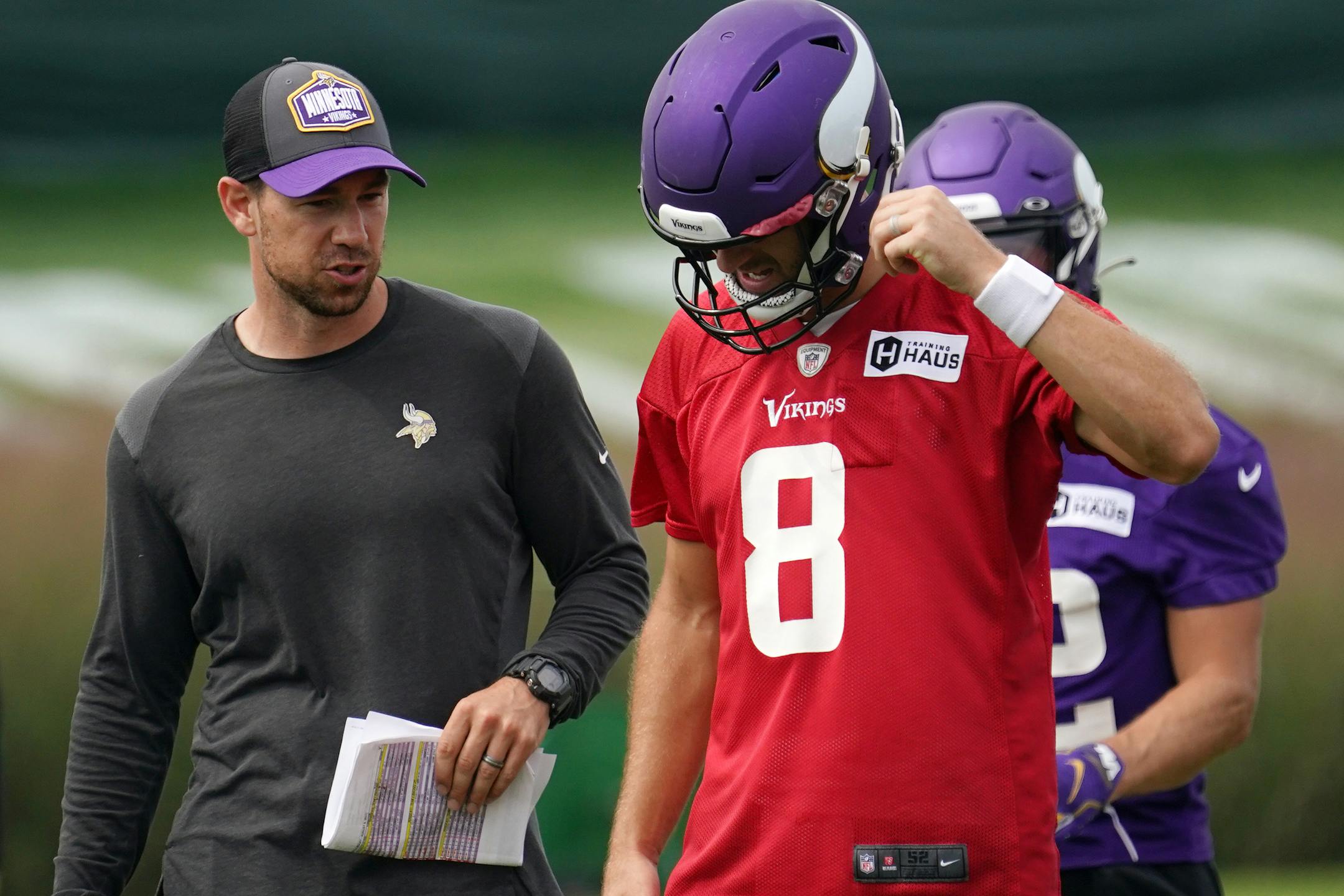
The path that led Klint Kubiak back to Minnesota, and eventually allowed him to become an NFL offensive coordinator for the first time at age 33, began three years ago with a Vikings loss to the Seahawks.
Shortly after the Vikings landed at Minneapolis-St. Paul International Airport the morning of Dec. 11, 2018, following a Monday night loss in which they'd narrowly escaped a shutout, coach Mike Zimmer ended months of disagreement with John DeFilippo by firing the first-year coordinator. Zimmer gave the interim coordinator title to quarterbacks coach Kevin Stefanski. When the Vikings removed the interim tag following the season, one of Stefanski's first moves was to reach out to Kubiak, who'd worked by his side as an offensive quality control assistant from 2013-14, about being the quarterbacks coach.
Their relationship led to Kubiak bringing his father, Gary, and a pair of longtime Kubiak assistants (tight ends coach Brian Pariani and offensive line coach Rick Dennison) to Minnesota. The Vikings committed to the Kubiak version of the West Coast offense that had taken root around the league with coaches such as Kyle Shanahan and Sean McVay. Even though the play-calling title passed from Stefanski in 2019 to Gary Kubiak in 2020 and onto Klint Kubiak in 2021, the identity of the Vikings' offense — a commitment to outside zone runs, as well as play action and bootlegs with the quarterback under center — remained the same.
Statistically, the Vikings have had better offensive days in Zimmer's eight seasons as head coach than the 30-point, 453-yard showing Sunday he called the best of his time in Minnesota. And the significance of the win, following seven consecutive losses to the Seahawks, wasn't something the coach was interested in entertaining; he cut off his postgame news conference after a question he didn't like about the Vikings' history against Seattle.
But given the context of the game — an 0-2 Vikings team, playing without Dalvin Cook in a home opener they desperately needed to win, facing an opponent they badly wanted to beat — it's tough to imagine the offense making a more emphatic statement on behalf of its first-year play-caller than it did Sunday.
The Vikings' third-down conversion rate of 64.3% matched their 2017 Week 1 win over the Saints for their third-best mark under Zimmer. They held the ball for 35 minutes, 53 seconds without Cook and averaged 8.03 net yards per passing attempt, in a game where Kirk Cousins completed 30 of his 38 passes and was sacked only once.
"He did a good job last week, too," Zimmer said of Kubiak. "And the first week, I mean, I don't know who could have called a good game on second-and-20 and third-and-20. But he called a good game again [Sunday]. He's also getting a lot of help from these other offensive coaches: [running backs coach] Kennedy Polamalu's doing a great job, and [wide receivers coach] Keenan McCardell, and [offensive line coach] Phil Rauscher. [Tight ends coach Brian] Pariani. … Andrew Janocko, [the coach] with the quarterback, I think he's done a nice job with him. It's a good collective thing where we figure out, 'OK, how can we affect this defense and what plays can we work to get to it?'"
Kubiak has continued to put his own stamp on the Vikings' scheme; with tight end Irv Smith Jr. hurt and K.J. Osborn emerging, the Vikings were lining up in three-receiver sets almost twice as much as they did last year, according to Sharp Football Stats. They've used play action far less frequently through the first three weeks of the season, but have employed more pre-snap motion to gain advantages in the running game.