
NFL general managers shattered this year the previous draft record of 34 trades, with Rick Spielman making seven of his own moves for the Vikings. The first moved up seven spots to select college phenom running back Dalvin Cook in the second round.
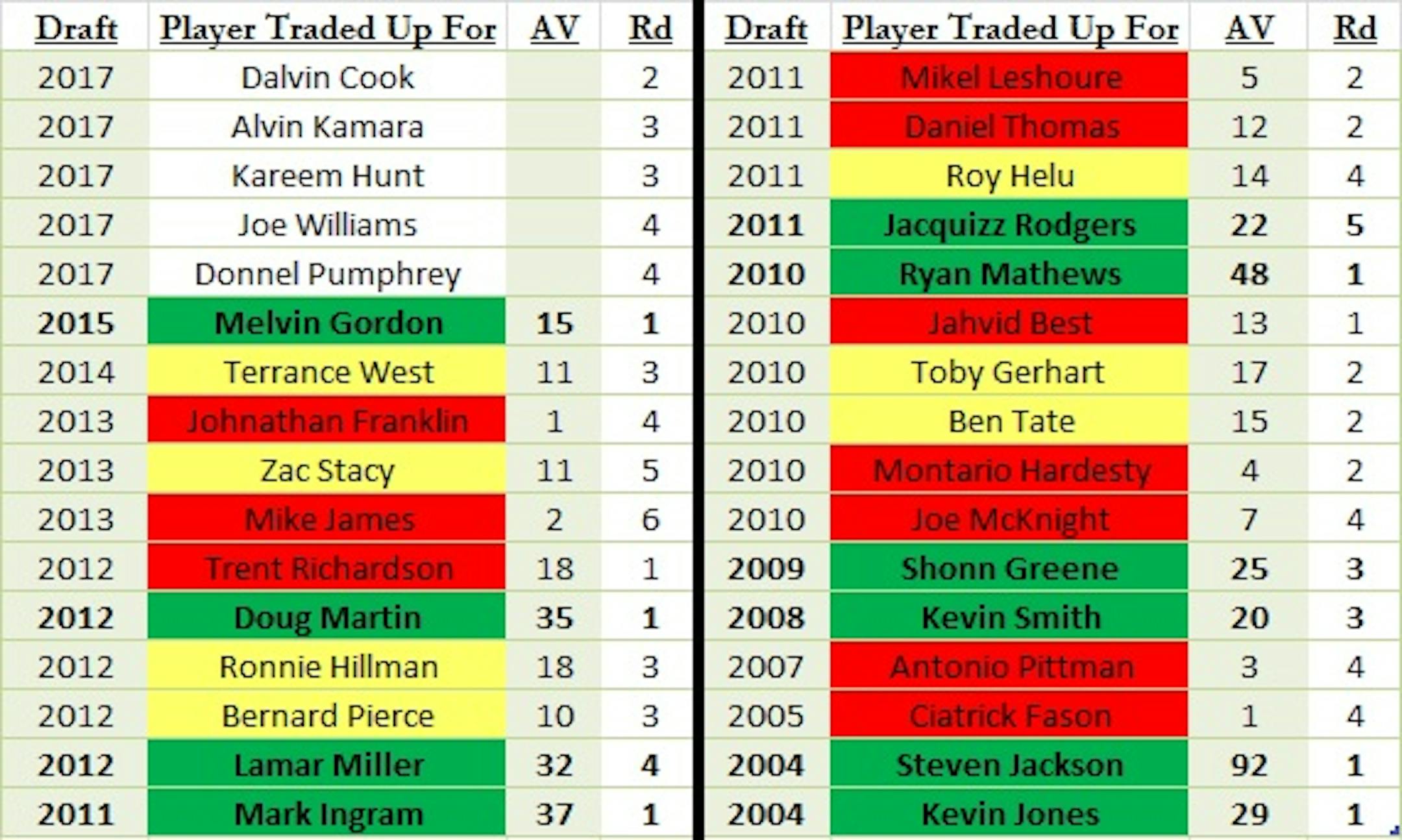
Trading up for a running back had become taboo for a while. Personnel evaluators moved up only twice in the last three drafts, for Melvin Gordon and Terrance West, to add to the backfield.
That changed last weekend when a strong running back class enticed the Vikings and four other teams to trade up for ball carriers.
But how often does it work out?
Pretty well if you're trading up in the first round. San Diego took a budding star in Gordon after moving up to the 15th-overall pick in 2015. Same for the Saints and Mark Ingram in 2011. The Rams also ended up happy after trading up for Steven Jackson in 2004′s first round.
A review of running backs acquired by teams trading up since 2000 shows those backs are measurably more effective than other running backs, according to an Approximate Value metric created by Pro Football Reference. AV is a compound measurement based on games played and started, key stats, individual awards and team wins.
About 37 percent of those RBs acquired via trade up (10 of 27) currently have or finished careers with a 20 AV or better. That's compared to about 25 percent for all drafted running backs within the past two decades, according to the Tampa Bay Times. A back like Trent Richardson can accumulate 3,000 combined yards in 46 games and still only register an 18 AV for his career.
The second round hasn't been as fruitful as the first for ambitious teams. Cook would be the first running back acquired via second-round trade up to make much of an impact in the NFL since 2000. His second-round trade up predecessors include unheralded players like Mikel Leshoure (2011), Daniel Thomas (2011), Toby Gerhart (2010), Ben Tate (2010) and Montario Hardesty (2010).