

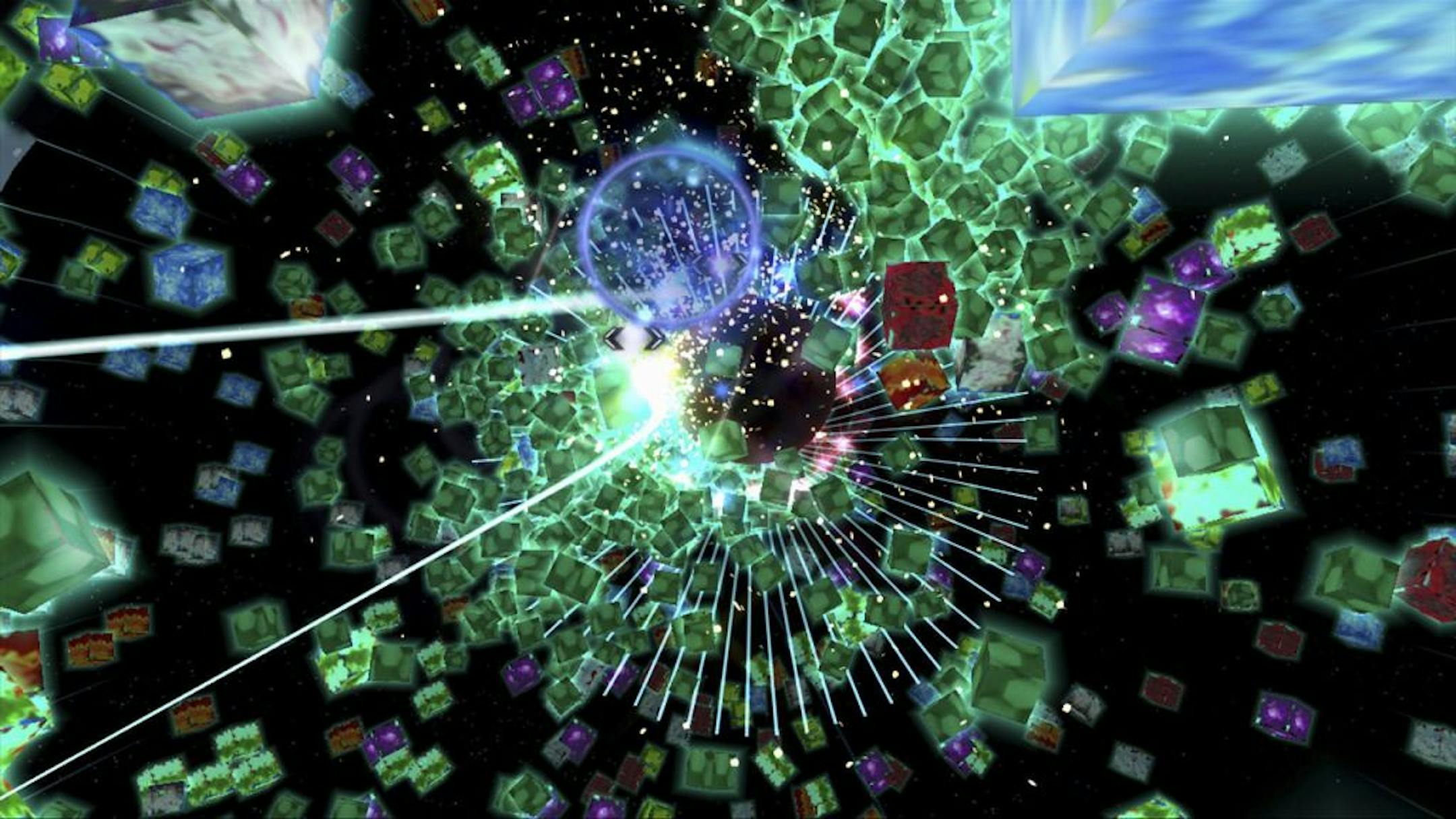
Spectral whales undulate through ethereal mist, their hides speckled with winking gems that pulsate to a throbbing bass line. Gleaming motes of color spin and coalesce into flowers, layer upon layer of shimmering petals. A girl named Lumi, born in outer space and transported to cyberspace, beckons you to rescue her digital consciousness.
Sounds pretty trippy, huh?
This is "Child of Eden," the luminous new game from the Japanese auteur Tetsuya Mizuguchi and one of the more inspirational exhibits of artistry to be found in interactive entertainment today. The game -- available now for the Xbox 360 and scheduled to arrive for the PlayStation 3 in September -- was developed by Q Entertainment (of which Mizuguchi was a founder) and published by Ubisoft.
In the quest for commercial success, so many games (like so much of any medium) end up being similar. The formulas are known, the structures accepted. For many top games, the question becomes how well they fulfill and execute the basic template of their genre.
"Child of Eden" is an example of what can happen when creativity is liberated from the bounds of convention. It hews to only the most basic form of an arcade-style shooting game (stuff is whirling around on a screen; shoot it), perhaps in the way that even rebellious painters hew to the convention of stretching canvas across a wooden frame. From there Mizuguchi goes wild, integrating music, sound and the player's own physical movement into a full-body experience.
And that is because "Child of Eden" makes the best use yet of the new Kinect system for the Xbox 360. Kinect, introduced by Microsoft last fall, does away with the video game controller altogether. Using advanced technology and software, the Kinect sensor, which sits under your television, can see your body in three dimensions and recognize your voice. So in all sorts of games, you just lean if you want your character to lean. If you want it to jump, you jump, and so on.
In this game you use your hands to control pointers on the screen to direct your fire. After a few minutes of adjustment it feels completely natural. But the beauty is not merely in the controls; it's in how those controls draw you into what feels like a transformation. (You can also play with a traditional controller, but that completely misses the point.)
When Kinect was introduced, it was immediately clear that the system could usher in a wave of innovative games accessible to a vast majority of people who can't deal with a complicated controller covered with buttons, triggers and sticks. With Kinect, you don't hold anything.

