

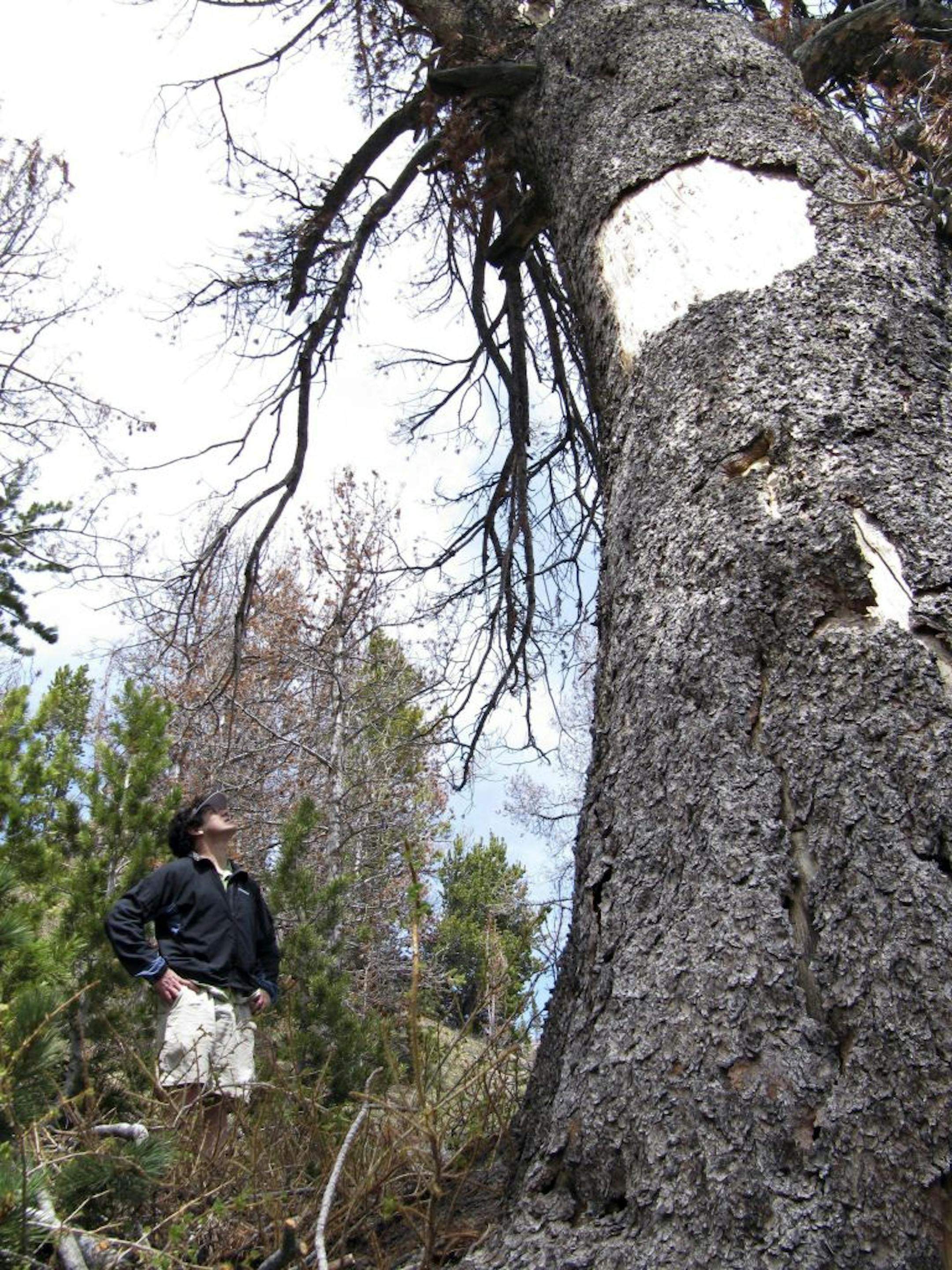
BILLINGS, Mont. — Climate change, voracious beetles and disease are imperiling the long-term survival of a high-elevation pine tree that's a key source of food for some grizzly bears and found across the West, U.S. officials said Tuesday.
A Fish and Wildlife Service proposal scheduled to be published Wednesday would protect the whitebark pine tree as a threatened species under the Endangered Species Act, according to documents posted by the Office of the Federal Register.
The move marks a belated acknowledgement of the tree's severe declines in recent decades and sets the stage for restoration work. But government officials said they do not plan to designate which forest habitats are critical to the tree's survival, stopping short of what some environmentalists argue is needed.
Whitebark pines can live up to 1,000 years and are found at elevations up to 12,000 feet (3,600 meters) — conditions too harsh for most tress to survive.
Environmentalists had petitioned the government in 1991 and again in 2008 to protect the trees, which occur across 126,000 square miles (326,164 square kilometers) of land in Wyoming, Montana, Idaho, Washington, Oregon, California, Nevada and western Canada.
A nonnative fungus has been killing whitebark pines for a century. More recently, the trees have proven vulnerable to bark beetles that have killed millions of acres of forest, and climate change that scientists say is responsible for more severe wildfire seasons.
The trees have been all but wiped out in some areas, including the eastern edge of Yellowstone National Park, where they are a source of food for threatened grizzly bears. More than half of whitebark pines in the U.S. are now dead, according to a 2018 study from the U.S. Forest Service.
That has complicated government efforts to declare grizzlies in the Yellowstone area as a recovered species that no longer needs federal protection. Grizzlies raid caches of whitebark pine cones that are hidden by squirrels and devour the seeds within the cones to fatten up for winter.


