

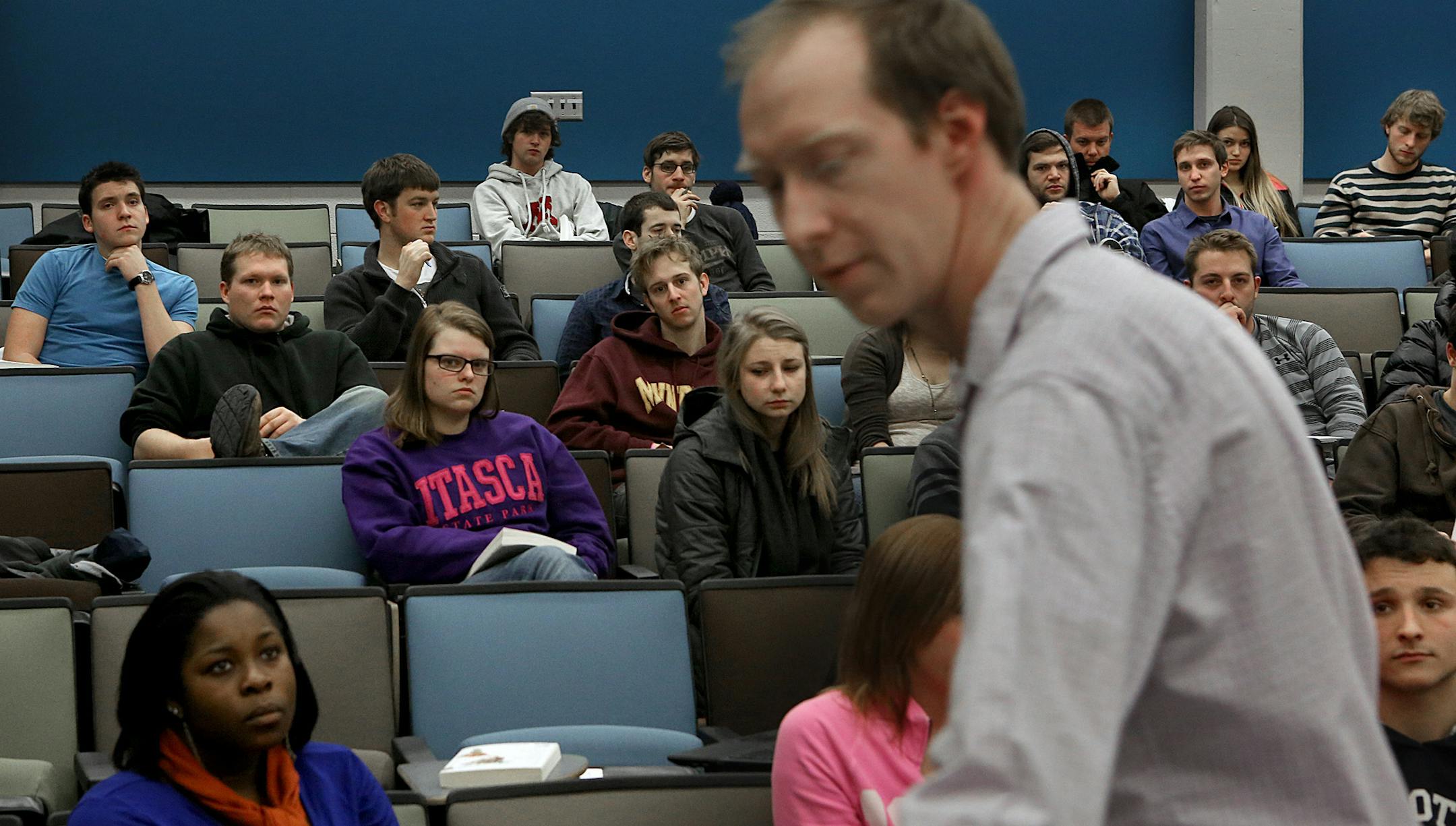
The University of Minnesota will create its own free online courses, joining an ever-growing group of universities in a grand experiment that some expect to remake higher education.
University officials announced late Wednesday night that the U is partnering with Coursera to produce massive open online courses, or MOOCs, available to anyone in the world for free. It's part of a new wave of 29 universities to sign on with the California-based company, which is already working with 33 others.
The courses' ability to attract huge numbers of students — tens of thousands, in some cases — has ignited the imagination of some officials and pundits, who believe they could help make a quality college education more affordable. But others argue that the courses' efficacy is still untested and point to their high dropout rates.
Five University of Minnesota professors have signed on to create the courses, including "Sustainability of Food Systems" and "Interprofessional Healthcare Informatics."
The format will "make available to the broader public the expertise of our faculty," said Karen Hanson, the university's provost and senior vice president for academic affairs.
Like other universities offering MOOCs, the U will not award students credit for completing them. But professors will reuse and refine the material for courses that U students pay for and take for credit, Hanson said.
"The relation between completion of a MOOC and credit at a university like this is an issue which is going to require a lot more faculty attention," she said. "We are proceeding cautiously here."
This partnership represents a new era for Coursera and Minnesota, which will forever be linked in the early history of MOOCs. Last fall, Coursera posted a warning on its website that the state's Office of Higher Education had notified the company that none of the universities offering classes to Minnesota students through Coursera was authorized to do so.
![Professor Jason Hill taught a course, Natural Resources Consumption and Sustainability, to students at the St. Paul campus of the University of Minnesota. Hill is one of five instructors who will be teaching a MOOC (massive open online course). ] JIM GEHRZ•jgehrz@startribune.com (JIM GEHRZ/STAR TRIBUNE) / February 20, 2012 / 12:00 PM St. Paul, MN](https://arc.stimg.co/startribunemedia/GKGJBC3OOADYHJNPNLBF3YWK6Q.jpg?&w=1080)
![Professor Jason Hill taught a course, Natural Resources Consumption and Sustainability, to students at the St. Paul campus of the University of Minnesota. Hill is one of five instructors who will be teaching a MOOC (massive open online course). ] JIM GEHRZ•jgehrz@startribune.com (JIM GEHRZ/STAR TRIBUNE) / February 20, 2012 / 12:00 PM St. Paul, MN](https://arc.stimg.co/startribunemedia/JTSHD2FY5CLJUTHICXUEUCHCXY.jpg?&w=1080)


