

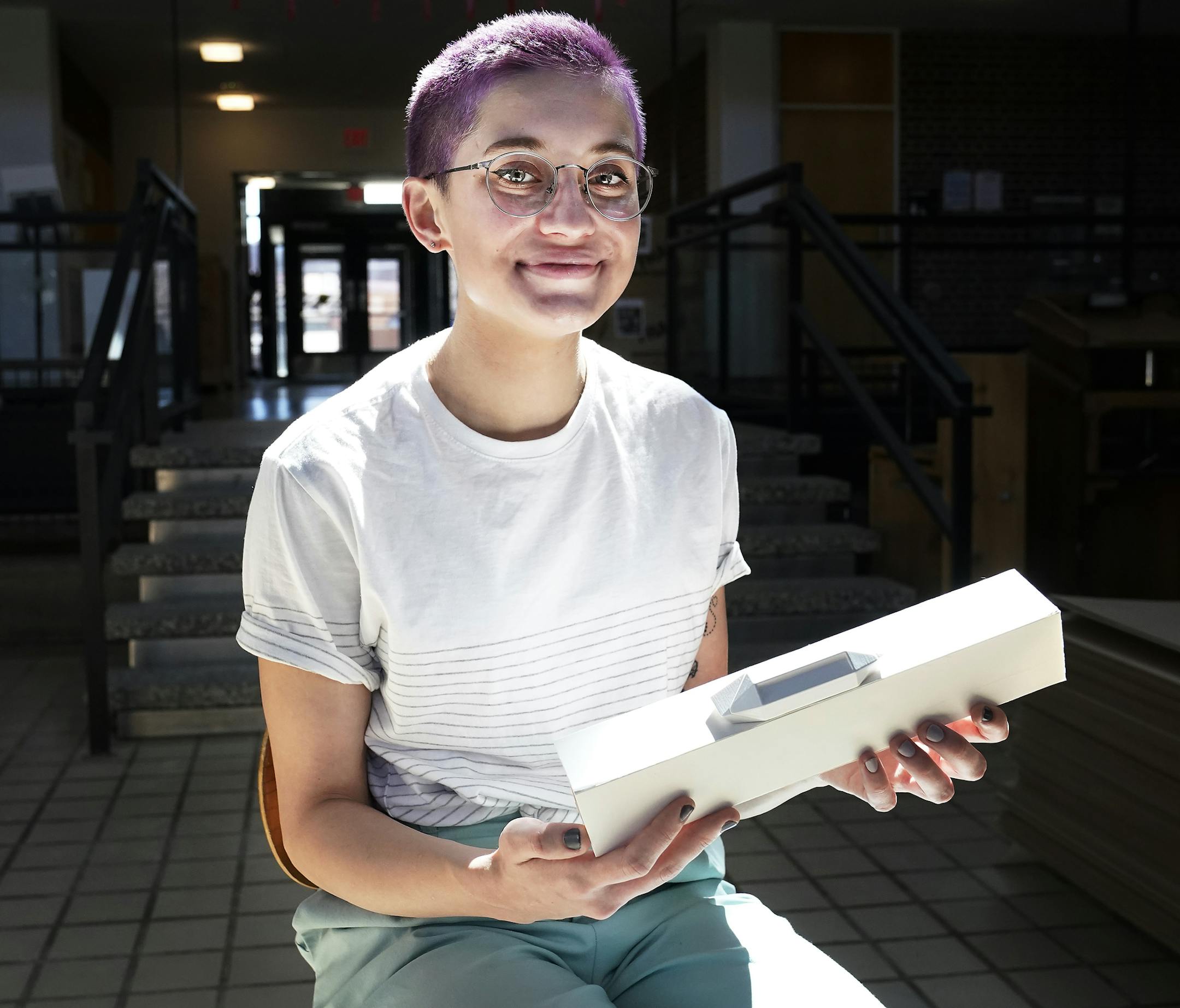
Talk about cleaning up your act.
With a long-term goal of generating minimal waste while crafting useful prototypes, students in the University of Minnesota's College of Design recently began swapping different substances — namely, glycerin and clay — for the less earth-friendly but popular high-density polyurethane foam (HDPU).
While the latter is considered an industry standard for prototyping and model-making, polyurethane foam doesn't degrade, instead disintegrating into an abrasive dust that requires excellent ventilation for safe air quality.
On the other hand, "glycerin and clay are infinitely reusable," said Anna Marie Mitchell, one of nearly three dozen undergraduate product design students enrolled in instructor Jason Quick's Product Design Studio 2 classes this spring.
Annie Henly, a fabrication technician in the College of Design's fabrication shop, also supports recyclable substitutions.
The high-density foam, Henly said, "is an amazing material but it goes straight to the landfill. And with students working remotely during the pandemic, we didn't want them hot-melting pink foam in their dorm rooms and getting headaches because they lacked proper venting to remove the fumes."
Enter the creative minds of Henly and fabrication director Molly Sanford. They set out to identify better options for Quick's product design students to use in their mock-ups this semester, as well as in future design assignments.
"This is what I'd call a harmonica-sized project — a bit smaller than average," said Quick, explaining that the students were tasked with creating models to improve on a real-world, everyday element — window latches — at the behest of corporate sponsor Andersen Windows.
![University of Minnesota College of Design student Liam Arbeiter, a sophomore from Maple Grove, with his redesign window lock he created from clay for an Anderson Windows project and seen at Ralph Rapson Hall at the U of M Tuesday in Minneapolis. ]](https://arc.stimg.co/startribunemedia/2ZY7KDJNSKRQLWZPDN72WMVYBU.jpg?&w=1080)

