

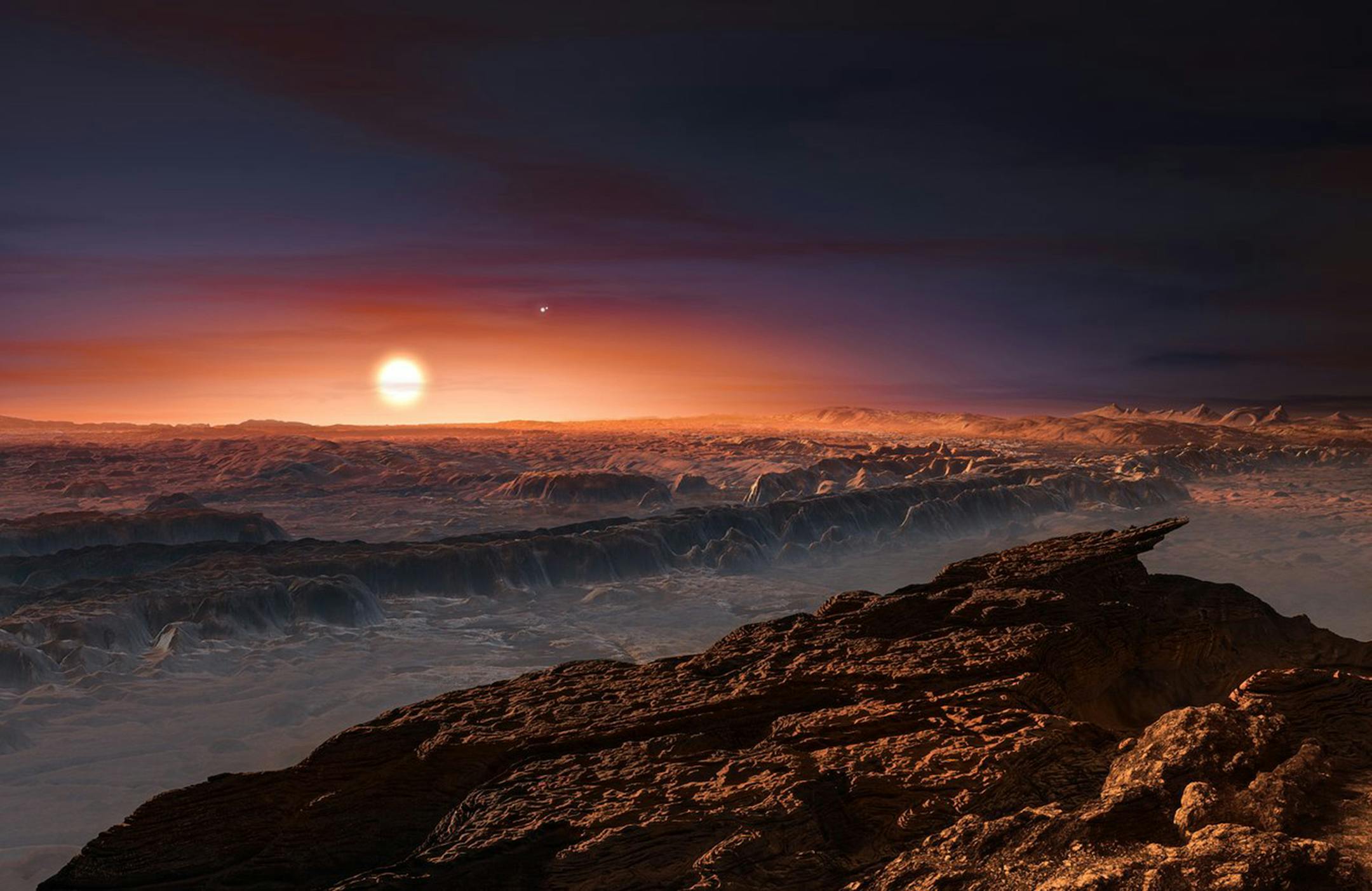
My 2013 science fiction novel, "Proxima," is about a habitable planet of the star Proxima Centauri, a "red dwarf," small and dim, that is the nearest star of all to our sun. I called my planet Per Ardua (after the motto of the Royal Air Force, "Per Ardua Ad Astra," "through struggle to the stars"). Last week, a team led by Guillem Anglada-Escudé of Queen Mary University of London announced the discovery of a planet, called Proxima b, in this very location.
Proxima is part of the Alpha Centauri stellar system, around four light years away. Its two principal stars, known as A and B, are like the sun, but Proxima is so dim it's invisible to the naked eye and was not discovered until 1915, by astronomers working in Johannesburg.
As the closest star to Earth, Proxima has featured quite frequently in science fiction before but generally simply to serve as the default first destination for early interstellar missions. The very first fictional starship bound for Proxima may have been by the mighty Adastra, in Murray Leinster's "Proxima Centauri" (1935), which travels to Proxima for that most enduring of reasons: It is the "nearest of the fixed stars to humanity's solar system." Proxima was mankind's first interstellar target in Robert Heinlein's famous two-part serial "Universe" and "Common Sense" (1941) — and again as recently as 2009, in the BBC's "Doctor Who" ("The Waters of Mars"). Perhaps the most significant literary usage of Proxima was by Philip K. Dick, whose novel "The Three Stigmata of Palmer Eldritch" (1964), coincidentally set in the year 2016, features a surreal invasion from the star.
But in the science fiction of the past, little thought seems to have been given to the details of any worlds of Proxima. The scientific consensus used to be that stars like Proxima could not host habitable worlds because such a world would need to be so close to its chill star that tidal effects would lock its rotation — like the moon orbiting the Earth. With one face in eternal day and the other in unending night, perhaps all the water, even the air, would freeze out on the dark side: one hemisphere a blasted desert, the other an ice cap.
In recent years, however, we have been discovering "exoplanets," planets of nearby stars, and as a result we've learned an awful lot more about planets, their origin and nature than we ever could have learned from the worlds of the solar system alone. And my novel was inspired by new thinking about planets of stars like Proxima. It seems that even a thin blanket of air could transport enough heat around such a planet to keep the dark side from freezing entirely, and a deep enough ocean would not freeze to the sea bed — and so a Proxima planet may be habitable after all.
There is a kind of feedback between science fiction and science, with the fiction extrapolating from the scientifically known into the unknown, and the science confirming or refuting these wild guesses — the scientists themselves inspired, perhaps, by the visions of the fiction. Guillem Anglada-Escudé, who contacted me before the discovery was announced, told me he came across my novel during a public-outreach exercise while the search for Proxima planets was in progress — and, he told me, got hooked on it because of the plausibility of Per Ardua.
Given the science that was already known, in fact, the invention of a plausible Proxima world was easy. I have an academic background in math and science myself, which makes technical papers reasonably accessible for me. I've always tried to keep in touch with relevant science developments; I've joined task groups working on speculative starship designs and the search for extraterrestrial intelligence. So I was able to see the essence of the science of Proxima, and build a plausible world on that basis.
An Earthlike world must exist in a star's "habitable zone," close enough for liquid water to exist on its surface: not too close and not too far. For any given star, the zone distance can be calculated: Earth is about 93 million miles from the sun, right in the middle of our system's habitable zone. A Proxima planet would need to be much closer to its star, but a planetary magnetic field should protect the planet from the star's flares and other hazards.


