

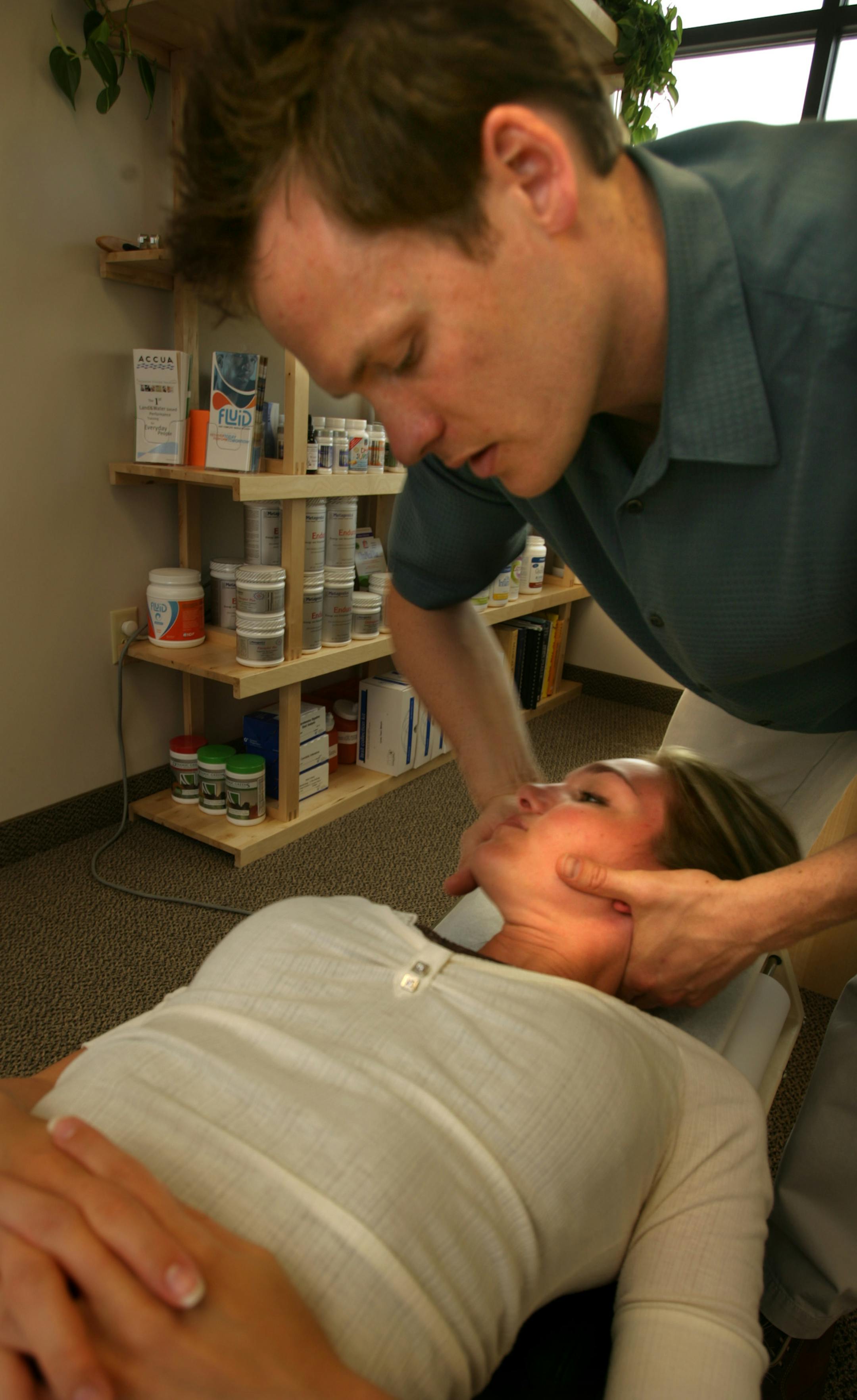
Dr. Chris Frykman is pressing on my adrenal gland, fingers plunged in a fold of skin near my right kidney. His free hand manipulates my leg.
"Can you pressure your foot toward the wall?" he asks. I'm lying on my back under a fluorescent light. My head rests on the padded pillow of a chiropractic table, the centerpiece implement at Vibrant Potential, Frykman's clinic in Shakopee.
"You feel that weakness?" the doctor asks, pushing my leg in a manual muscle test.
I've come to Frykman's office to undergo an assessment incorporating acupressure, chiropractic techniques, crystals, liquid concentrates and qigong, an ancient Chinese form of "energy work" -- all treatments loosely governed by Frykman's interpretation of an alternative medicine system called applied kinesiology.
Frykman, 31, teaches tae kwon do and is a certified triathlon coach. He is visibly healthy and in shape. When he speaks, an energy emanates from his gaze, an I-want-to-help-you look behind clean skin and immaculate teeth.
A husband and the father of three young girls, Frykman is easy to like, forthright and passionate about the business he founded one year ago.
But after my first appointment -- where he employed an electrified crystal stylus and vials of hydrochloric acid before wielding "thought energy" -- I left in a quiet spell, half-wondering whether he wasn't a shaman dressed in casual clothes.
Controversial medicine
The International College of Applied Kinesiology (ICAK), a Kansas City, Mo.-based organization, has certified more than 3,000 doctors to practice its namesake alternative medicine system. Developed in the 1960s, applied kinesiology (AK) is a holistic health care practice that evaluates structural, chemical and mental aspects of the body using manual muscle resistance testing.


