
U.S. strategy on North Korea in flux after student's death

Otto Warmbier's death has injected new political complications into the debate of how to deal with North Korea.

The Washington Post
June 21, 2017 at 3:49AM
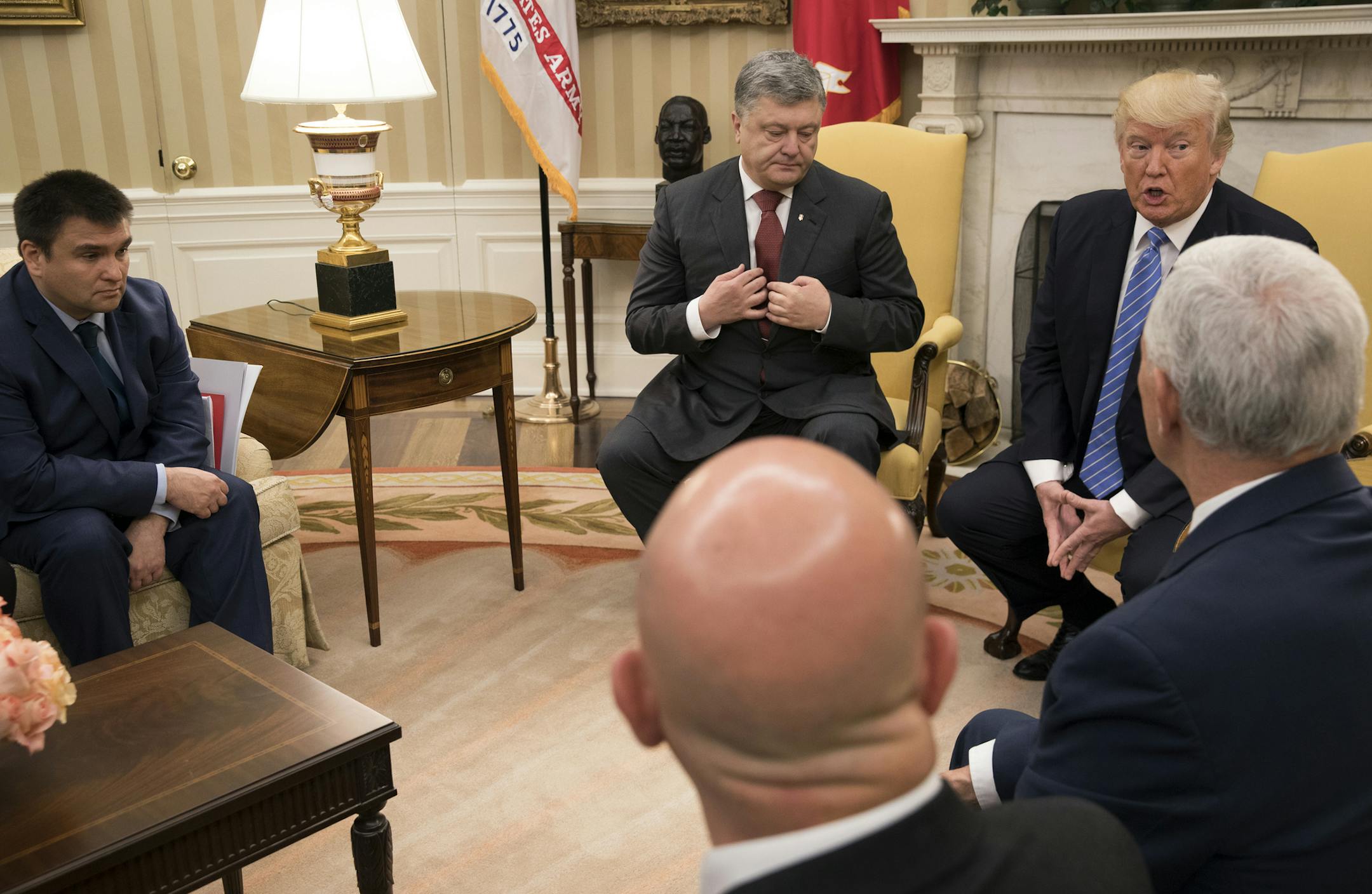
President Donald Trump meets with Ukrainian President Petro Poroshenko in the Oval Office at the White House, in Washington, June 20, 2017. In the meeting Trump mentioned that it was a “disgrace” about what happened to Otto Warmbier, a recently released U.S. student held prisoner for 17 months in North Korea only to die a few days later. Vice President Mike Pence and National Security Adviser H.R. McMaster were also present. (Stephen Crowley/The New York Times)
President Donald Trump meets with Ukrainian President Petro Poroshenko in the Oval Office at the White House, in Washington, June 20, 2017. In the meeting Trump mentioned that it was a “disgrace” about what happened to Otto Warmbier, a recently released U.S. student held prisoner for 17 months in North Korea only to die a few days later. Vice President Mike Pence and National Security Adviser H.R. McMaster were also present. (The Minnesota Star Tribune)

President Donald Trump on Tuesday appeared to lose faith in China's ability to pressure North Korea, and his spokesman said the White House is "moving further away" from direct engagement with Pyongyang, throwing into question the administration's strategy to contain the rogue nation's growing nuclear threat.

The death of U.S. college student Otto Warmbier in Cincinnati this week, days after his release from 17 months of detention in North Korea, has injected new political complications into Trump's bid to persuade dictator Kim Jong Un to curb his regime's behavior.

Trump called the treatment of Warmbier, who reportedly was in a coma for most of his captivity, "a total disgrace" and suggested that he has given up hope that Beijing could exert meaningful leverage on Kim.

"While I greatly appreciate the efforts of President Xi & China to help with North Korea, it has not worked out," Trump wrote in a tweet. "At least I know China tried!"

Trump had placed a heavy bet on China during a two-day summit with President Xi Jinping in Florida in April, personally lobbying him to impose sanctions on Chinese banks and other entities that do business with North Korea, whose economy and military program rely heavily on financial capital from its large and powerful neighbor.

At the time, Trump said he had chosen to hold off on campaign pledges to punish China over trade disputes, in part because of Beijing's assistance on North Korea. Xi has sought to curry favor with Trump.

But Trump's souring views on China's influence with North Korea could affect economic policy, including a pending decision on whether to impose new restrictions on steel imports, which could spark a trade war with China.

Asked Tuesday whether Trump was still open to meeting with Kim — something Trump once said was possible — press secretary Sean Spicer said the administration was "clearly moving further away" from direct engagement.

On Wednesday, Secretary of State Rex Tillerson and Defense Secretary Jim Mattis are scheduled to meet with Chinese officials in Washington to resume economic and security-related talks that began during the summit.

At the State Department, Tillerson is weighing a ban on U.S. citizens traveling to North Korea, a rare step that would seek to stop the flow of an estimated 1,000 Americans who travel there each year.

about the writers

about the writers

David Nakamura

Carol Morello

More from No Section

See More
FILE -- A rent deposit slot at an apartment complex in Tucker, Ga., on July 21, 2020. As an eviction crisis has seemed increasingly likely this summer, everyone in the housing market has made the same plea to Washington: Send money — lots of it — that would keep renters in their homes and landlords afloat. (Melissa Golden/The New York Times) ORG XMIT: XNYT58
Melissa Golden/The New York Times

It’s too soon to tell how much the immigration crackdown is to blame.