

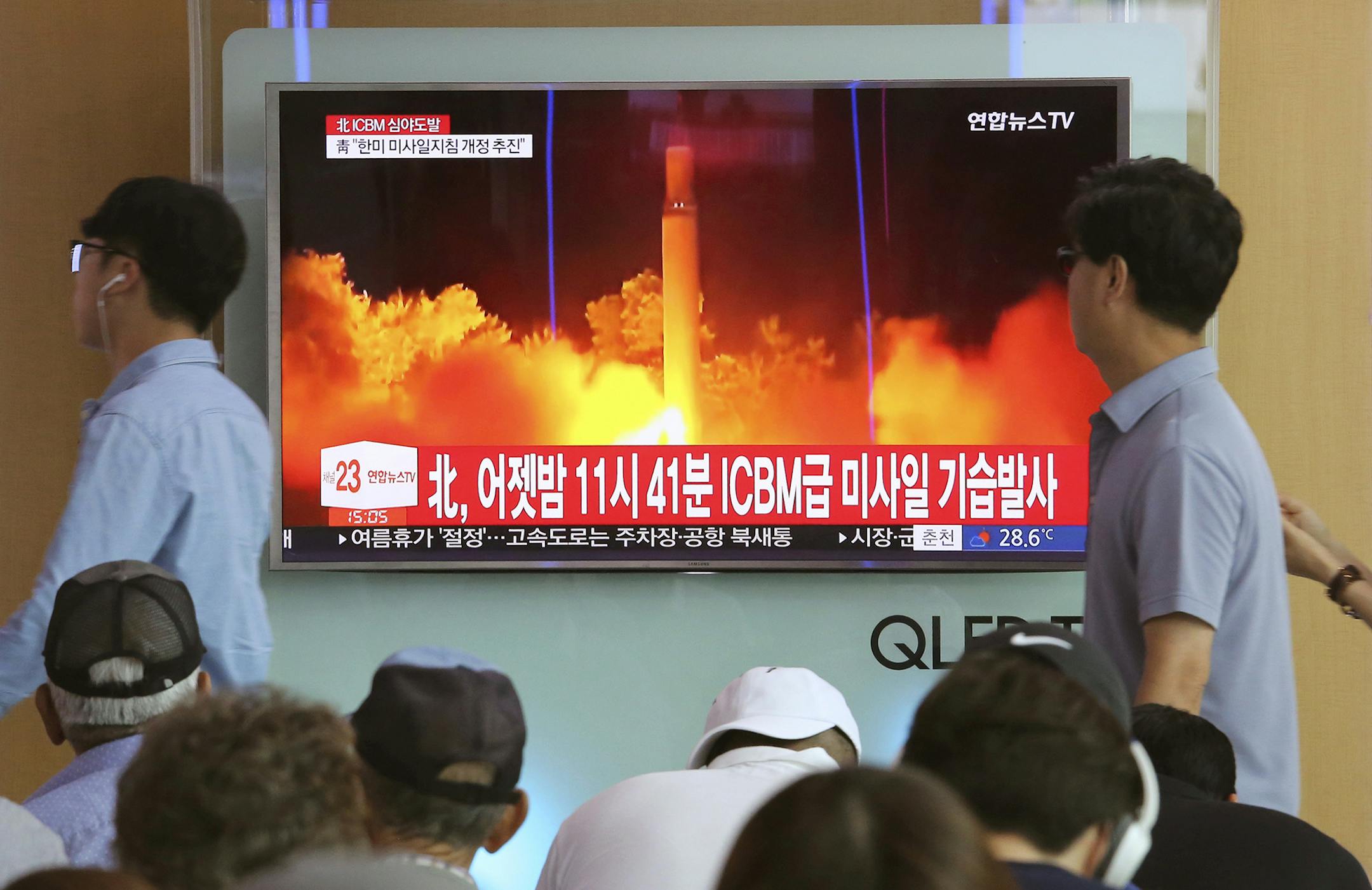
Four years ago, North Korea's Rodong newspaper released a photograph of Kim Jong Un sitting in front of an intercontinental-ballistic-missile targeting map depicting Washington, Los Angeles and Austin, Texas. What once may have sparked laughter is no longer a joke. Kim's latest successful ICBM test last week could make the entire continental U.S. vulnerable to a nuclear strike from Pyongyang.
We can no longer defer our response to this crisis. North Korea has demonstrated, time and again, that it may upend the tenuous armistice along the 38th parallel at any moment and drag the U.S. and our allies into a devastating conflict. What the U.S. needs now is swift action backed by a realistic strategy to secure the denuclearization and reunification of the Korean Peninsula.
We can achieve this if we effectively nullify Pyongyang's ability to target the U.S. and our allies; freeze the resources that North Korea funnels to its ballistic missile and nuclear capabilities; and send a signal to disenchanted Korean Workers Party elites that they could have a future in a reunified Korea.
Today, only the ground-based midcourse defense system — designed to intercept ICBMs as they travel through space — protects the U.S. from nuclear attack. The terminal high-altitude area defense system, calibrated to destroy medium-range missiles as they re-enter Earth's atmosphere, defends South Korea. Both platforms, and accompanying missile-interceptor programs such as the multi-object kill vehicle, must remain top priorities, but North Korea's ICBM tests necessitate new measures.
We must now take missile defense into space.
Although the Institute for Defense Analysis reported in 2011 that the U.S. possesses the requisite technology to field a space-based interceptor (SBI) program within 10 years, little progress has been made in the six years since. Legislating to advance SBI and expand the scope of the Missile Defense Agency has been a critical priority for me on the Senate Armed Services Committee. Only with a serious space-based capability can we target missiles in their boost phase and maximize discrimination of decoys during midcourse flight.
Our aim must be to outpace the North Korean threat by orders of magnitude, not merely keep up with it. Space-based missile defense can get us there.
However, simply defending against North Korean projectiles is insufficient. We must also deprive Pyongyang of the resources it directs to its nuclear and ballistic-missile programs. Unfortunately, during the Obama administration, the White House was more interested in securing a climate deal with China than enforcing sanctions against Pyongyang.


