

President Obama more than likely will have to put more U.S. troops on the ground if his effort to provide humanitarian aid to the Yazidis trapped on Mount Sinjar in northern Iraq is truly to succeed.
I say that having watched a similar U.S.-led effort to airdrop food, tents and medical supplies to Iraqi Kurds driven into the same northern mountains by Saddam Hussein's military in the wake of Desert Storm in 1991.
On that occasion, President George H.W. Bush decided not to pursue the Iraqi military into their homeland after pushing them out of Kuwait. Instead, he urged the Kurds to rise up against Saddam on their own. They tried, failed, and by the thousands were forced from their homes and brutally expelled to the mountains, trapped between Iraqi soldiers and Turkish forces that refused to let them cross the border to safety.
Photographer Stormi Greener and I were there, reporting for this newspaper.
Initial airdrops failed, even when they hit their target zones. Immediately a battle for survival of the fittest erupted. The fastest and the strongest won — those who reached the aid pallets first and could carry the most. Trucks carrying bottled water up the mountains were ripped of their cargo before coming close to the top. A black market arose overnight, those who had selling to those who had nothing. Fairness was absent.
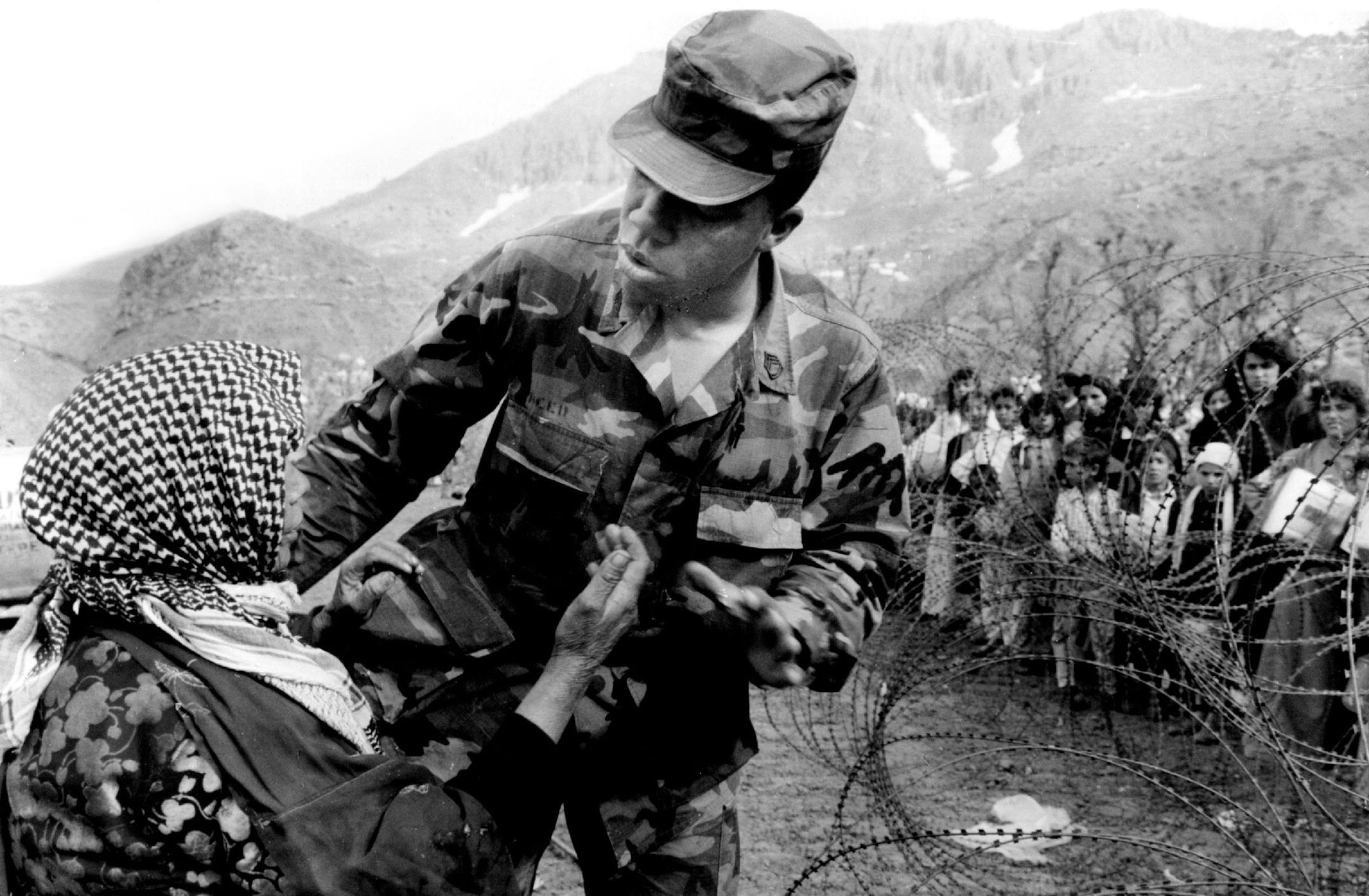
The United Nations, which was in charge, called for help. The United States led the response, sending a squadron of helicopters and a unit of Green Berets. Along with roll after roll of barbed wire. Order was restored. Black-marketeering almost disappeared. Fairness prevailed.
Airdrops stopped. Helicopters ferried the aid to designated zones, protected by coiled wire. Two or three heavily armed Berets guarded each zone.
Beret commanders summoned the leader of each Iraqi extended family, tribal group, religious group or political faction. Each received a specific time and place to periodically pick up sufficient aid for their group — and for no other.


