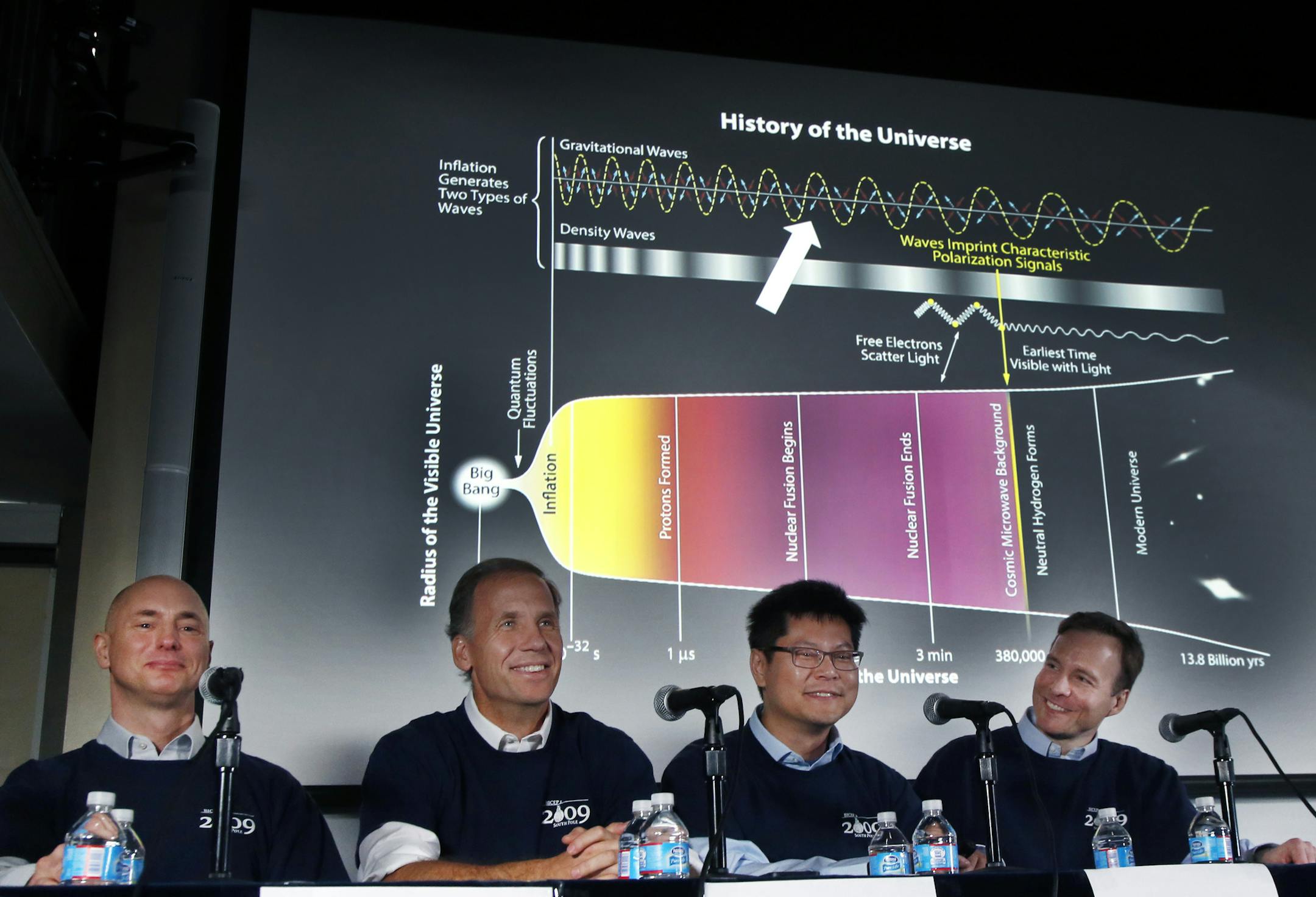
In the beginning, the universe got very big very fast, transforming itself in a fraction of an instant from something almost infinitesimally small to something imponderably vast, a cosmos so huge that no one will ever be able to see it all.
This is the premise of an idea called cosmic inflation — a powerful twist on the big-bang theory — and Monday it received a major boost from an experiment at the South Pole called BICEP2. A team of astronomers led by John Kovac of the Harvard-Smithsonian Center for Astrophysics that included researchers from the University of Minnesota announced that it had detected ripples from gravitational waves created in a violent inflationary event at the dawn of time.
"We're very excited to present our results because they seem to match the prediction of the theory so closely," Kovac said. "But it's the case that science can never actually prove a theory to be true. There could always be an alternative explanation that we haven't been clever enough to think of."
University of Minnesota physics and astronomy professor Clem Pryke, who played a leading role in the construction and operation of a series of telescopes at the South Pole in Antarctica and in the analysis of the data they produced, said: "This has been like looking for a needle in a haystack, but instead we found a crowbar. This discovery gives us direct insight into the birth of the entire universe in which we find ourselves," Pryke said.
The reaction in the scientific community was cautiously exultant. The new result was hailed as potentially one of the biggest discoveries of the past two decades.
'It's magnificent'
Cosmology, the study of the universe on the largest scales, has already been roiled by the 1998 discovery that the cosmos is not merely expanding but doing so at an accelerating rate, because of what has been called "dark energy." Just as that discovery has implications for the ultimate fate of the universe, this new one provides a stunning look back at the moment the universe was born.
"If real, it's magnificent," said Harvard astrophysicist Lisa Randall.
Lawrence Krauss, an Arizona State University theoretical physicist, said of the new result, "It gives us a new window on the universe that takes us back to almost the very beginning of time, allowing us to turn previously metaphysical questions about our origins into scientific ones."