

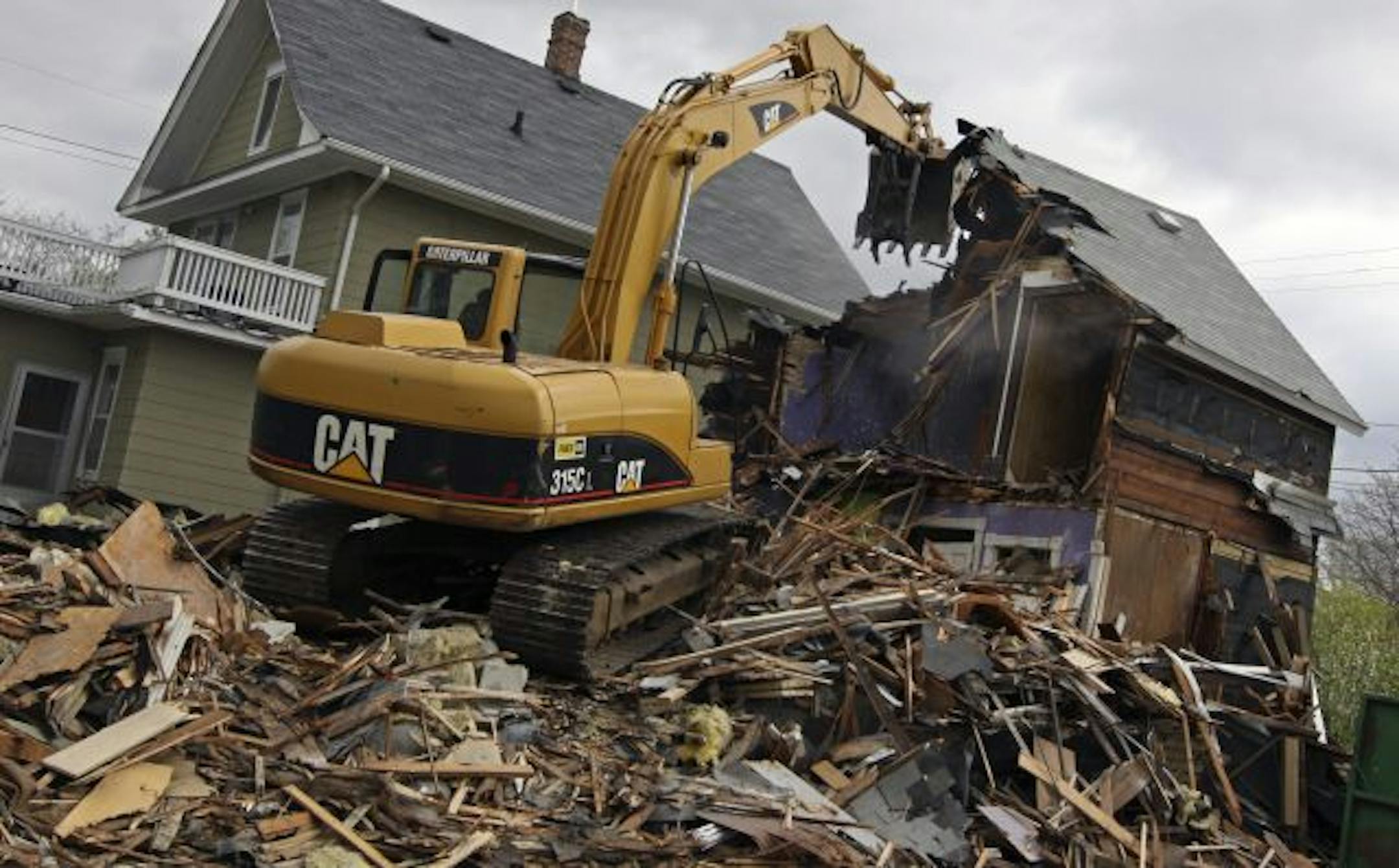
Ryan Kapaun strolls through his St. Paul neighborhood these days wondering what's going to replace the holes on the blocks where houses used to be.
It's a question on the minds of many in Twin Cities neighborhoods where houses are falling vacant -- and then falling down.
The cities of Minneapolis and St. Paul are tearing through their budgets to tear down buildings that drag down neighborhoods because they're eyesores, safety hazards or crime magnets.
Numbers are growing at an impressive rate, mostly the result of foreclosures and general economic woes. Demolitions in Minneapolis have quadrupled from 2006 to 2008; St. Paul has seen a 16-fold increase in that time.
Residents and neighborhood advocates often feel relief when a nuisance disappears, but now the question is: What happens next with the checkerboard of empty lots?
"It's noticeable for a neighborhood because obviously the house was torn down for a reason," Kapaun said. "Every time you walked by before it was sticking out for a reason, now it's gone and you're reminded what was there and what the potential can be."
"We know that vacant lots are not ideal; there are problems associated with them, but they're very mild problems compared with the cost of a nuisance building," said Henry Reimer, director of inspection services for the city of Minneapolis.
The soaring number of vacant buildings has squeezed city resources, from stepped-up inspections and monitoring to increased police and fire calls.


