
Washington: 10 good things about Metro Transit — including one that’s simply priceless

Despite all the system’s woes, I asked riders to share stories of what works.

Columnist Icon
The Minnesota Star Tribune
November 6, 2025 at 9:43PM
Contributing columnist Robin Washington set out to find 10 good things to be said of the Metro Transit system, and he found them. Above, a Green Line train at the Robert Street Station in St. Paul. (Anthony Souffle/The Minnesota Star Tribune)

Opinion editor’s note: Strib Voices publishes a mix of material from 8 contributing columnists, along with other commentary online and in print each day. To contribute, click here.

•••

Chances are if you’re reading about Metro Transit in the Minnesota Star Tribune, it’s because something bad happened. The system’s been plagued by high crime, low ridership, rampant fare evasion and an ever-ballooning billion-dollar budget. But there are good things to be said about the buses and trains, and at the risk of looking for lutefisk at a taco truck, I went out to find them.

My goal was to find 10 such positives — and who would know better than those who regularly ride the system? To my surprise, riders unhesitatingly offered them to me when I asked around one day last week. Here are their responses, in reverse order:

10. It’s cheap.

“It’s a lot cheaper than owning a car,” said Jayna Breda of West St. Paul, waiting for a bus at Jackson and 6th Street E. in downtown St. Paul. She also appreciated the electronic fare payment systems that, despite evasion, mean you rarely have to wait for someone counting out pennies to put in a fare box. “My ticket’s on my phone, so I can just show my phone and walk right on.”

9. It gets us everywhere we need to go.

The doors of the C Line bus had just closed on Jeremiah “Tiny” Williams at the Brooklyn Center Transit Center. But he wasn’t upset. “He’s got a job to do too,” he said of the driver. “If his job wasn’t to open the door at that time, I’m going to respect that.” Williams, an artist who lives in downtown Minneapolis and rides Metro Transit to various studios, summed it up simply: “It gets us everywhere we need to go.” He caught the next one just fine.

8. It runs frequently enough.

Also waiting at Brooklyn Center, Andrea Smith of northeast Minneapolis said the buses are reliable when it counts. “Monday through Thursday, [my route runs] every five-to-ten minutes. Weekends, it’s a 30- or 45-minute wait. But other than that, it’s pretty good for me. It gets me where I need to go on time.”

7. Some buses are faster than the trains.

Overhearing Smith was Kimberly Block of Brooklyn Park, who elaborated on bus timeliness to laud the No. 94 express that connects downtown Minneapolis to downtown St. Paul via Interstate 94. “If I go from my house early in the morning and catch the express bus from [Brooklyn Center] and then the 94 to St. Paul, I’m there in like an hour and 15 minutes,” she said. “If I took the light rail, it’d take two and a half hours.”
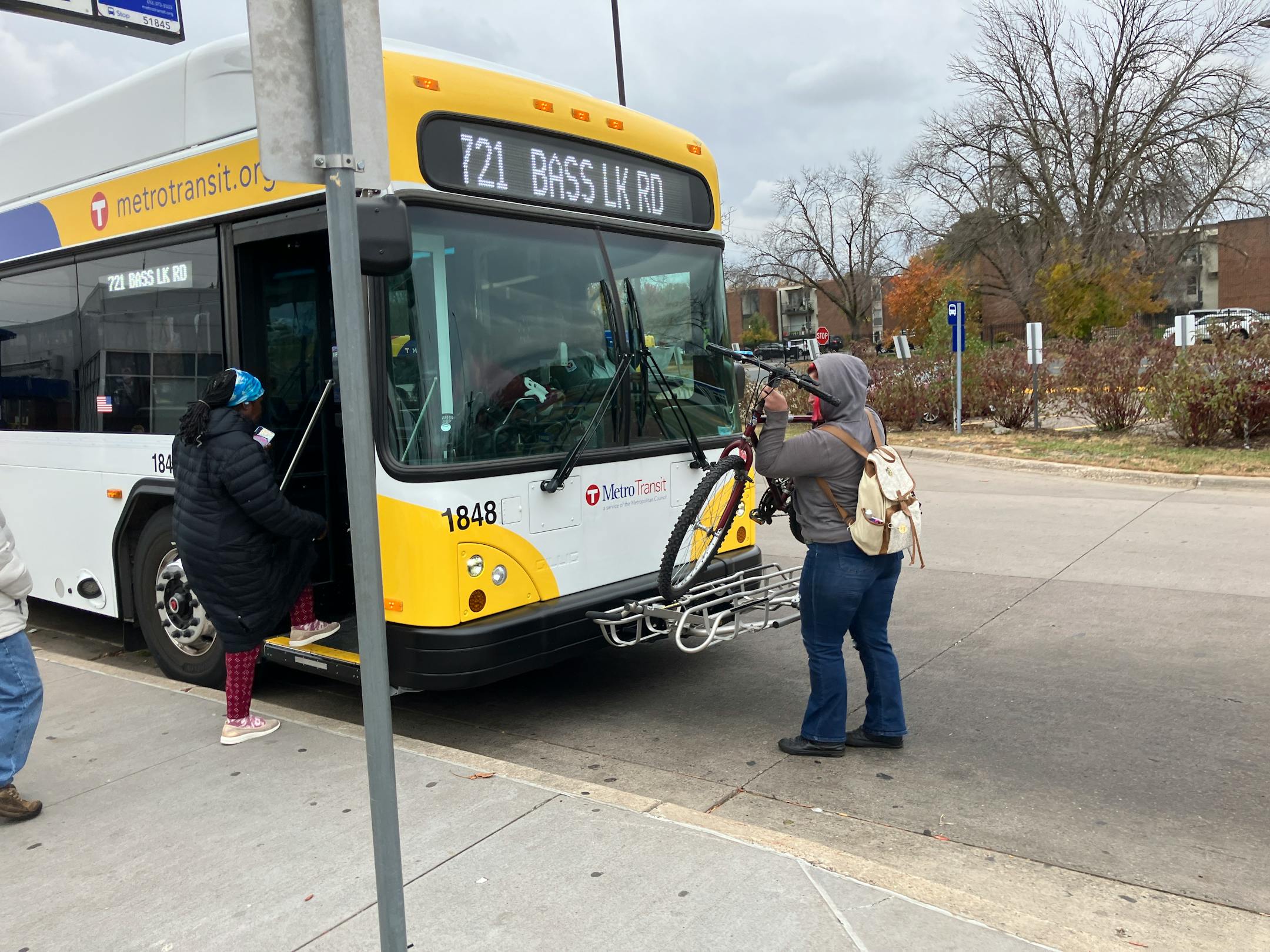
6. Bikes are welcome — and they won’t fall off.

In a pinch, Nicole Najmon of New Hope doesn’t have to take the bus; she’s got a sturdy Motiv Tahoe mountain bike. But it’s the combination of both that makes her commute a breeze. “I’ve never had a bad experience or anybody steal my bike off the bus,” she said as she fastened her bike to the rack on the 721 bus. “Each rack holds two bikes,” she said, “so if there’s two already on there, you gotta wait for the next bus. But other than that, I’m happy I don’t have to bike everywhere.”

Nicole Najmon of New Hope loads her bike on the rack of the No. 721 bus at the Brooklyn Center Transit Center. (Robin Washington/The Minnesota Star Tribune)

5. It’s clean and there’s usually somewhere to sit.

Green Line rider Samantha Sarmiento of New Hope was impressed with the train’s physical space. “It’s usually super clean,” she said, “and I can always find somewhere to sit.”

That last observation may need qualification: Sarmiento got on at the Nicollet station in downtown Minneapolis in late afternoon, not at Target Field after a Twins game when the trains can be jammed. But the season’s over anyway.

4. It’s clean and warm.

Sarmiento’s friend Lucia Rojas seconded the observation about cleanliness and added that Metro Transit vehicles are climate-controlled. “It’s usually really warm inside during winter,” she said.

3. It goes to all the right places, and you can track it.

Riding to a University of Minnesota stop, Muhammed Lone praised the system for going where people actually need to go — “like the Mall of America, downtown, the University of Minnesota and all the way to downtown St. Paul.” What’s really useful, he added, is that tracking apps work. “I can check Apple Maps or Google Maps, see when it’s coming, and leave my apartment three minutes before that and reach the station right in time.”

2. It’s sometimes faster than a car.

Chloe Pemberton of Minneapolis said her Green Line ride is more direct and “a lot faster for me — sometimes faster than a car.” That may be due to her specific commute and the time of day, which she said also makes it faster than the bus. I’m not sure if she knows about the 94 (see No. 7 above) or if it just doesn’t go where she’s headed. But I’ll take her vote for speed.

All of their answers were insightful — and frankly, better than I expected. Maybe the thesis is if you go looking for good, you might find it. Satisfied that I had all I needed, I settled in my seat on a clean, warm train for the ride home — only to be jolted by a loud crash.

At first, I thought it was a bicycle falling. (A rider had placed one in front of the doors instead of hanging it on the bike bar, which, with all the good feeling I had just heard, I was willing to forgive this time.)

But it wasn’t. Far more seriously, a woman had collapsed on the floor of the car. A companion talking to her was getting no response and the woman wasn’t moving. I couldn’t tell if she was breathing.

A man who identified himself as a nurse crouched down and said, “She barely has a pulse!” Two of us called 911. The dispatcher immediately transferred my call to Metro Transit’s emergency line, who asked for her condition, the train number, and where exactly we were. I couldn’t think of the names of the stops and said we were two before the St. Paul Depot, the end of the line. My thought was if the train just kept going, we would meet the transit personnel stationed there.

Yet as we pulled into the next stop, Central, two squad cars had their lights flashing. A Metro Transit cop boarded. Kneeling, he said, “I need you to get up with me, OK?”

Her lips began moving. “Drank too much,” she replied.

“You drank too much. OK. We got medics on the way for you.”

And he got her up and out, the train barely delayed.

So does a person falling unconscious on your train ruin the idea of good things on the transit system? Actually, it makes it better — because:

1. Help is never far away.

The number one good thing that any system can offer is that when something serious happens, first responders will be there at the next stop. And that’s definitely good enough for me.

about the writer

about the writer

Robin Washington

Contributing columnist

Robin Washington is a contributing columnist for the Minnesota Star Tribune. He is passionate about transportation, civil rights, history and northeastern Minnesota. He is a producer-host for Wisconsin Public Radio and splits his time between Duluth and St. Paul. He can be reached at robin@robinwashington.com.

See Moreicon

More from Contributing Columnists

See More
card image
card image