

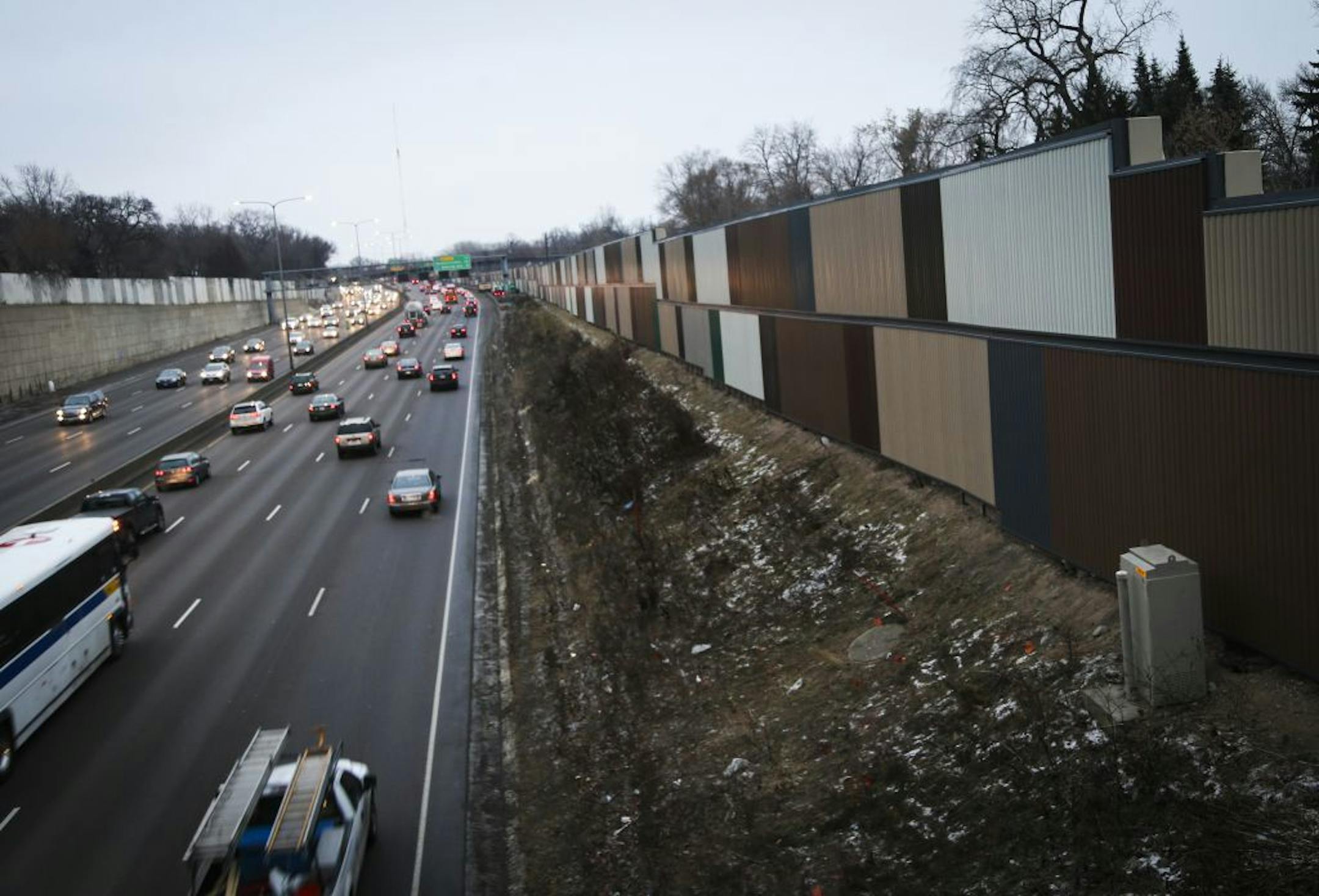
Road crews are installing the last sound-absorbing panels on a distinctive noise wall along Interstate 94 that should bring quieter days to southeast Minneapolis' Prospect Park neighborhood — and already is drawing comments from passing drivers.
In a project it has never tried before, the Minnesota Department of Transportation has affixed a patchwork of panels in 12 colors to the wooden wall on the south side of the freeway between Huron Blvd. and Hwy. 280 to muffle noise created by 153,000 vehicles that whiz by each day.
Longtime resident Amy Hargens both loves and loathes what she calls the "ribbon of color."
"They are not very beautiful, but I don't care what they look like," said Hargens, 70, who has lived on SE. Seymour Street since 1972. Before them, she was getting only six hours of sleep because she didn't go to bed until after the traffic stopped.
"It's better now," she said. "I slept through the night and that has not happened in a really long time."
MnDOT built the noise wall on the south side of I-94 in 2011. A concrete wall built in the 1970s was already in place on the north side. Normal noise walls usually are enough to keep the hum of the highway out of adjacent neighborhoods. In the case of the Prospect Park neighborhood, which sits atop a hill overlooking I-94, noise was bouncing off the south wall and reverberating into the neighborhood.
"That made it unbearably loud. I could not be outside in the summer for more than 10 minutes or I'd get anxious," said Hargens, who said an app on her phone measured decibels as high as the 90s. Long-term exposure to 80-85 decibels or more can cause hearing loss, according to the National Institute on Deafness and Other Communication Disorders. "The sound was just horrible," Hargens said. "We just wanted the sound abated."
Unanticipated problem
MnDOT spent $758,000 to retrofit the wall spanning about 2,200 feet, MnDOT spokesman Bobbie Dahlke said. She said the agency did not anticipate the noise problem when the south wall was built. The agency now has a new policy to test for noise problems when new walls are built, she said.
![The Minnesota Department of Transportation is wrapping up work on a one-of-a-kind noise wall project that is bringing peace and quiet to some residents of Minneapolis' Prospect Park neighborhood in Minneapolis, Minn., photographed on Wednesday, December 10, 2014. ] RENÉE JONES SCHNEIDER reneejones@startribune.com](https://arc.stimg.co/startribunemedia/BSQIFUHN6UIVQPUWGFCLKQJXVA.jpg?&w=1080)


