

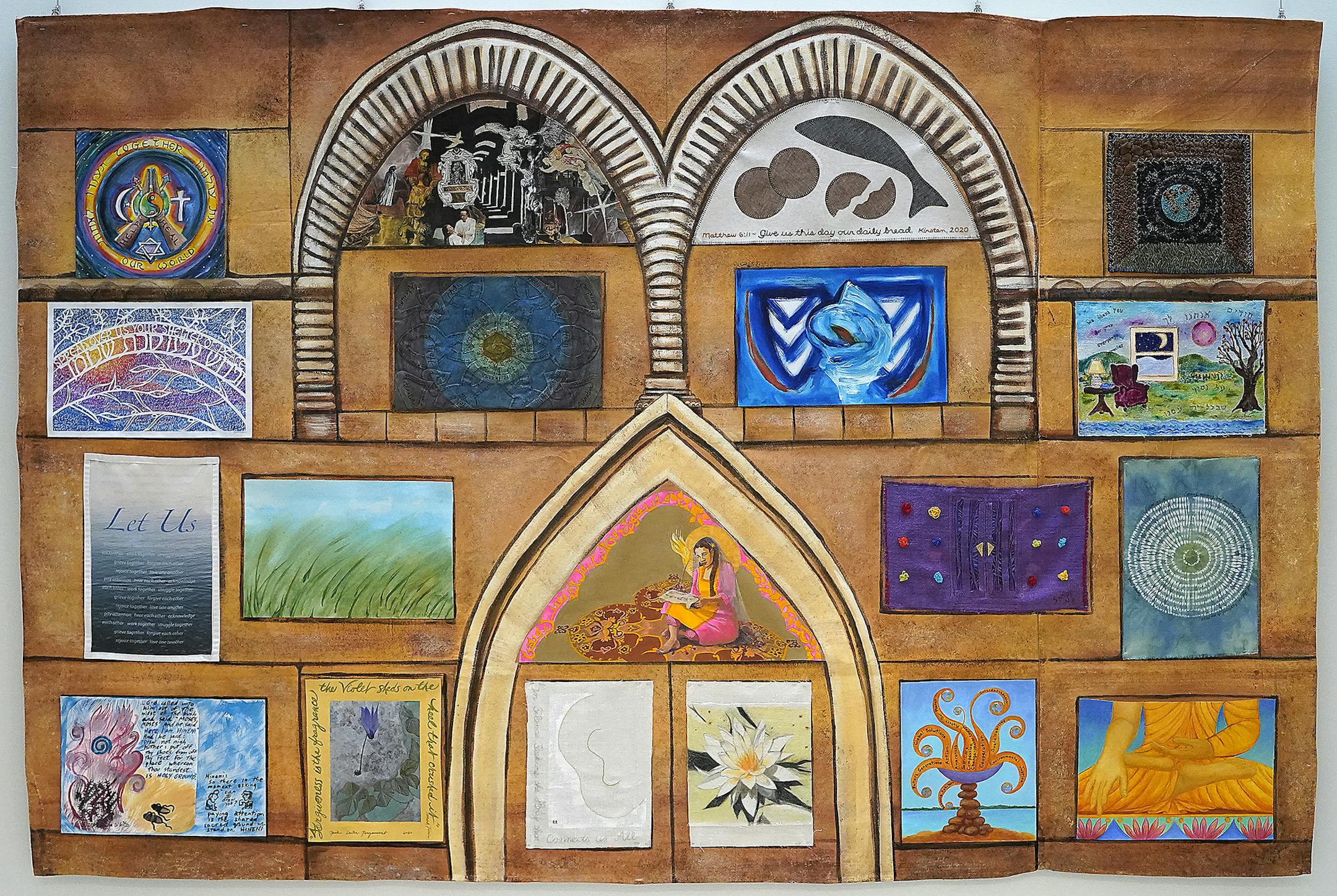
On a large canvas, 18 local artists' pieces reflect multiple religions including Judaism, Christianity and Islamic faiths — illustrating the unity and connection across religions.
The Interfaith Prayer Wall, a 6-by-9-foot canvas created last year by Twin Cities artists, was on display at a Jerusalem art gallery and at the University of St. Thomas until April 20 and will be displayed at the Wilson Library at the University of Minnesota June 21 to Oct. 1. It's also viewable online, part of a virtual exhibit launched this year.
In an increasingly polarizing, contentious time, the artists hope their art bridges divides and inspires calm.
"I think it sets a tone of welcoming different faiths," said Aimee Orkin of Minneapolis, an art teacher and Judaic artist. "It's not enough just to go to our own synagogue, our own church or our own mosque. We need to connect to each other, respect each other, learn from each other and create community that is interfaith."
The 18 artists are from the Interfaith Artist Circle, a group formed in 2015 from the Jewish Women's Artists' Circle (go to interfaithartistcircle.com). The canvas features a backdrop painted by Orkin of religious architecture modeled after Solomon's temple, the Church of the Holy Sepulchre and a prayer niche, or mihrab.
"It's just like a magnet. People are really drawn to it," said Orkin, who took a sabbatical from teaching at the Heilicher Minneapolis Jewish Day School for the project. "I think that there's a big place for art in building bridges."
The Interfaith Prayer Wall's online presence, a shift necessitated by COVID-19, is part of a broader new virtual exhibit called Visual Prayer, launched this year by the Interfaith Artist Circle, University of Minnesota Libraries, the Jay Phillips Center for Interreligious Studies at the University of St. Thomas and Jay Phillips Center for Interfaith Learning at St. John's University. It can be viewed at https://bit.ly/3tgoIys.
Hend Al-Mansour, an Arab-American artist in St. Paul, created paintings both for the online exhibit and the prayer wall depicting Islamic women, including Fatimah, the daughter of the prophet Muhammed, and Hafsa, one of his wives. Art, she said, can help address growing racism during the pandemic.


