

Three weeks before becoming president, Donald Trump weighed in on the threat of North Korea developing a nuclear warhead capable of reaching the U.S.: "It won't happen," he vowed on Twitter.
Now planners are contemplating what a U.S. strike to prevent that development might look like, and the options are grim.
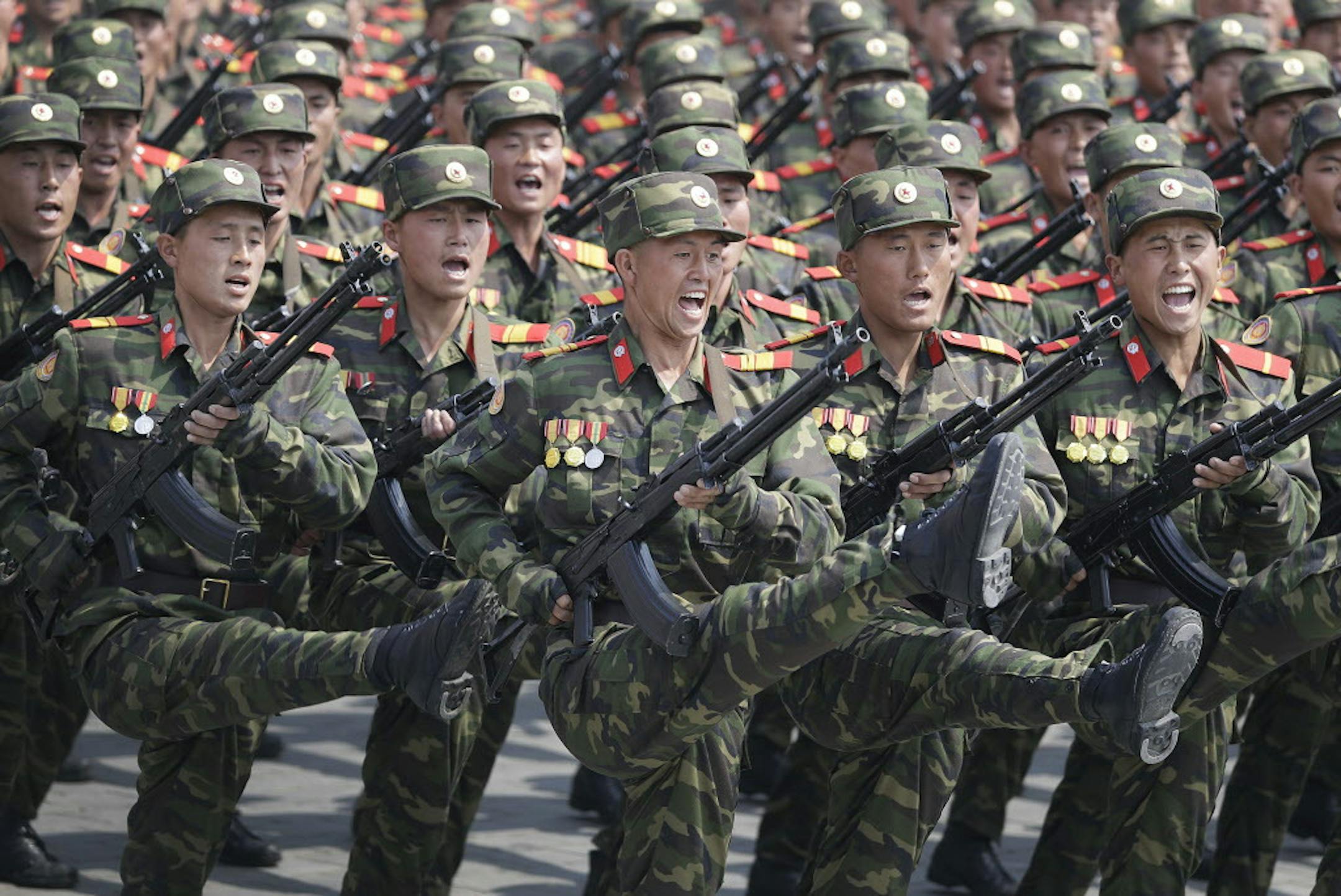
Analysts estimate North Korea may now possess between 10 and 25 nuclear weapons, with launch vehicles, air force jets, troops and artillery scattered across the country, hidden in caves and massed along the border with South Korea. That's on top of what the U.S. estimates to be one of the world's largest chemical weapons stockpiles, a biological weapons research program and an active cyberwarfare capability.
And with Seoul and its 10 million residents just 35 miles south of the border — well within North Korea's artillery range — any eruption of hostilities could have devastating human and economic costs. That's why the North Korean dynasty founded by Kim Il Sung has long hinged its survival, in part, on a warning that any attack could provoke all-out war.
"Unless you were in a crisis situation where we thought the North Koreans were getting ready to attack us, a pre-emptive strike against the North Korean nuclear and missile program is simply not a practical option," said Gary Samore, a former White House coordinator for weapons of mass destruction, proliferation and terrorism, who's now at Harvard University's Belfer Center. "This has always been the problem for the U.S. and our allies."
After Trump ramped up his rhetoric against North Korea this month, the Pentagon ordered the USS Carl Vinson to head toward Korean waters, where the aircraft carrier is expected to arrive next week after some initial confusion in the administration on when it would go. Trump has warned that if China — North Korea's closest ally — can't help rein in the regime, the U.S. and its allies will.
Among the war-game scenarios at the Pentagon's disposal are an airstrike using precision-guided munitions, launched from submarines or stealth aircraft, against the Yongbyon nuclear reactor facility, where North Korea has produced plutonium for its bombs. That was an option weighed as far back as the Clinton administration, according to two former Pentagon chiefs.
"We were highly confident that it could be destroyed without causing a meltdown that would release radioactivity into the air," Ash Carter and William Perry wrote in a report for the Belfer Center back in 2002. That plan was seen as a worst-case scenario.


