

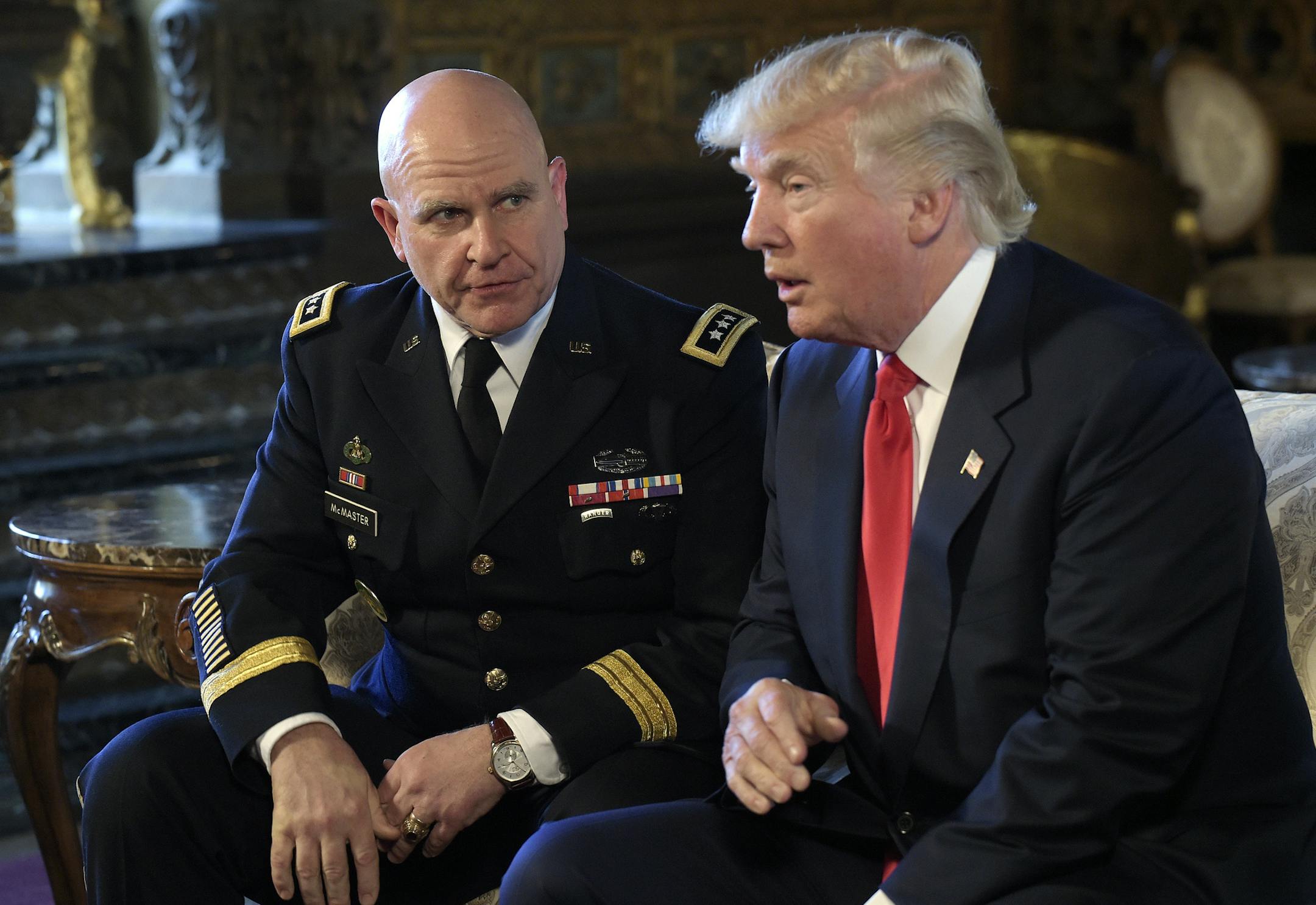
For those looking for good news on the foreign-policy front under President Trump, his selection of Lt. Gen. H.R. McMaster as national security adviser should be very welcome.
McMaster couldn't be more different from his deposed predecessor, Michael Flynn, in personality and in his likely approach to this key position. Where Flynn was hot-tempered, narrowly focused and prone to conspiracy theories, McMaster is a strategic thinker with a broad grasp of global issues who is comfortable with complexity, consults widely and listens intently.
"You cannot be anything but moved by his extraordinary grasp of the security issues facing the United States," says Alan Luxenberg, president of the Foreign Policy Research Institute in Philadelphia, where McMaster spoke Friday. "What really impresses you is his sense of humility and willingness to listen to other people."
Those qualities — strategic thinking, steadiness, a grasp of complexity and integrity — are critical for someone whose job is to create a coherent foreign policy process for this president. They are especially vital given the current state of disarray and uncertainty at the National Security Council, where any deliberations may be undercut by presidential tweets.
So McMaster will have his work cut out for him. No one is certain about the role that will be played by Steve Bannon, the former Breitbart News chairman who is the president's chief political strategist but was given a permanent seat on the council, a sharp break with tradition. The risk that the process will be politicized is there.
Nor is it yet clear whether McMaster will be able to choose his own deputy and staff without interference from White house operatives — an issue that reportedly discouraged Trump's first choice to replace Flynn, retired Vice Adm. Robert Harward, from taking the job. One good sign was the fact that when announcing his choice of the general, Trump made no mention of K.T. McFarland, Flynn's chosen deputy, who still holds the position. She should go, too.
But here's another quality that may stand the new White House adviser in good stead: His impressive history of challenging superiors on strategies that he felt did a disservice to the military or the country he served.
McMaster first made a name for himself in 1997 when he turned his doctoral thesis from the University of North Carolina into the widely praised book "Dereliction of Duty." The book harshly criticized high-ranking officers of the mid-1960s for failing to challenge Secretary of Defense Robert McNamara and President Lyndon B. Johnson on their Vietnam strategy, even though they knew the strategy wasn't working.


