

Opinion editor’s note: Strib Voices publishes a mix of guest commentaries online and in print each day. To contribute, click here.
•••
President Donald Trump has accused the South African government of genocide against white farmers. So convinced of the aggrieved status of white South Africans, the Trump administration has made them a priority category of refugees eligible for entry into the United States. Recently released documents from the State Department show that Trump has largely suspended the refugee program for most countries around the world — except white South Africans. Minnesota welcomed one white family from South Africa. There will undoubtedly be more.
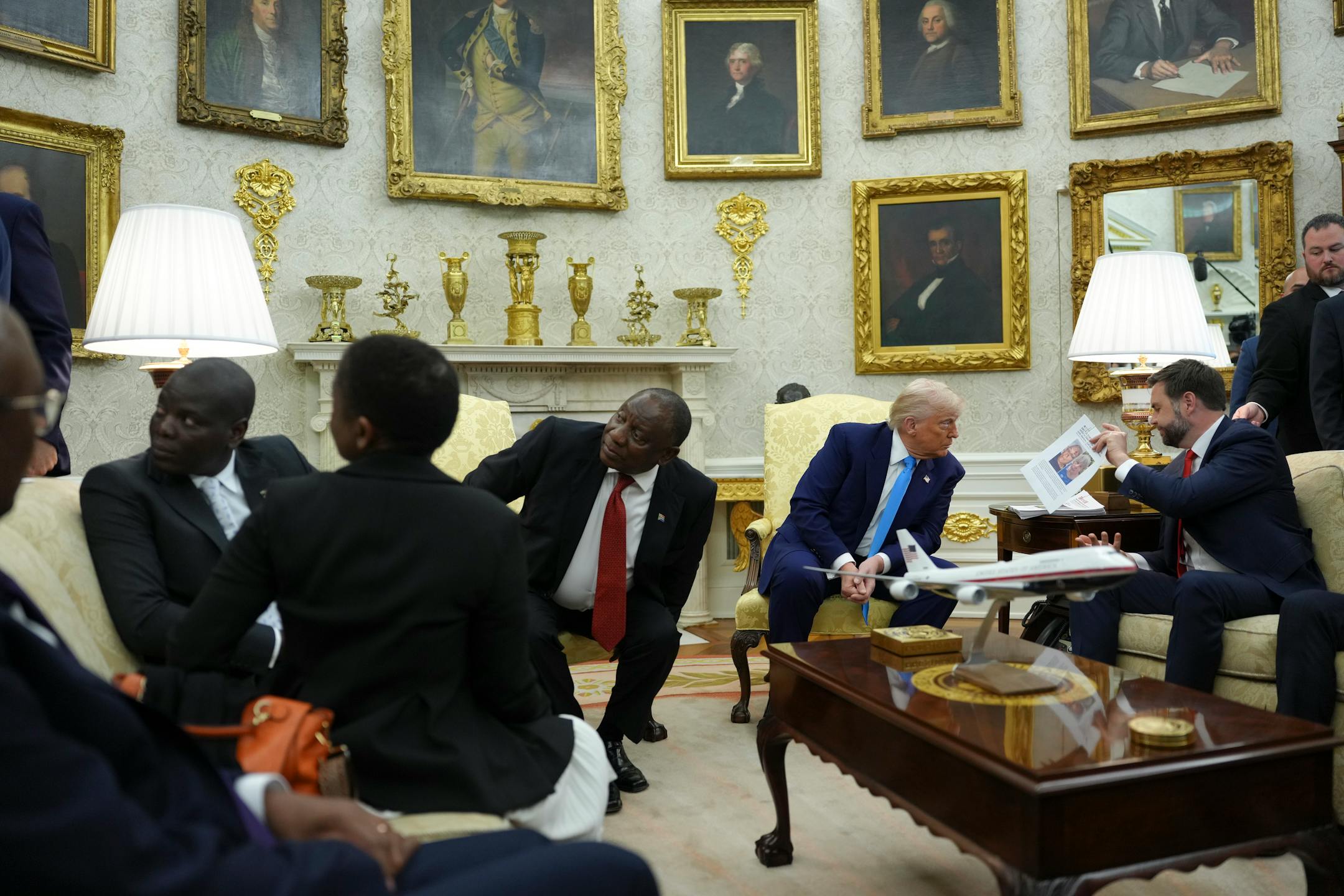
When South African President Cyril Ramaphosa visited the Oval Office recently, Trump showed him a film that purportedly showed the government murdering white farmers. Anticipating this accusation, Ramaphosa was accompanied by a white South African billionaire who is a friend of Trump’s and two white professional golfers. All were there to counter Trump’s claims. Despite Ramaphosa’s diplomatic initiative, the Trump administration remains unconvinced.
Writing from South Africa, I find little support — among either Black or white people — for any occurrence of white genocide. In fact, most of the violent expropriation of land in South Africa was done by white people who seized land from Black and “coloured” people during the brutal apartheid regime that lasted for much of the 20th century. Passed in 1950, the Group Areas Act forcibly removed millions of nonwhite South Africans from their homes to areas the government deemed to be “whites-only.” Savagely implementing the act in 1959, the South African government forcibly removed 65,000 Black people from Sophiatown, a thriving multiracial community, and moved them to a Blacks-only neighborhood — Soweto — that was markedly poorer. The government then renamed Sophiatown as “Triomf” which means “Afrikans for Triumph.” By law, it became a whites-only suburb.
After decades of struggle, Black South Africans finally overthrew the murderous apartheid regime. Following the first democratic election of 1994, Nelson Mandela became the first Black president of South Africa. Negotiating for a new Constitution, Black leaders gained free elections and the end of apartheid segregation. While gaining political freedoms, they also respected the property rights of all South Africans — Black and white alike. Because white people owned most of the land, this meant that the Black majority gained virtually all of the political power — but hardly any economic power. The majority Black government did not seize any land — even land illegitimately seized by white people during apartheid.
Throughout history, many revolutionary governments have expropriated land owned by the government they overthrew. But South Africa has not gone down that path. As a result, white people today are about 7% of the population but own about 70% of the land. South Africa is a relatively prosperous country — but suffers from the worst inequality in the world. And unemployment is 40%.
Land redistribution in South Africa has occurred under a policy known as “willing buyer, willing seller.” That is, if a white land owner wants to sell, the South African government can buy the land and redistribute it to Black citizens who have no land. A small amount of land has been transferred in this way. South Africa also retains the power to expropriate land without compensation, but it has not taken that step. The government passed a law recently that reiterated that power. However, most observers expect limited use of the power and only on land that is unused or dormant.


