
Trump, Hunter Biden have flimsy defenses in common

One was president and one was drunk or stoned, but those aren't shields for bad behavior.

December 19, 2023 at 11:45PM
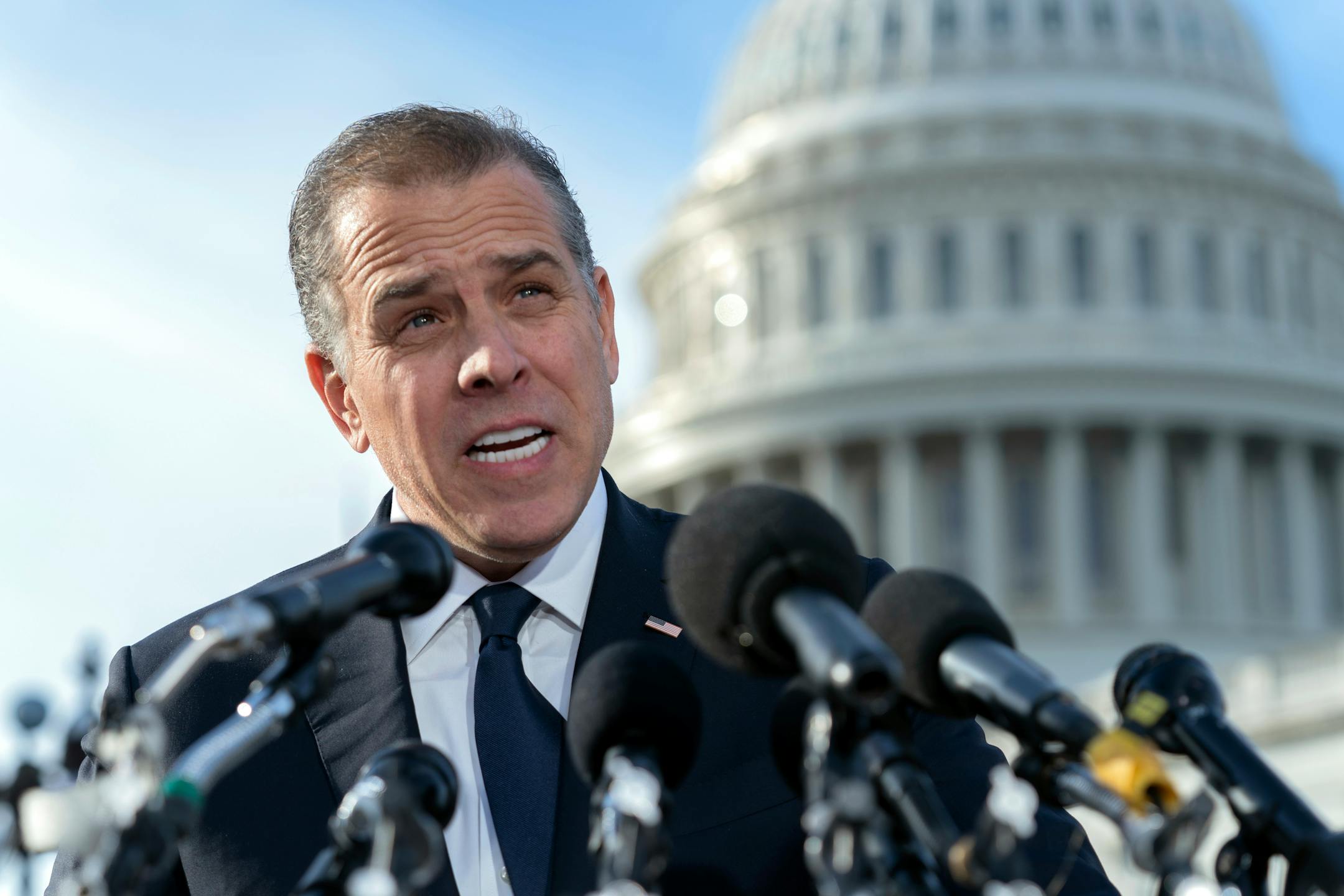
Hunter Biden, son of U.S. President Joe Biden, talks to reporters at the U.S. Capitol, in Washington, Wednesday, Dec. 13, 2023. (Jose Luis Magana, Associated Press/The Minnesota Star Tribune)

Opinion editor's note: Star Tribune Opinion publishes a mix of national and local commentaries online and in print each day. To contribute, click here.

•••

Former President Donald Trump and Hunter Biden, son of President Joe Biden, have little in common, but their criminal cases share certain features. Both have retained high-priced defense attorneys praised for their acumen and prowess.

Trump's squadron of lawyers, including those for his election interference case in the nation's capital, have reportedly been paid more than $1 million each, some quite a lot more. The lawyer for the younger Biden in the newly filed income tax evasion charges and his other prior tax and gun possession case, Washington, D.C., power player Abbe Lowell, is not working pro bono, either.

Both legal teams have another commonality: They are asserting what seem to be wholly untenable defenses.

Trump's claim of immunity is grounded on the dubious assertion that he cannot be prosecuted for any conduct he undertook while in office. It eerily tracks the remark by disgraced President Richard Nixon, rebuffing objections to his unlawful conduct with the explanation that "when the president does it, that means it's not illegal."

Trump's costly defense rests on the Nixonian proposition that he has "absolute" immunity from legal prosecution because he was carrying out his constitutional duties when he tried to subvert the result of the 2020 election and unleashed his mob of Jan. 6 insurrectionists on the nation's Capitol.

The courts in Nixon-related litigation recognized the concept of presidential immunity, but it's limited to conduct within the "outer perimeters" of presidential activities in order to avoid creating "distraction" from a sitting president's official duties. But in Jones v. Clinton, the Supreme Court in 1997 rejected an immunity defense asserted by President Bill Clinton in an unsuccessful attempt to derail a civil lawsuit by a woman who alleged pre-presidential sexual harassment and retaliation while Clinton was governor of Arkansas. The court held that such immunity does not extend to "unofficial conduct."

In short, if a president were to assault someone visiting the Oval Office for a briefing or while at a state dinner for a foreign dignitary, the immunity defense would probably apply. But it wouldn't protect a president who, say, carelessly struck someone with an errant golf ball.

Further, the presidential immunity doctrine has only been applied in civil litigation, not in any criminal case. That makes this one what lawyers and judges call "a case of first impression."

Last week special prosecutor Jack Smith made a preemptive strike, asking the Supreme Court to decide before trial whether the immunity claim has merit. In a rarity, the justices seem inclined to do so, requesting expedited briefing this week on the issue, prompting the D.C. trial judge, Tanya Chutkan, to postpone the trial that had been scheduled for the first week in March.

While the case simmers, perplexed onlookers fear that acceptance of Trump's Nixonian argument by the high court would deal a stunning blow to Smith's prosecution and expand the Constitution to countenance criminality. It's an extension of what candidate Trump famously boasted during the 2016 campaign: that he "could shoot someone" on Fifth Avenue without recourse.

Taken to its logical end, Trump need not have provoked a riot; he could simply have shot Joe Biden.

It remains to be seen if — and when — the high court will exercise its discretion to intervene, and how it will decide the matter if, as seems likely, it chooses to do so. The justices will not be making a decision whether to hear the case until at least the first week off January, at which time four of the nine members of the tribunal would need to agree to hear it sometime in the first part of 2024, resulting in further delay of the proceedings.

Meanwhile, the ex-president may have a more meritorious defense to other charges he's facing in the nation's capital (apart from the three other criminal cases pending against him elsewhere).

Another charge in the D.C. case against the former president is for conduct that seeks to "corruptly obstruct" an official proceeding, a charge that yielded convictions of a number of Jan. 6 rioters. The Supreme Court will soon be hearing an appeal by some of them, questioning whether that proscription applies to their conduct in trying to prevent the ceremonial tally and announcement by the vice president of the electoral vote count for president.

Many observers feel that the justices, who tend to construe criminal laws narrowly, will deem the law passed to combat corporate corruption spurred by the Enron scandal two decades ago inapplicable to the Jan. 6 rioters. If so, it may not cover the former president's conduct, either.

Thus, there's a reasonable possibility that none or only some of the Jan. 6-related charges against Trump might still be standing after the high court finishes with them.

Meanwhile, the high-powered defense attorney for Hunter Biden has trotted out his shopworn explanation that his client should not be prosecuted for three years of nonpayment of income taxes and one year of false filing because he was in a prolonged state of intoxication. He was too drunk, or stoned, to pay his taxes.

It takes almost as much chutzpah as raising drunkenness as a defense to a driving while intoxicated charge.

It's a form of exculpation that has been uniformly rejected in numerous cases, and this may be the first time a lawyer has used drunkenness as a defense to tax charges.

Neither the presidential immunity nor drunkenness defenses raised by these high-profile defendants and their high-priced lawyers is likely to prevail. But both provide fodder for faithful followers.

Marshall H. Tanick is a Twin Cities constitutional law attorney.

about the writer

about the writer

Marshall H. Tanick

More from Commentaries

See More
card image
Evgeniy Maloletka/The Associated Press

Yes, it has resources and strategic value. But it isn’t simply up for grabs.

card image
card image