

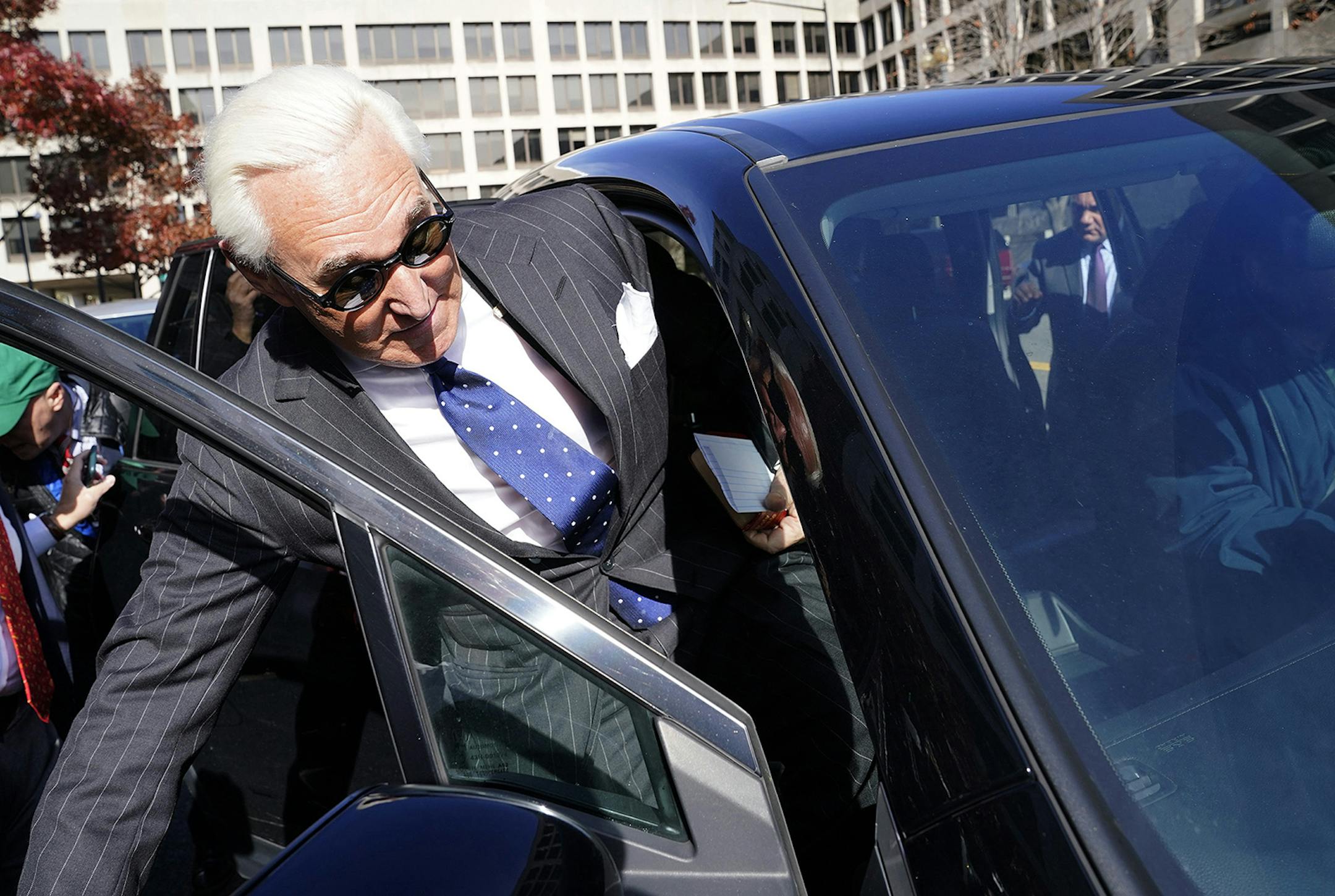
President Donald Trump tweeted last week that he has the "legal right" to tell Attorney General William Barr how to handle Roger Stone's prosecution — bringing the fury of the legal establishment down on him. Federal prosecutors had recommended a seven-to-nine-year sentence for Stone, who was convicted of perjury and witness tampering. Trump tweeted that the recommendation was "horrible and very unfair." Subsequently, the Justice Department dropped the recommendation.
More than 2,000 former Justice Department employees promptly declared in an open letter that they "condemn" Trump and Barr's "interference in the fair administration of justice." Donald Ayer, who served as deputy attorney general under President George H.W. Bush, wrote in the Atlantic magazine of Barr's complicity in the sentencing shift: "Given our national faith and trust in a rule of law no one can subvert, it is not too strong to say that Bill Barr is un-American."
Un-American? Absolutely not. Unconstitutional? Not even close. Unwise? Yes. As a policy matter, the president should stay out of sentencing decisions, especially those involving his friends. But the president is correct that he has the legal authority to intervene in the case. The Constitution does not create a wall of separation between the president and the Justice Department. To the contrary, the Constitution vests the "executive power" in the president. And the decision whether and how to prosecute someone ultimately belongs to the president.
Article II of the Constitution establishes a single president, and all of the executive powers belong to that elected official. As a practical matter, the president delegates some of those powers to the Justice Department — specifically, prosecutorial discretion for criminal matters. But if the president chooses to intervene, the attorney general has two options — comply or resign. So far as we know, Trump has not formally intervened in the Stone case. (The president's tweets were not an order, and Barr says he did not take them as such.) And to date, Barr has maintained his autonomy. Indeed, Barr pushed back against Trump in an interview with ABC News. The tweets, Barr said, were "disruptive" and "undercut" his authority. That was a good statement. Presidents should not micromanage criminal prosecutions. Doing so creates the appearance that the president wields the official powers to serve his personal whims. But there is nothing constitutionally improper about such an intervention.
During her brief tenure as acting attorney general under Trump, Sally Yates — a holdover from the Obama administration — tried to maintain the kind of rigid separation between the Justice Department and the White House that Trump's critics endorse today. She refused to defend the president's travel ban and also refused to resign. Trump was right to swiftly remove her, after a mere 10 days of service. In 2017, she explained her theories about the limits of executive-branch power, in USA Today. "The rule of law," she wrote, "requires a strict separation between the Justice Department and the White House on criminal cases and investigations." Versions of that argument, which get bandied about all too frequently, distort public understanding of the executive branch's structure.
A cursory glance at political history shows there has never been a strict separation between the Justice Department and the White House: Political appointees routinely alter the agency's criminal agenda on a quadrennial basis. In 2009, to give just one example, the Obama administration deprioritized certain types of marijuana prosecutions. In 2018, the Trump administration reversed that policy. The Obama administration also instructed line prosecutors to avoid seeking mandatory minimum sentences for certain drug offenses. The Trump administration reversed that policy, as well. This ebb and flow happens with every shift of administration.
But there is a more focused criticism that deserves attention. Those 2,000-plus former Justice Department employees wrote that "it is wrong for the President to interfere in specific enforcement matters, either to punish his opponents or to help his friends." In other words, they grant that it is permissible for the executive branch to set broad policies but impermissible for the White House to intervene in specific cases — particularly prosecutions of the president's allies (or foes).
At least since Watergate, a norm has developed in which the president stays out of individual prosecutorial decisions. A bipartisan consensus had emerged that President Richard Nixon improperly politicized the department for his personal ends. I hedge slightly, because it's impossible to be sure this norm has been strictly adhered to. If such interventions occurred, they would not be made public.


