

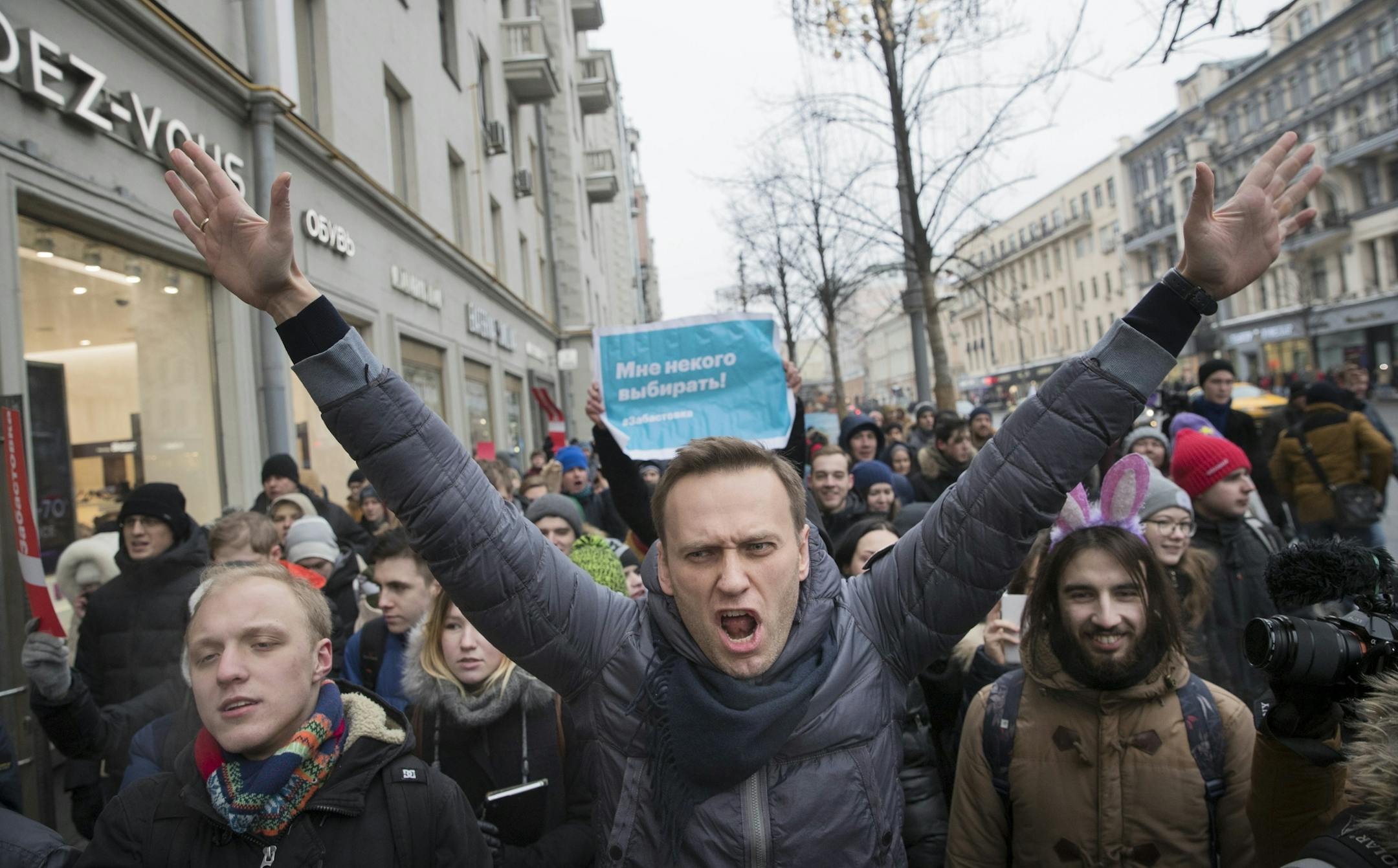
Alexei Navalny, the opposition leader whom the Russian secret police nearly killed with military-grade poison last year, is worried about Twitter's decision to shut down Donald Trump's account.
Navalny is no Trump fan. The reason he is worried is that the way U.S. tech has ganged up on Trump and his most radical supporters can lead to Navalny's own deplatforming in Russia, where he has no access to state-controlled media and relies on mostly U.S.-based social networks — YouTube, Facebook, Twitter — to spread his message. It's a valid concern.
Navalny laid out his logic in an English-language Twitter thread. "In my opinion, the decision to ban Trump was based on emotions and personal political preferences," he wrote. "Don't tell me he was banned for violating Twitter rules. I get death threats here every day for many years, and Twitter doesn't ban anyone (not that I ask for it)."
He added: "Of course, Twitter is a private company, but we have seen many examples in Russia and China of such private companies becoming the state's best friends and enablers when it comes to censorship." And, "This precedent will be exploited by the enemies of freedom of speech around the world. In Russia as well. Every time when they need to silence someone, they will say: 'this is just common practice, even Trump got blocked on Twitter'."
I can't say I was surprised to see American commentators jump in with condescending retorts telling Navalny that he doesn't get it, doesn't understand the importance of cracking down on insurrection or the right of private companies to police their platforms.
The thing is, Navalny nearly died defending Russians' right to protest and, as a corruption fighter, he's spent more than a decade delving into the shadowy relationships between private companies and the state. If he hasn't earned the right to be heard as an expert on such matters, I don't know who has.
The private company argument simply doesn't fly. Twitter and Facebook have tolerated Trump and his fans in all their glory — calls for journalists to be murdered, racist bile, direct threats — throughout the Trump presidency. Even if they said they didn't, the stuff was impossible to miss as a user of the social platforms. Apple, Google and Amazon allowed the censorship-free platform Parler, frequented by the far right, to grow using their services until two things happened: last week's Capitol riot — and the Georgia Senate elections that handed the Democrats full political control of the U.S.
I don't know which of the two was the actual deciding factor in the tech giants' Trump crackdown. But look at it from the point of view of someone fighting an authoritarian regime in Russia, Turkey, Belarus or elsewhere. What you'll see is the U.S. president-elect declaring protesters who broke into a government building "domestic terrorists" — and an immediate response from the tech companies, which fall all over themselves trying to prove they aren't providing "terrorists" with a platform.


