

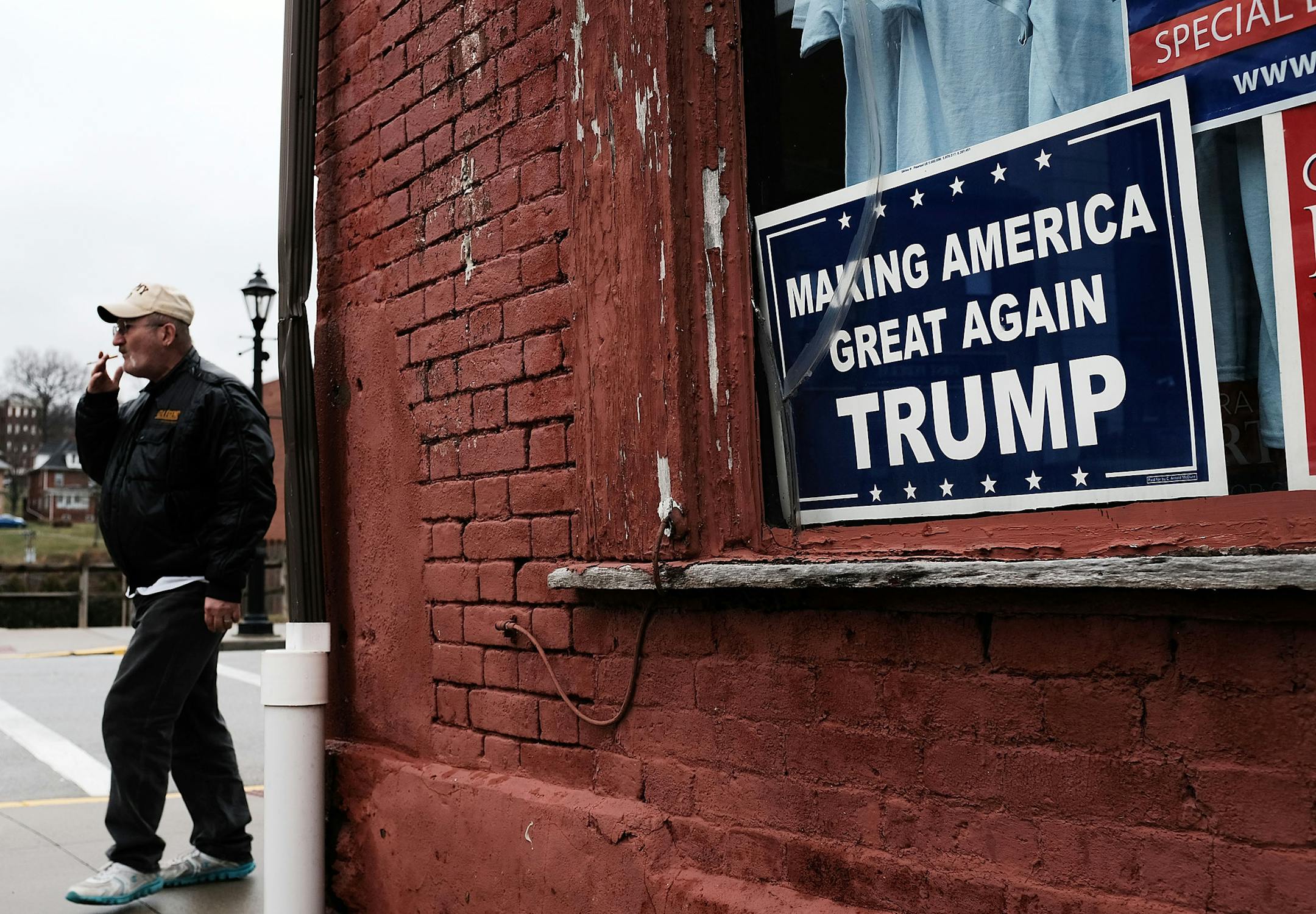
Remember when President Donald Trump promised to revive the coal industry? When he vowed to "put our miners back to work" during his 2016 campaign trips to coal country? When he said he would end "the war on coal?" A half-dozen times after becoming president, Trump signed bills and executive orders that were supposed to save the industry, always with coal miners standing behind him, applauding his promise to bring coal back.
It hasn't exactly worked out that way. According to a recent article in the New York Times, 145 coal-burning units at 75 power plants have been idled during Trump's time in office ("the fastest decline in coal-fuel capacity in any single presidential term"). Power generated from coal has dropped from 31% to 20%. Coal production is down 34% ("the largest four-year drop in production since at least 1932"). And some 5,000 coal miners — nearly 10% of the workforce — have lost their jobs while Trump has been president. Not only has Trump not brought back the coal industry, he hasn't even been able to slow its decline.
Remember when Trump said he was going to revive the steel industry? "Steel, we're bringing back," he told supporters in Pittsburgh during his first presidential campaign. In 2018, he imposed 25% tariffs on steel imports from China, Europe, Canada and Mexico, arguing that making imported steel more expensive would cause domestically produced steel to become more competitive.
Guess how that turned out? In an initial burst of enthusiasm, U.S. steel companies cranked up production and hired workers — only to lay many of them off when it turned out there simply wasn't enough demand to buy the increased U.S. production. By 2020, U.S. Steel Corp. was laying off thousands of workers and idling some of its blast furnaces. Its stock price dropped by two-thirds from its 2018 peak. Meanwhile, companies that relied on steel had to raise prices on consumers. Many of them also laid off workers.
How about manufacturing jobs? Remember when Trump said he was going to stop companies from shifting production abroad and even bring manufacturing jobs back to the U.S.? Early on, Trump claimed to have cut a deal to keep a Carrier Corp. plant operating in the U.S. instead of moving to Mexico. But just eight months later, Carrier revealed that it was eliminating 338 jobs at the factory — and moving the positions to Mexico. Trump said he would punish companies that moved jobs offshore, but executives quickly realized he was never going to follow through on that threat.
"Under Trump, U.S. jobs are moving overseas even faster than before," business website Quartz wrote in 2017. Two years later, the Guardian noted that since Trump became president, "nearly 200,000 jobs have moved overseas." And just a few months ago, the Economic Policy Institute reported that between 2016 and 2018 — the most recent year for which data is available — "nearly 1,800 factories have disappeared" from the U.S. manufacturing base.
Let's not forget China. Remember how Trump promised to shrink the trade deficit with China? China was one of the countries that was "stealing our businesses, stealing our jobs, stealing our money," he said at one campaign rally. "We can't continue to allow China to rape our country," he said at another rally. "We will end our chronic trade deficits."
To this end, he badgered the Chinese, negotiated with them, played nice (sometimes) and rough (sometimes). He imposed tariffs. He announced that big trade agreements were right around the corner. The outcome? In 2016, the U.S. trade deficit with China was $346.8 billion, according to Census Bureau data. Last year, the trade deficit was — are you ready for this? — $345.2 billion. All that Trumpian hullabaloo shaved a negligible $1.6 billion from the trade deficit with China.


