
Burcum: There was more public input on my farmhouse project than the White House demolition

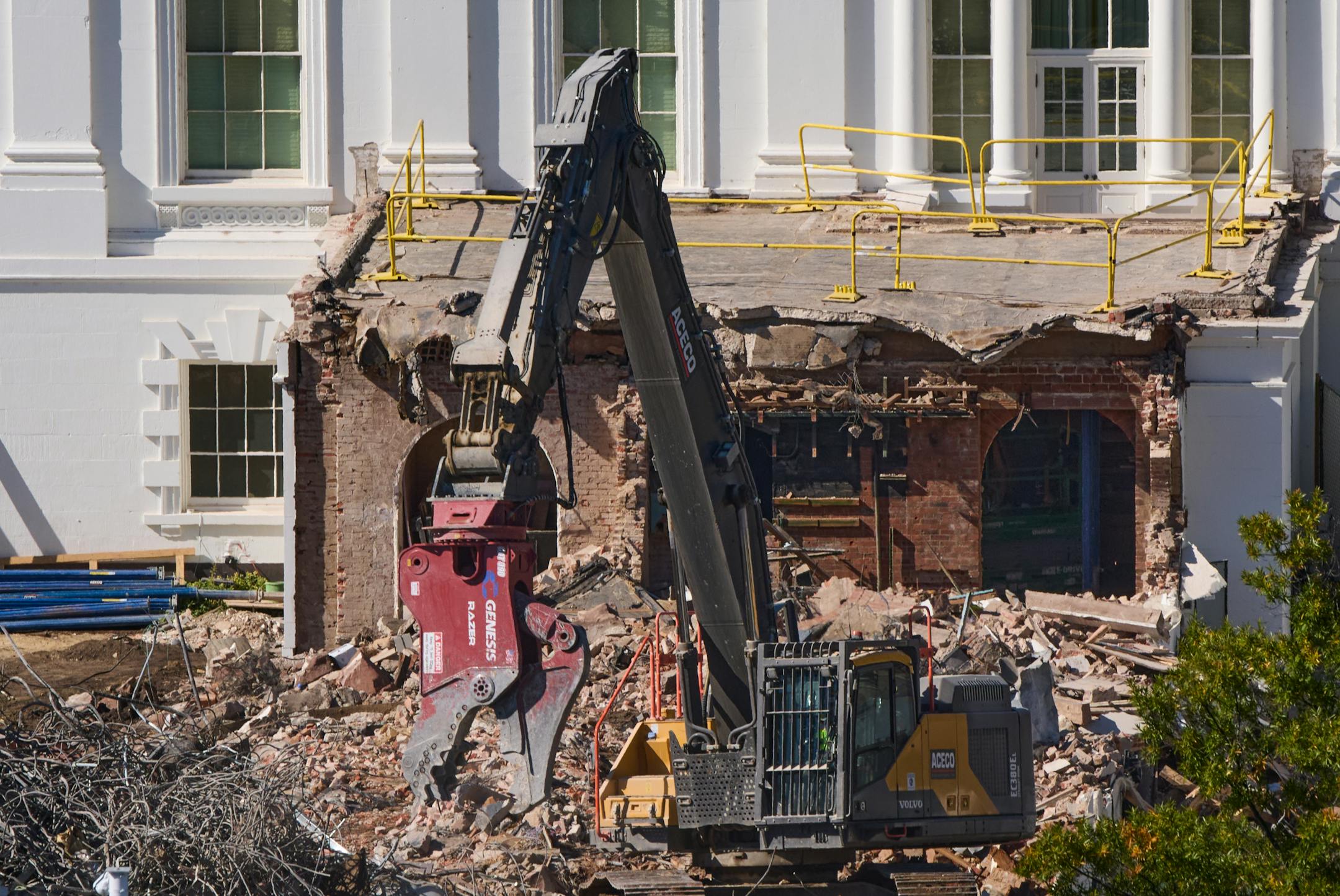
It’s hard to think of a project that would require more care. Yet we’re watching the East Wing become rubble with little public discussion.

Columnist Icon
The Minnesota Star Tribune
October 23, 2025 at 8:29PM
Work continues on a largely demolished part of the East Wing of the White House Thursday before construction of a new ballroom. (Jacquelyn Martin/The Associated Press)

Opinion editor’s note: Strib Voices publishes a mix of commentary online and in print each day. To contribute, click here.

•••

When we moved from suburban Andover to a southeast Minnesota farm three years ago, I worried about how we’d meet our new, more distant neighbors in the country.

Turns out they came to us. Down the long gravel lane they drove in pickups and ATVs to say hello, check us out and sometimes, ask about hunting in our woods. One neighbor, however, had something far more serious on his mind.

He worried that we’d tear down the classic four-square farmhouse and take a bulldozer to the historic silo and other outbuildings. We reassured him that we intended to restore, not destroy the farm’s rustic charm.

I’ve been replaying that conversation in my head recently as demolition began on the White House’s East Wing to make way for a $300 million ballroom. Our neighbor’s concerns that day drove home an important point.

The farmstead, owned by one family ’til we bought it, has lent a stately grace to this neighborhood for 99 years. It was here before us, and God willing, it’ll be here long after we’re gone. That makes us more stewards than owners, a reality requiring responsibilities and restraint in making the updates necessary for our house’s next century.

As someone who sweated over every change, I’ve watched photos of the White House’s massive construction project with dismay, bewilderment and yet, somehow, a few flickers of hope.

It’s hard to think of another renovation that would require more care, debate and review than this one. Yet here we are watching a backhoe turn the East Wing into rubble with little public discussion or clarity about who signed off on this and when.

This is happening despite assurances in July from President Donald Trump that the new ballroom “won’t interfere with the current building … it’ll be near it but not touching it and pays total respect to the existing building.”

We’re well past not touching it, a situation that’s incomprehensible. We had to make presentations to our township’s planning commission and then the full board of supervisors to get approval for the farmhouse’s addition and garage. We also had to get a county permit.

The White House project has turned into a full teardown of the East Wing, with plans to add a 90,000-square-foot ballroom to a structure that is currently 55,000 square feet. Renderings regrettably suggest that when it’s done, it’ll look like someone stuck a Target store onto this historic house.

It’s difficult at best to discern if there was even a modest review and permitting process like our farmhouse project went through. Where was Congress? What about historic preservation requirements that can add months, even years and a lot of expense for those brave enough to update iconic properties anywhere else in the United States?

It sure feels like we had more public hurdles to clear in rural Goodhue County than this massive addition to a property that is a potent symbol of our nation.

It’s also one that Trump does not own. Yes, it is the presidential residence. But like all occupants, the current officeholder is a guest due to constitutional limits on how long a president can serve.

With that reality comes stewardship obligations. So far, the lack of transparency and the photos of the speedy demolition suggest a president who somehow doesn’t understand that.

The hulking, disproportionate ballroom is especially heartbreaking as someone who took our preservation obligations seriously. We spent months reviewing architectural plans to ensure that expanded footprint did not detract from our house. Instead, the new space is tucked behind it. From the road, our home still looks like it did for decades.

The actual renovation itself took eight months. Like any project, there were unexpected issues to contend with and plans that had to change for structural or other reasons. With each, we tried to honor the house’s history. For example, I couldn’t afford replicas of the original door handles, but I found something in my price range that came darn close.

We would have done all this without prompting from the neighbor. But that conversation made it clear that we had broader obligations.

I wish Trump understood this. The White House renovation has 342.7 million stakeholders, the current U.S. population according to Census.gov. We all should have been consulted before the backhoe arrived.

Maybe the White House did need a ballroom. Times change, and so do the occupants’ needs. But a project like this requires careful consideration, especially when it involves tearing down an entire wing. For someone who bristled about being called a king during the recent “No Kings” protests, springing this on the public underscores protesters’ argument.

To be sure, there are the “what about” responses from Trump fans that former President Barack Obama added a basketball court and President Harry Truman gutted the White House while in office.

These are ludicrous false equivalencies. A basketball court is not a 90,000-square-foot expansion of the residence’s footprint.

As for the Truman renovations, those were necessary after “engineers confirmed that the White House was structurally weak and in danger of collapse,” according to the White House Historical Association.

Among other issues, the leg of a piano played by Truman’s daughter pierced the weak floor of her room. The house was also considered a firetrap. Truman himself worried that the floor beneath his bathtub would give way while he was in it.

Truman also sought congressional approval. This was a necessary renovation, not a vanity project like the ballroom.

And yet, I remain hopeful.

We lucked out with the local construction crew who worked on our place. They were expert craftsmen experienced at restoring older homes like ours. They cared as much as we did and made suggestions along the way that improved on our choices. The designers at our small-town building supply store also provided superb guidance.

So my hope at this point is that those doing the actual work understand what a historic effort this is.

If the East Wing isn’t already gone, it soon will be. May the construction crews soon to arrive be expert at their craft and make helpful suggestions that are heeded.

If we’re going to do this, and it appears we are, please let there be far more care in the project’s execution than its planning.

about the writer

about the writer

Jill Burcum

Editorial Columnist

See Moreicon