

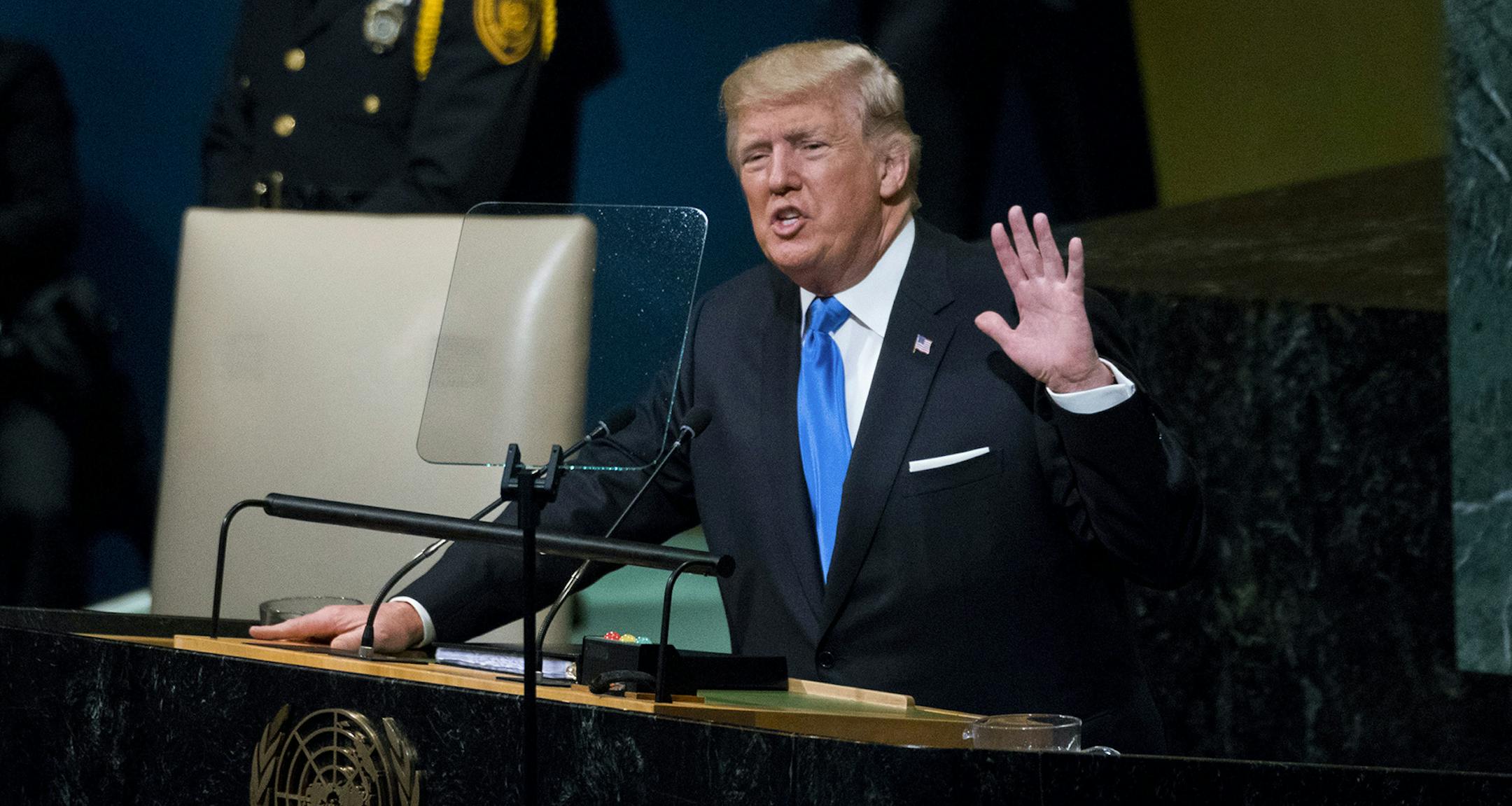
Speaking before the United Nations, President Donald Trump gave a conventional speech artfully disguised as a nationalist provocation.
Trump campaigned as someone who would put America first, a commitment he claimed foreign-policy elites of both parties had failed to make. His U.N. speech might seem to fit with that campaign promise, since he both uttered the phrase "America First" and used the words "sovereign" or "sovereignty" 21 times.
But the heavy-handed emphasis on these concepts didn't lead to any major departure in policy. Trump said America would exercise its sovereignty in concert with allies. He pledged humanitarian assistance abroad. He told the U.N. itself that it was important but that it had to be reformed and that other countries had to pay more for its upkeep.
And he threatened action against rogue regimes that pose a risk to American interests — or even American values. He didn't make the point about values explicitly, but he defended sanctions on Venezuela and possible further action wholly on the basis of its oppressiveness.
The verbiage was unusual, but the underlying message was roughly the same as what any Republican president would have delivered. (More than a little of it was the same as the one Hillary Clinton would have delivered if she had been elected.)
Another president, it's true, might not have bluntly warned North Korea that "we will have no choice but to totally destroy North Korea" if it threatens nuclear aggression. That other president may have been wise to speak with less bravado. But the threat of retaliation has always been our chief deterrent against nuclear attack, and it was our explicit policy during the Cold War.
I won't overstate the case. Another president would have drawn a different line on refugee policy, agreeing to take them in rather than just provide funding to help them be settled elsewhere. Only Trump would have denounced trade deals in an address to the U.N.
But you had to look in the speech to see any payoff to Trump's solicitude for sovereignty.


