

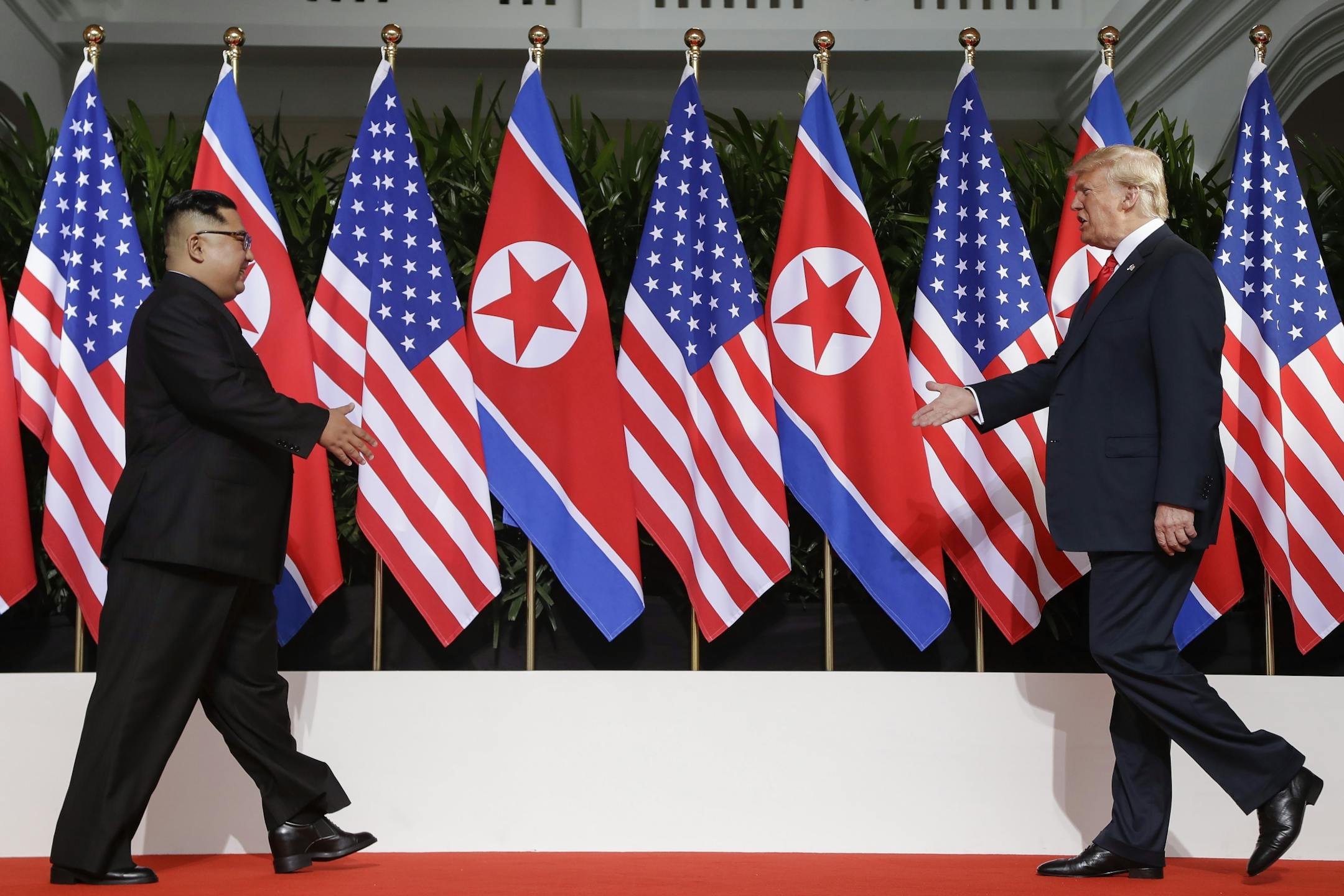
SINGAPORE — Donald Trump approached from the right, striding down the long portico at the colonial-era Singapore resort. Kim Jong Un, dressed in his familiar Mao suit, emerged from the left. They met in the middle, on a red carpet, dozens of cameras recording their every move as the world watched.
And counted.
Thirteen seconds. That's how long the American and North Korean leaders shook hands at the start of their summit Tuesday. The length of the contact, their facial expressions and body language, the stunning backdrop of interlocked national flags — all of it was instantly analyzed, criticized and marveled at in tweets and commentary in South Korea, the United States and beyond.
Kim may have best summed up the surreal quality of what was happening when he said that many of those watching will think it's a scene from a "science fiction movie."
South Koreans applauded in a train station as they watched; the South Korean president grinned broadly; one official compared the summit, favorably, to the birth of his daughter. On the flipside, critics said the welcome Trump was giving Kim in Singapore would legitimize one of the world's worst human rights offenders.
It was a single, quintessentially human moment — a greeting, a welcome, a start of a relationship — but the reaction to the handshake was as complicated as the standoff that the two countries these men represent have been locked in for seven decades now.
There was shock, relief, worry, sometimes simultaneously, as the world watched Trump and Kim — who were insulting each other's mental and physical prowess and threatening nuclear war just a few months ago — shaking hands and smiling.
Trump put his hand out first, followed by Kim as they strode toward each other. Trump grasped Kim's right arm as they shook, and then, later, took ahold of Kim's left arm as they turned to face the cameras and the world, both their expressions momentarily deadening before they turned to face each other again, and smiled.


