

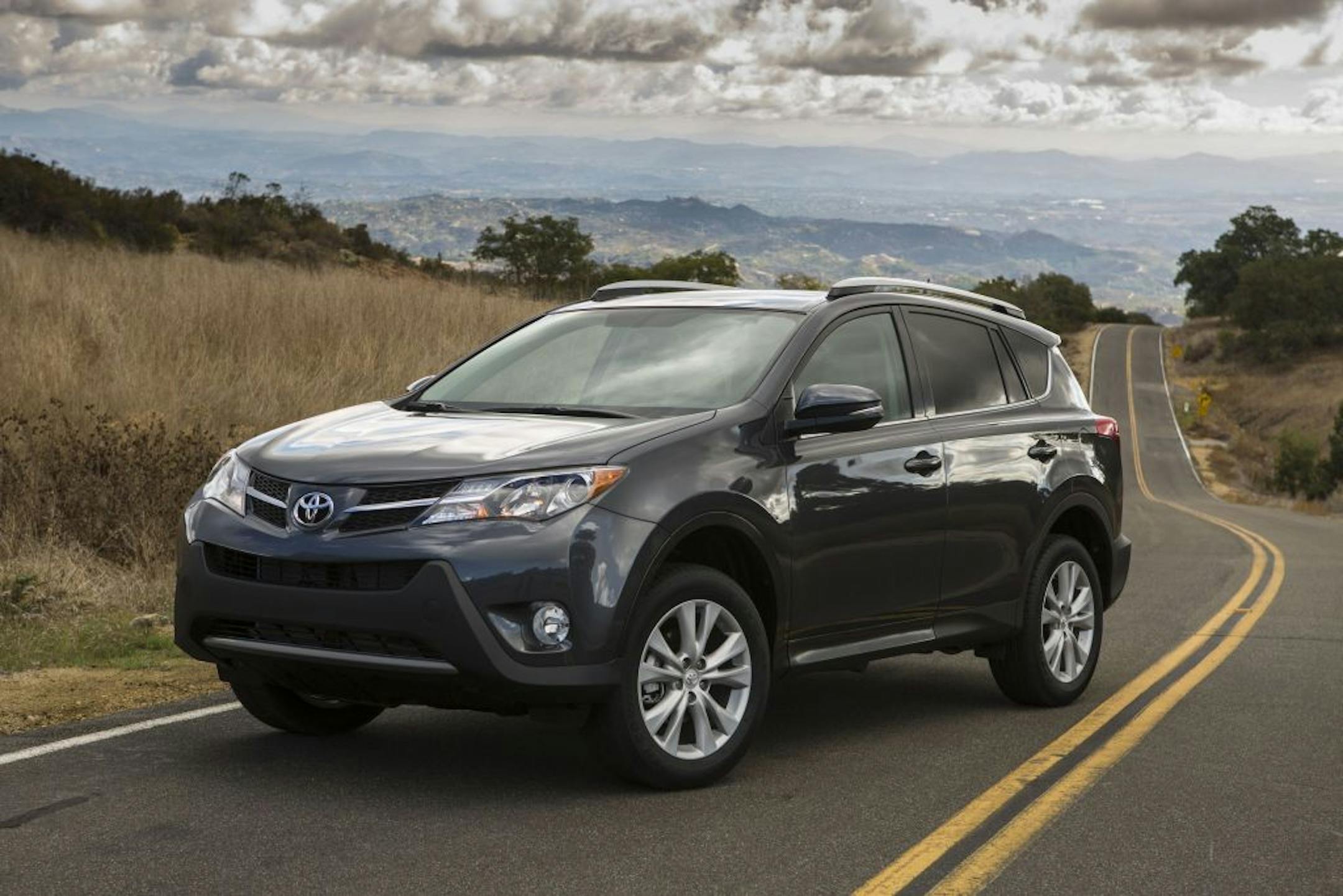
Anyone who pays attention to other vehicles instantly recognizes the Toyota RAV4 from behind. Since the compact SUV was first introduced in 1996, it's always carted its spare tire on the back door.
But as part of its 2013 makeover, Toyota's ditching the exposed tire and tucking it where it belongs: Under the cargo floor. And the side-hinged gate that swings wide and could decapitate a toddler? That's been changed too; to lift up, rather than out.
It's all part of an overhaul of one of the first crossovers -- a category that's seeing more competition in today's value-oriented marketplace, as manufacturers roll out model after new model that marry the cargo space, visibility and four-wheel capability of larger SUVs with the fuel economy and handling of smaller cars.
For its fourth-generation redo, Toyota kicks its Recreational Active Vehicle with four-wheel drive into high gear, powering it with a fuel-conscious 2.5-liter, four-cylinder engine. The V6 option has been discontinued, as has the dated four-speed automatic transmission. That's been upgraded with a long-overdue six-speed, the gearing of which has been optimized to enhance mileage at low and high speeds.
New for 2013 is a drive-mode selector that lets operators switch between an eco option (that makes the accelerator feel as if it was shot with Novocain) and sport (which doesn't quite live up to its name). Toggling between the two modes, I averaged 24.3 miles per gallon -- just shy of the 26 mpg Toyota claims for the base model front-wheel drive version I tested for a day.
Like previous generations, the RAV4 is available in front-wheel and all-wheel drive, the latter of which is equipped with Toyota's new dynamic torque control system and is probably worth the extra cost premium for those who drive aggressively or, less commonly, off-road.
Most RAV4 drivers restrict their four-wheeling to the asphalt, where it felt quiet and smooth, especially for its $23,300 starting price. To help reduce noise, the front windshield is made from acoustic glass that is also designed to absorb solar energy.
The glass is one of the more subtle improvements to the RAV4. The interior has been upscaled with faux carbon-fiber details and more standard technology across all three trims, including steering wheel controls for Bluetooth hands-free phone and audio, as well as a rear-view camera that displays on a 6.1-inch touch screen in the center stack. Buttons on either side of the screen toggle the display between audio, phone, CD and "car," which provides data such as average speed, length of time driving, the number of miles left before the fuel injectors are sucking air and real-time mpg.


