

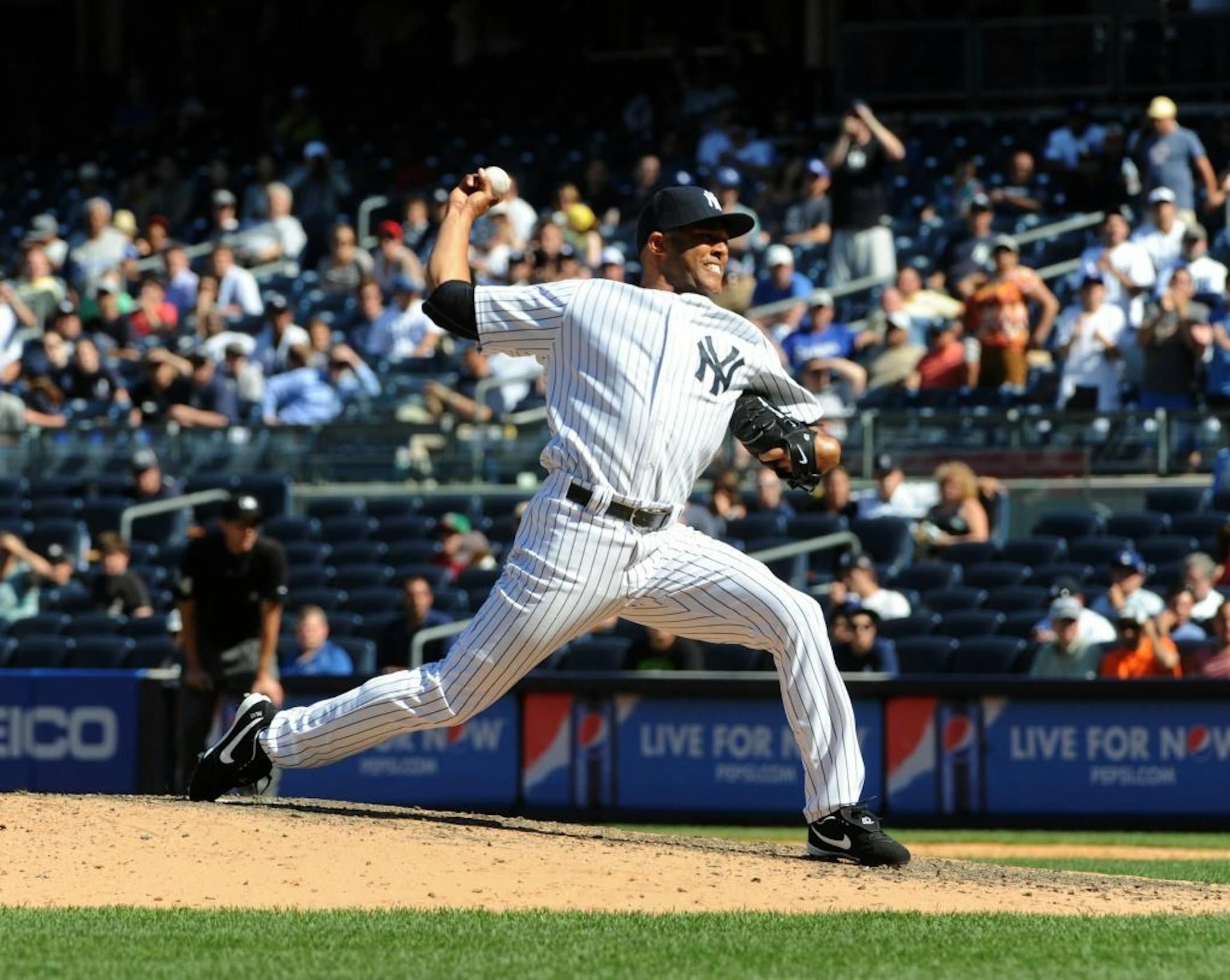
NEW YORK — It's a big year for throwing. The greatest closer in baseball history, Mariano Rivera of the Yankees, is retiring. Aroldis Chapman, the overpowering Cincinnati Reds reliever, continues to fire fastballs beyond 100 mph.
And now some scientists say they've figured out when our human ancestors first started throwing with accuracy and firepower, as only people can: Nearly 2 million years ago.
That's what researchers conclude in a study released Wednesday by the journal Nature. There's plenty of skepticism about their conclusion. But the new paper contends that this throwing ability probably helped our ancient ancestor Homo erectus hunt, allowing him to toss weapons — probably rocks and sharpened wooden spears.
The human throwing ability is unique. Not even a chimp, our closest living relative and a creature noted for strength, can throw nearly as fast as a 12-year-old Little Leaguer, says lead study author Neil Roach of George Washington University.
To find out how humans developed this ability, Roach and co-authors analyzed the throwing motions of 20 collegiate baseball players. Sometimes the players wore braces to mimic the anatomy of human ancestors, to see how anatomical changes affected throwing ability.
The human secret to throwing, the researchers propose, is that when the arm is cocked, it stores energy by stretching tendons, ligaments and muscles crossing the shoulder. It's like pulling back on a slingshot. Releasing that "elastic energy" makes the arm whip forward to make the throw.
That trick, in turn, was made possible by three anatomical changes in human evolution that affected the waist, shoulders and arms, the researchers concluded. And Homo erectus, which appeared about 2 million years ago, is the first ancient relative to combine those three changes, they said.
But others think the throwing ability must have appeared sometime later in human evolution.


