

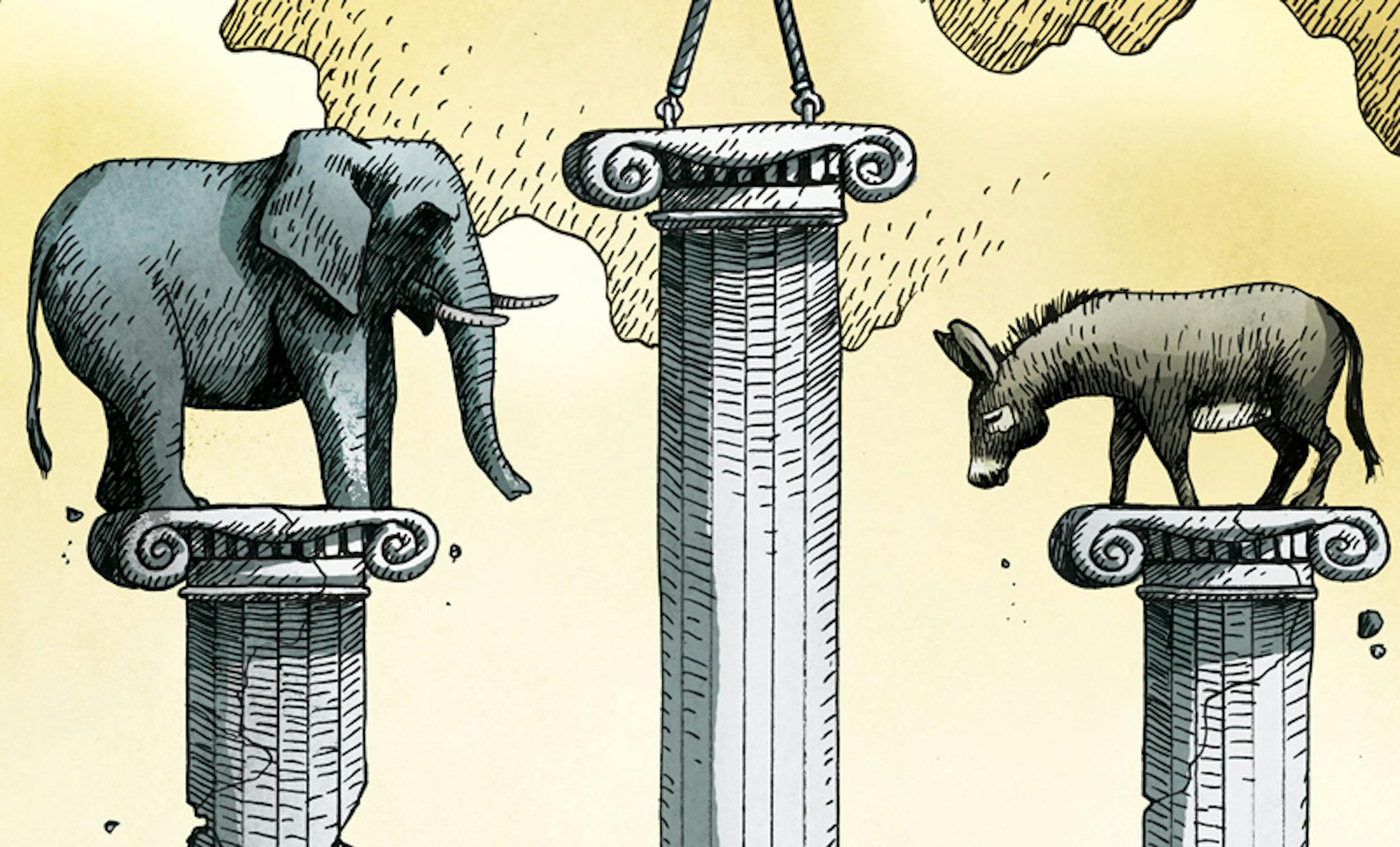
During his 26 years in the U.S. Senate, Kent Conrad rose to become a leading expert on the federal budget and demonstrated many times his willingness to cross party lines. But in his farewell remarks in December, the retiring Democrat from North Dakota scolded his colleagues for a growing partisanship that in recent years has all but paralyzed the Senate and the political system.
"We spend now too much of our time seeking partisan advantage; we spend too little time trying to solve problems," he told them.
Conrad was right, of course. His harsh words matched the sentiments of a stream of other moderates who departed the Senate last year -- or will soon depart it -- including Republicans Olympia Snowe of Maine, Richard Lugar of Indiana and Scott Brown of Massachusetts, and Democrats Ben Nelson of Nebraska, Jim Webb of Virginia and Jay Rockefeller of West Virginia.
Of the 18 senators who left last year for one reason or another, or announced their impending retirements, 12 were rated as moderates by That's My Congress, which analyzes voting records. Of their replacements, half are expected to be more ideological in their approach.
In addition to those 12, we would add Saxby Chambliss, R-Ga., who is retiring, and Lugar, who was defeated last year, because both have shown a willingness to be bipartisan problem-solvers.
The dysfunction prompted former Minnesota Gov. Tim Pawlenty, a Republican presidential candidate early in the 2012 campaign, to bemoan the divided nature of today's politics in a speech Wednesday in Washington.
"Sadly, we have become a government by crisis," Pawlenty told a conference organized by the Business Roundtable. "Things get done only when there is a moment of crisis."
The trend away from collaboration validates the blistering critique leveled last year by congressional scholars Tom Mann and Norm Ornstein in their acclaimed book "It's Even Worse than it Looks: How the American Constitutional System Collided with the New Politics of Extremism."


