
Tolkkinen: In praise of a refrigerator, still chugging after 75 years

What made the International Harvester refrigerator last so long? Was it just built better?

Columnist Icon
The Minnesota Star Tribune
November 13, 2025 at 12:00PM
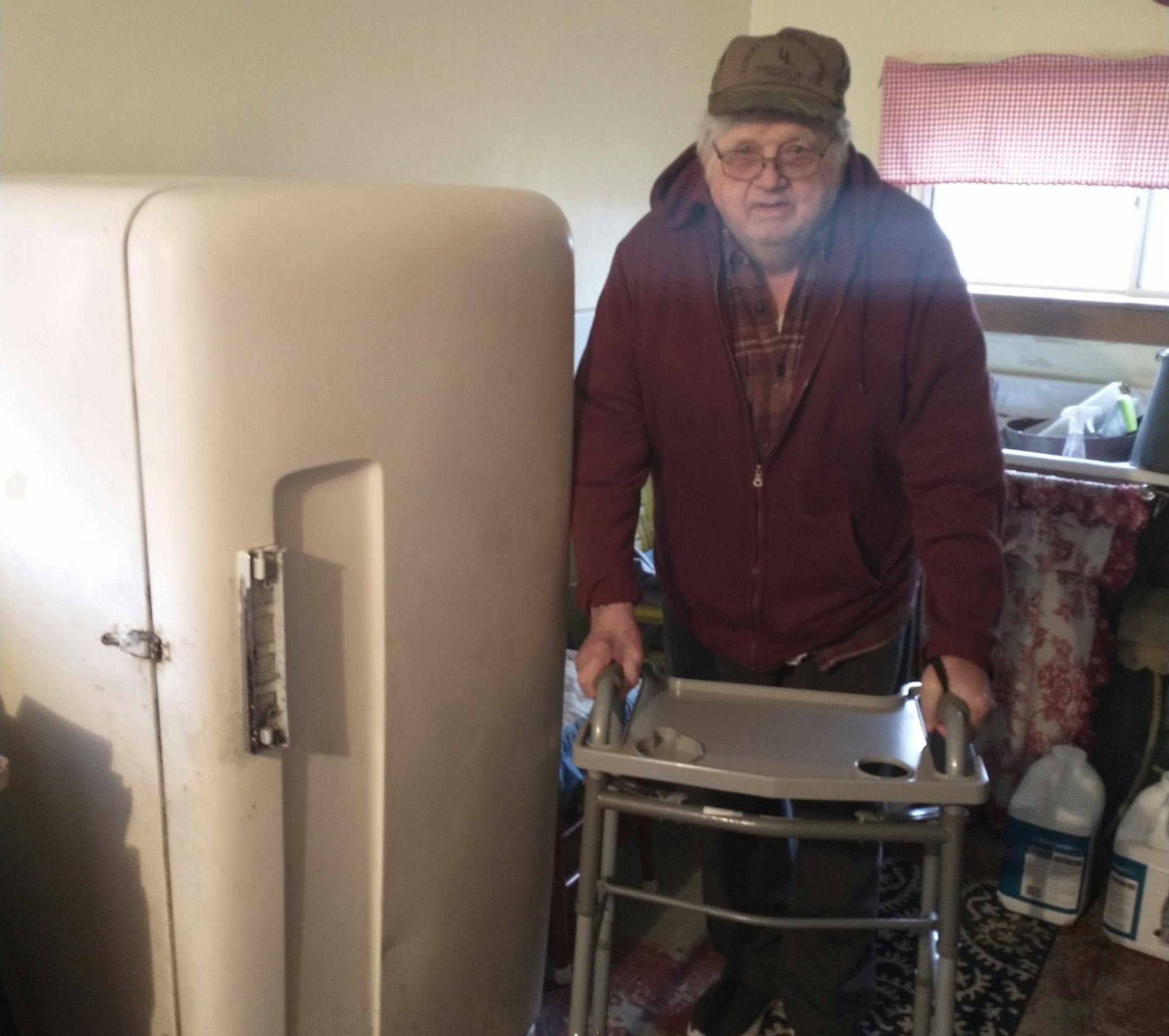
Ron Nelson, 83, of Clitherall, Minn., with the International Harvester refrigerator his family bought when he was about 9. It still works.

CLITHERALL, MINN. - I am devoting this column to a very special birthday/anniversary.

This year, turning 75, is … my in-laws’ 1950 International Harvester refrigerator, which still works, gusting out frosty air every time you open its door, just as it did the day it first arrived at my father-in-law’s home in the rolling hills of Inspiration Peak a lifetime ago.

My father-in-law, Ron Nelson, remembers that day. He was about 9 years old then. He’s almost 84 now. Their farm had just gotten electricity, and as if an overhead light wasn’t enough, his parents splurged on the refrigerator.

“That was a big thing,” he remembers. They had been storing milk and cream in the well pit, an outdoor cement-lined square that sometimes got water in the bottom. Now they could retrieve it right from inside their home. Later, they got a TV, too, which brought one channel into their home, in the age of “Gunsmoke” and “Bonanza.”

Those were heady days, heralding times of great change for rural America. On a hot summer day you could get a moment’s relief by standing in front of the open refrigerator door or drink a cold pop from its icy recesses.

International Harvester, or IH, was better known for its red tractors and agricultural equipment that revolutionized farming. But as electricity lit up more and more farms, the American manufacturer was in a good place to make and sell refrigerators to rural Americans, building on its experience producing blood plasma coolers during World War II. The venture didn’t pay off for IH, and it sold its refrigeration division to Whirlpool in the 1950s. International Harvester continued to make tractors, which have a sort of cult following among tractor buffs.

My in-laws’ refrigerator didn’t travel far once it arrived in Otter Tail County. Replaced by a newer, more spacious upstart with a frost-free freezer, it was relegated to the pumphouse, where it chilled pitchers of Kool-Aid for thirsty grandchildren. It fell into disuse and in the 1990s, my in-laws snagged it for their granary where they stored extra garden produce and pop. Now it runs in the back room behind their garage, primarily in the summer, when they need extra space for produce and beverages. Come winter, they unplug it.

Its existence is a reminder of how much can change in the span of one person’s life and how much later it was that rural areas caught up to the technology of the metro. Born days after the bombing of Pearl Harbor, my father-in-law attended a nearby one-room school and traveled there, in the winter, by horse-drawn sleigh because the roads weren’t plowed.

The modern-day equivalent is the arrival of broadband internet in rural areas. We finally got ours in 2021.

But does the fact that the International Harvester refrigerator still runs after 75 years mean that it was built better than the refrigerators of today? Nowadays, refrigerators blaze through our lives like meteors. The U.S. Department of Energy says, straight-faced, that we can expect to replace fridges every 12 years on average.

Surprisingly, it does not mean that early refrigerators were built better, says Chris Worthington, who teaches in the University of Minnesota’s College of Design.

“There’s no reliable data that show that refrigerators lasted longer 50 or 70 years ago than they do now,” he told me.

But the perception that they do lingers for three reasons, he said. One, survivorship bias, meaning that even though other refrigerators of an era have given up the ghost, as long as one of them endures, we think their longevity is true of that group. Another is that modern refrigerators might last just as long, but they have different features that break down more quickly — an ice maker might quit working so we junk the whole fridge.

The third reason? Manufacturing in the 1950s wasn’t as streamlined as it is today, so you had more variation in the longevity of products, which produced outliers like my in-laws’ fridge, Worthington said. Today, a good manufacturing process means that all of the products expire at about the same time whether it’s five years for a cheap toaster or a lifetime for a cast-iron skillet.

My in-laws’ IH refrigerator isn’t the only one still running. I found a few for sale online throughout the country. They also have a devoted following. An International Harvester Refrigeration Enthusiasts and Collectors Facebook group claims 2,100 members, many of them looking for replacement parts or buyers or sellers. If you want to dig deep, there’s also a 230-plus-page book devoted to IH refrigeration.

One thing that I haven’t mentioned is that 1950s-era refrigerators were cooled with chlorofluorocarbons, synthetic compounds that destroyed the ozone layer. Sturdy as it is, the International Harvester refrigerator will inevitably break down someday, and if not properly reclaimed, those molecules may well drift upwards into the sky.

If scientists ever discover a teeny tiny hole in the ozone layer above Otter Tail County, we’ll trace it back many, many years to the day a tractor company delivered a young farm family’s first refrigerator in the hills south of Clitherall.

about the writer

about the writer

Karen Tolkkinen

Columnist

Karen Tolkkinen is a columnist for the Minnesota Star Tribune, focused on the issues and people of greater Minnesota.

See Moreicon

More from Greater Minnesota

See More
card image
Provided by Minnesota Department of Natural Resources

Most of the large cats, also called pumas and cougars, originate from Great Plains states and wander east.