


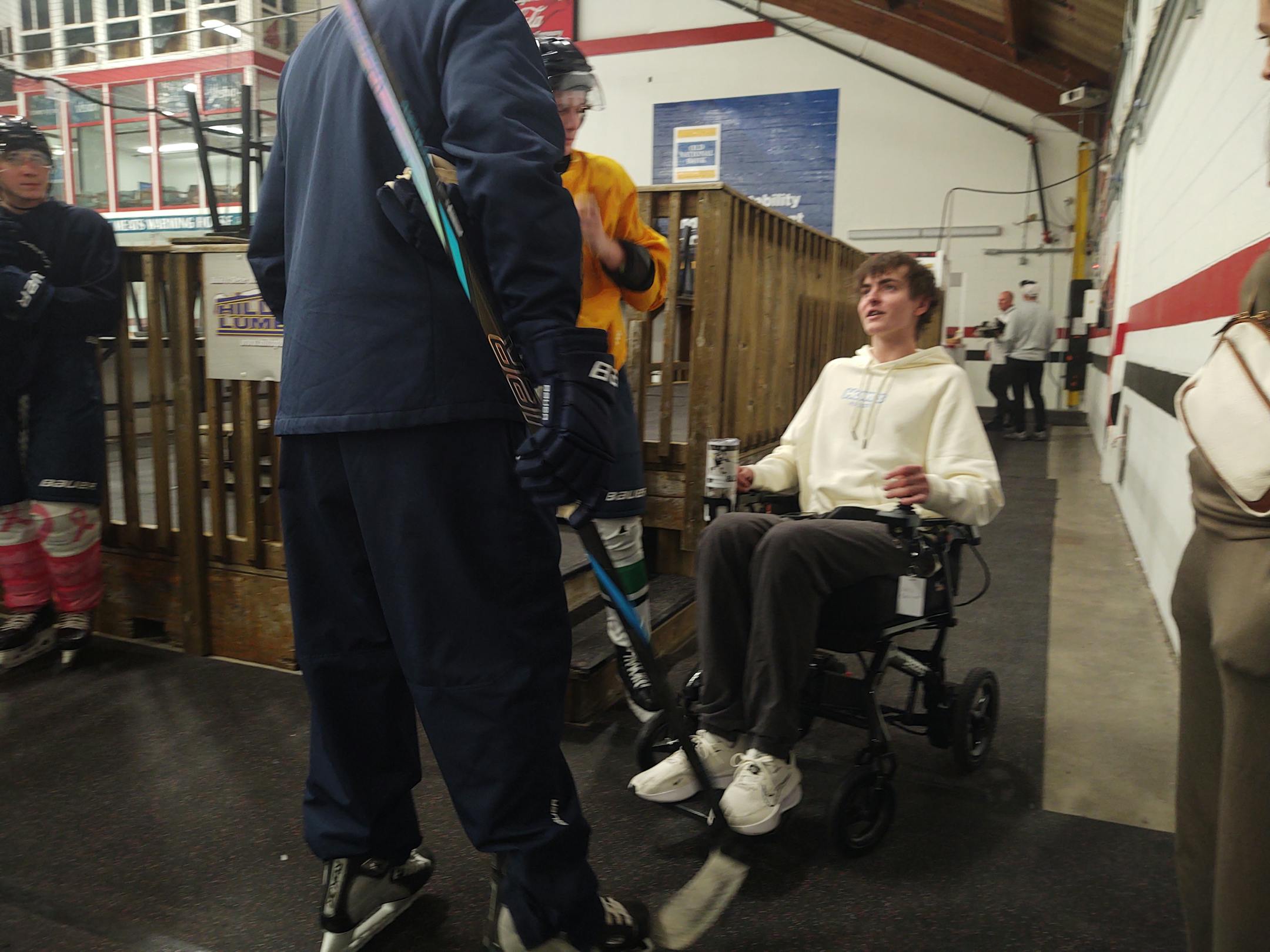
ALEXANDRIA, MINN. - Jackson Drum remembers the three doctors looming over his bed in a Canadian hospital.
They had heard that the rural Minnesota teen, badly injured in a hockey accident in Vancouver, was not accepting that he was paralyzed.
Doctors wanted him to understand just how badly he was injured. Scans showed a complete injury of the C1-C2 vertebrae, the ones near the brain stem that connect the head to the spine. It was worse than the injury that paralyzed Minnesota hockey player Jack Jablonski in 2011. It was the kind of injury that left actor Christopher Reeve quadriplegic in 1995 and unable to breathe on his own.
Injuries like Jackson’s are often fatal, and while patients can recover some function, very few do. Doctors said Jackson would most likely be on breathing and feeding tubes the rest of his life, depending on others to take care of his most basic needs.
Able only to mouth words or speak through a valve on his ventilator, Jackson told them they were wrong.
If anyone bumped or touched his arm, he could feel the pressure, but not how cold or warm their hands were. The doctors replied that it was likely central cord syndrome, where patients can still feel burning or tingling from blocked nerves.
Jackson remained confident about his future. He told his parents someone was going to make a movie about him someday. His parents went along with it. They knew his injury was critical, but they hoped that technology could help him. At a minimum, they hoped he could breathe on his own.
“Obviously you have hope that your kid’s not going to be paralyzed,” his mom, Erica Drum, said. “My parents were actually really upset that we weren’t accepting his diagnosis. But if that’s what he believes …”


