
To save water quality, think before you flush

Treatment plants can't handle some of those products being discarded.

August 21, 2015 at 11:06PM
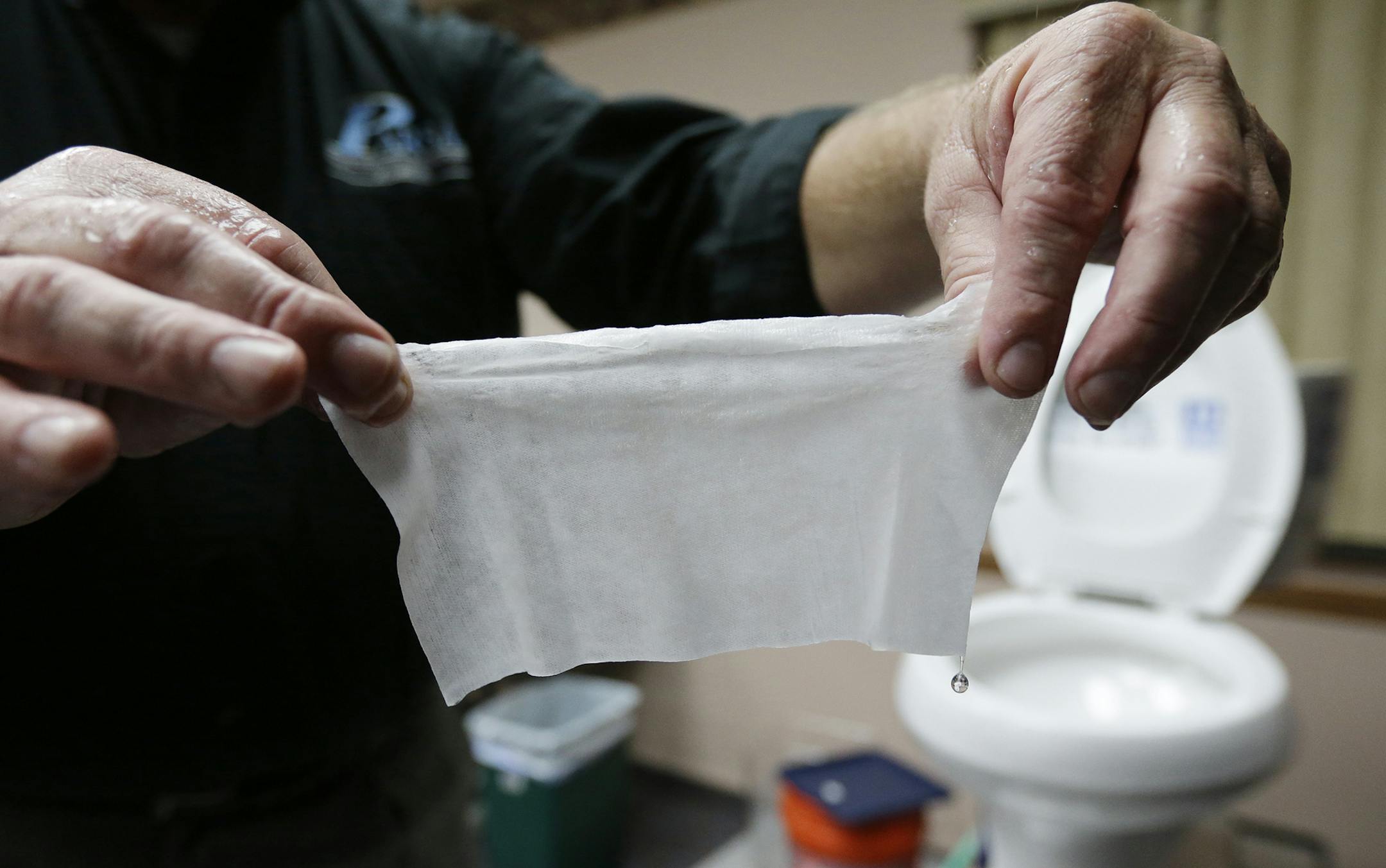
In this photograph taken, Friday, Sept. 20, 2013, in Middlesex, N.J., Rob Villee, executive director of the Plainfield Area Regional Sewer Authority in New Jersey, holds up a wipe he flushed through his test toilet in his office. Increasingly popular bathroom wipes, thick, premoistened towelettes that are advertised as flushable, are creating clogs and backups in sewer systems around the nation. The problem has gotten so bad in this upstate New York town that frustrated sewer officials traced th
Bathroom wipes — thick, premoistened towelettes that are advertised as flushable — are creating clogs and backups in sewer systems around the nation. The problem has gotten so bad in one upstate New York town that frustrated sewer officials traced the wipes back to specific neighborhoods and even knocked on doors to break the embarrassing news to residents that they were the source of a costly, unmentionable mess. (The Minnesota Star Tribune)

You flush, and it goes away. Or does it?

There's more going down the sewer pipes than you might imagine, and some of it is damaging stuff.

Newspaper headlines report the presence of drugs in our drinking water, male fish producing eggs, and the alarming fact that tiny plastic beads may be killing our lakes. It's easy to ignore our role in all of this. We just assume that someone, somewhere, is dealing with our waste — if we think about it at all.

But we have to remember that there is no "flush, and away." The choices we make every day are critical to solving these problems.

Thousands of chemicals exist in consumer products and medications, many of them unnecessary. Tests of water quality routinely find antibiotics and prescription drugs for everything from epilepsy to depression in the discharge from wastewater treatment plants. Although critical for human health, medications are often flushed down the toilet and find their way into our surface water, where they can harm fish, native mussels and other aquatic life.

Unnecessary perfumes and antimicrobials, routinely used in soaps, shampoos and personal-care items, also end up in surface water, where they can damage rivers and lakes. Wastewater treatment plants were not designed to eliminate these man-made compounds. As a result, we cannot reliably and affordably remove them.

Nonchemical, inert materials in our wastewater also have economic and environmental impacts. Microbeads, the tiny plastic particles used in personal-care products such as toothpaste and facial scrubs, aren't biodegradable and persist in the environment. The beads are so small that they pass through treatment plants and are released into rivers, lakes and eventually the ocean. Along the way, they adsorb contaminants from the water and enter the food chain as food for small aquatic species. As those animals are eaten by larger animals, the concentrated contaminants move up the food chain, eventually becoming part of our diet.

"Flushable" wipes cause expensive and damaging clogs in sewer systems, resulting in plugged drains, sewer backups, clogged and broken pumps, and increased maintenance and repair costs for taxpayers.

Wastewater treatment comes at a price, one that we continue to make worse with our personal choices. In Switzerland, the upgrade of 123 wastewater treatment plants to remove trace chemicals such as medications and personal-care products is estimated to cost $3.38 billion; a similar effort in the United States would cost hundreds of billions of dollars.

There are, however, easy and inexpensive ways to stop the discharge of these chemicals, beads and wipes into our sewer system and environment. We can all help the environment through some very simple actions:

• Dispose of unused medicines responsibly, not down the drain. The Minnesota Pollution Control Agency, as well as many law enforcement agencies, can provide guidance on the best way to dispose of these products.

• Purchase personal-care products with the environment in mind, limiting perfumes, antimicrobials and other synthetic chemicals.

• Purchase products that either do not contain microbeads or that substitute natural materials (such as ground nut hulls) in their manufacture.

• Flushable wipes are neither degradable nor trouble-free. Dispose of these wipes in the trash, not down the toilet.

We all have choices — ones that we make almost daily through our purchases and behavior. Let's make those choices smart ones that help preserve our lakes, rivers and environment.

Learn more about how you play a critical role in keeping our surface water clean and safe for all living creatures at the EcoExperience at the Minnesota State Fair.

Paige J. Novak is a professor in the University of Minnesota's Department of Civil, Environmental and Geo-Engineering and its BioTechnology Institute. Larry Rogacki is assistant general manager, support services, for the Metropolitan Council's Environmental Services Division.

about the writer

about the writer

PAIGE J. NOVAK and LARRY ROGACKI

More from Commentaries

See More
card image
Carlos Gonzalez/The Minnesota Star Tribune

It seems like we’re now heading in the right direction under the leadership of White House border czar Tom Homan.

Opinion | What happens after our shock fades?

card image
card image