

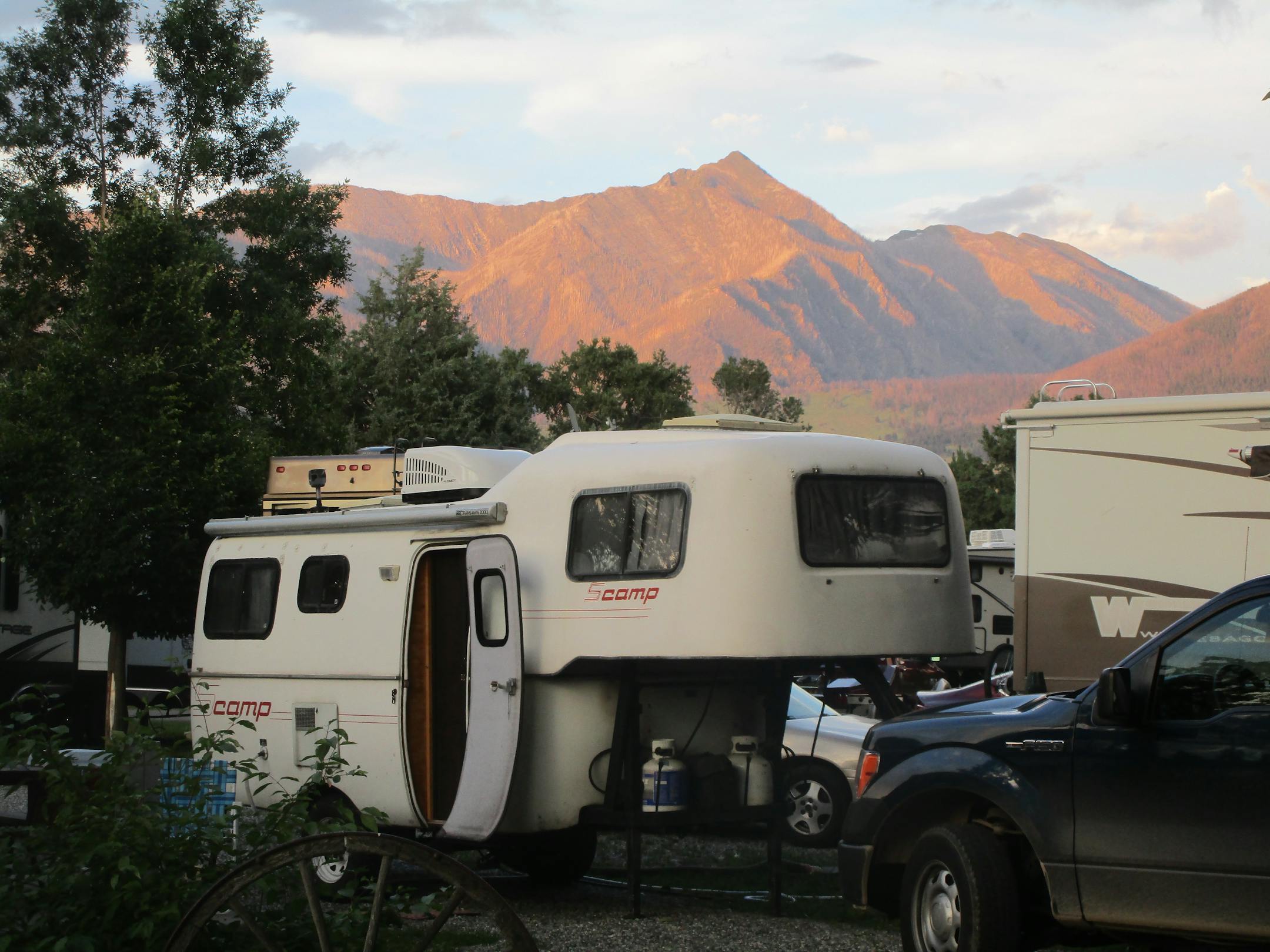
Sooner or later, one way or another, every relationship comes to an end. I've finally decided to end my 20-year friendship with my Scamp RV, and I'm discovering, once again, that breaking up is hard to do.
Back in 1999, not wanting to spend a two-month sabbatical trip in my drafty bathroom-less kitchen-less pop-up, I made a monthlong tour of used RV lots in the company of a friend with a keen nose for mildew, looking for an enclosed trailer that could be pulled by my Ford Ranger. Beside yet another used trailer with tacky pressed-wood cabinets and a whiff of mildew, there sat a Scamp fifth-wheel, a model I'd never seen before.
Scamps are lightweight fiberglass trailers manufactured in Backus, Minn., a small town between Brainerd and Bemidji. Most of them are conventional trailers, compact and lightweight enough to be pulled by a crossover SUV or even one of the heftier sedans, yet fully equipped with stoves and refrigerators, dinettes and bathrooms. Thirteen or sixteen feet long, Scamp trailers are practical and maneuverable alternatives to the 30- and 40-foot behemoths that clog the highways and RV parks of North America.
A few Scamps are fifth-wheels, 16-foot models with an attached overhang containing a bed and equipped with a yoke that fastens onto a hitch in the middle of the pickup's bed. Fifth-wheels follow better than tow-behind trailers, and they have a double bed in the overhang that, unlike a convertible dinette/bed, is always set up, so that the weary RVer can crash whenever he feels the need.
A fifth-wheel was not what I had in mind, but the Scamp seemed to be in good shape, had had one owner and was only 10 years old. A few minutes later, I was sitting in the dinette, surrounded by genuine hardwood cabinets — this fifth-wheel was the Deluxe model. Bathroom, stove, refrigerator, sink, and not the slightest whiff of mildew; everything I needed, nothing I didn't. The salesman assured me that this trailer was designed to be pulled by a Ford Ranger pickup. Within the hour, I was signing on the bottom line. The Scamp was mine.
My first trip was an adventure. I discovered while driving through a snowstorm in Iowa — on the way south we snowbirds always drive through a snowstorm in Iowa — that the Scamp was steady and controllable even in bad road conditions. In Memphis, in the course of experiencing real barbecue and world-class live jazz and 60 degrees in February, I had a homey place to return to after a strenuous day of touring, with my books and my music, my cooking if I chose to eat in, and the most comfortable bed I owned.
It was the same, or even better, in New Orleans, in St. Augustine, Fla., where I spent a pleasant month of reading and writing and eating fresh seafood; in Savannah and Charleston and Annapolis, the old small cities of the Atlantic coast: I had adventures and discoveries in the wide world during the day and a home away from home when the day was over. The best of home and away. What could go wrong?
Then while maneuvering the narrow lanes of an RV park near Cincinnati, I forgot that I had 19 feet of trailer behind me and dropped one wheel into a ditch. In the course of getting unstuck from the ditch, I bent the trailer's jacks so badly that I could only with great difficulty and the use of a car jack detach the trailer. Two days later, the earliest I could make a service appointment, I paid the first of what over the years would be many visits to an RV repair shop where, for a couple of hundred dollars, my mistake was corrected. At a cost, the Scamp was as good as new.


