

CHICAGO - Research and planning are often key factors scientists cite when they make a great discovery. Only rarely does being out of shape play a role.
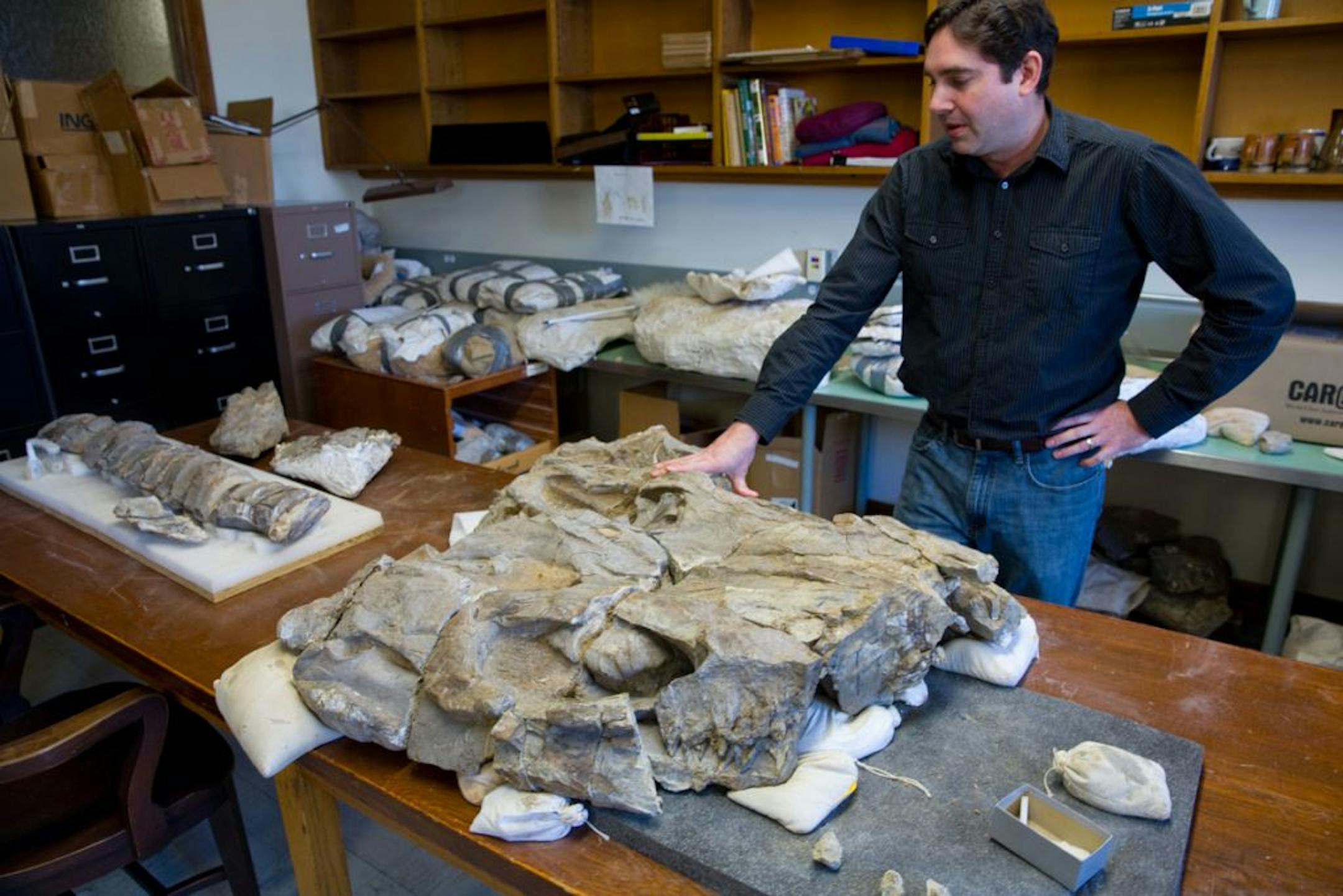
But Field Museum scientist Jim Holstein said being dog-tired after a long day of trekking through a Nevada mountain range led to his find of a new type of prehistoric marine reptile that on Monday was laid out, in fossil form, on a table in the Chicago museum.
The 28-foot-long animal is now known as Thalattoarchon saurophagis, "lizard-eating ruler of the seas," a member of the very successful ichthyosaur family that lived, for the most part concurrently with dinosaurs, for 160 million years.
It died roughly 244 million years ago and is the earliest type of ichthyosaur -- and only the second on record -- to show signs of being a "superpredator" that ate animals of its own size atop the marine food chain in a manner similar to a killer whale, said Nadia Frobisch, lead author of a paper on the new species in the recent electronic issue of the Proceedings of the National Academy of Sciences.
Before getting its new scientific name, it was known simply as "Jim," after Holstein, who credits his discovery to being the most exhausted of the original search party 14 1/2 years ago.
He was in central Nevada's Augusta Mountains, returning to camp along a high ridge after a day of searching for fossils in an ancient seabed turned mountainside.
Trailing his colleagues, Martin Sander and Olivier Rieppel, he saw the skull of the ichthyosaur that, upon closer examination, turned out to have a distinctive feature.
Ichthyosaurs -- from the Greek for "fish lizard" -- were once plentiful in what is now Nevada. The creature, a reptile that evolved from a land to sea animal and resembled a dolphin, is the official state fossil.


