

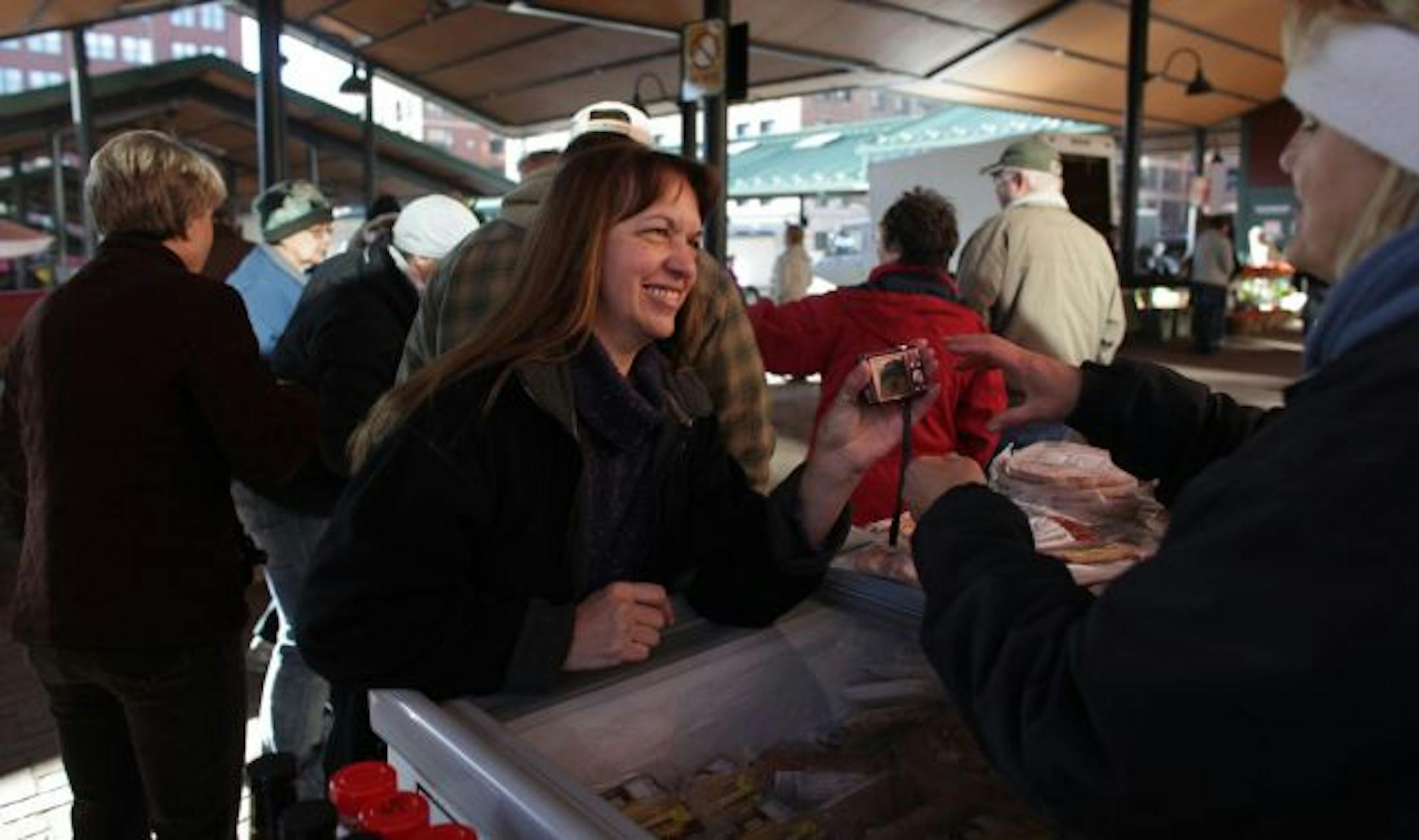
Shaun and Shannon Cooper of Minneapolis willingly pay more for their meat, sometimes almost 40 percent more. It's the price of buying local, but the Coopers don't mind. "We could buy cheaper meat, but there are hidden costs," he said. "What costs me more now will cost society less in the end."
By purchasing locally raised chicken, pork and beef from animals raised without hormones, medications or animal byproducts, they believe they are eating healthier. Grass-fed animals are often lower in fat and cholesterol and have a higher omega-3 content. The Coopers have been buying meat at the St. Paul farmers markets for a couple of years now. "It's a safety issue for us," said Shaun.
It's a concern that's been highlighted by the Cold Spring, Minn., woman left paralyzed after eating a Cargill-produced hamburger patty contaminated with E. coli. Buyers of locally raised and processed meat feel a sense of control when they buy directly from a farmer who can answer questions about the conditions in which the animals are raised, what they're fed and how they're processed.
Generally, small farms (raising 150 to 300 chickens at a time, for example) are thought to be cleaner and more humane than large-scale feedlots. Some, such as Otis Family Farms in Baldwin, Wis., have an open-door policy for anyone wishing to visit. In addition to the transparency, buyers are minimizing the distance the food travels, helping small- or midsize farms, and keeping money in the local economy.
The interest in locally raised meat is difficult to measure, but the number of farmers selling directly to the public is steadily growing, said Paul Hugunin, coordinator of the Minnesota Grown Program. In 2008, the program included 60 beef producers. There were 69 in 2009. The number of chicken and pork producers increased at a lesser rate. Larger increases have been seen in the number of farmers markets and CSA (Community Supported Agriculture) organizations, both of which include farmers selling chicken, beef, pork, lamb, turkey or bison.
Part of the reason the growth is steady but slow is price. For shoppers used to paying $2 per pound or less for ground beef and chicken breasts, prices for meat from small Minnesota farms can be a shock. Boneless, skinless chicken breasts are about $7 per pound, whole chickens about $3 per pound. Ground beef is about $3.50 per pound. Whole Foods' prices -- for nonlocal, certified organic meat -- are generally even higher.
In addition to buying directly from farmers, Twin Cities residents can find products from Bar Five, Callister Farms, Kadejan, Otis Family Farms, Prairie Pride and Thousand Hills, for example, at co-ops and some grocery stores (see accompanying story).
Customers might be disappointed that few local meat producers are certified organic. Bob Otis said that his farm has adopted many organic principles: The chickens, cows, pigs, lambs and turkeys roam in pastures, not confined in cages. Many growers refuse to, for example, feed animals hormones, antibiotics or animal byproducts, but they find the paperwork and expense required for organic certification prohibitive, Otis said. The advantage to buying local is that customers can ask the farmer directly about their farming methods.


